

ॐ श्री परमात्मने नमः !!
ŚRĪMAD-BHAGAVAD-GĪTĀ
॥प्रथमोऽध्यायः॥
धृतराष्ट्र उवाच ।
धर्मक्षेत्रे कुरुक्षेत्रे समवेता युयुत्सवः ॥
मामकाः पाण्डवाश्चैव किमकुर्वत सञ्जय ॥१॥
Dhṛtarāstra said:
Tell me, O Sañjaya! Assembled on Kuruksetra, the centre of religious activity, desirous to fight, what indeed did my people and the Pandavas do?
True it is that the two parties were gathered together for battle, but was the influence of Kurukşetra, the sacred centre of religious and spiritual activity from of old, barren of any result?
Did not the spiritual influence of the spot affect any of the leaders in a way unfavourable to the occurrence of the battle? is the purport of Dhrtarāştra’s question.
सञ्जय उवाच ।
दृष्ट्वा तु पाण्डवानीकं व्यूढं दुर्योधनस्तदा ॥
आचार्यमुपसङ्गम्य राजा वचनमब्रवीत् ॥२॥
Sañjaya said:
But then King Duryodhana, having seen the Pandava forces in battle-array, approached his teacher Droņa, and spoke these words:
Sañjaya’s reply beginning with “But then” and describing Duryodhana’s action is a plain hint to the old king that his son was afraid. For he went to his teacher (regarded as father) instead of to the commander-in-chief, as a child in fright would run to its parents in preference to others.
पश्यैतां पाण्डुपुत्राणामाचार्य महतीं चमूम् ॥
व्यूढां द्रुपदपुत्रेण तव शिष्येण धीमता ॥३॥
“Behold, O Teacher! this mighty army of the sons of Pandu, arrayed by the son of Drupada, thy gifted pupil.
As a scorpion would sting even him whose protection is sought to be free from fear, so did the wicked Duryodhana insult his teacher. His meaning in plain words comes to this: thus think of your stupidity in teaching the science of fight to the son of Drupada and to those of Pandu. They are now arrayed to kill you!
अत्र शूरा महेष्वासा भीमार्जुनसमा युधि ॥
युयुधानो विराटश्च द्रुपदश्च महारथः ॥४॥
धृष्टकेतुश्चेकितानः काशिराजश्च वीर्यवान् ॥
पुरुजित् कुन्तिभोजश्च शैब्यश्च नरपुङ्गवः ॥५॥
युधामन्युश्च विक्रान्त उत्तमौजाश्च वीर्यवान् ॥
सौभद्रो द्रौपदेयाश्च सर्व एव महारथाः ॥६॥
“Here (are) heroes, mighty archers, the equals in battle of Bhima and Arjuna the great warriors Yuyudhāna, Virāța, Drupada; the valiant Dhrstaketu, Cekitāna, and king of Kāśī;, the best of men, Purujit, Kuntibhoja, and Saibya; the powerful Yudhāmanyu, and the brave Uttamaujas, the son of Subhadra and the sons of Draupadi – all of whom are lords of great chariots.
Maharathah (महारथ): great-charioted: one who is well-versed in the science of war and commands eleven thousand bowmen.
अस्माकं तु विशिष्टा ये तान्निबोध द्विजोत्तम ॥
नायका मम सैन्यस्य संज्ञार्थं तान् ब्रवीमि ते ॥७॥
“Hear, also, O Best of the twice-born! the names of those who (are) distinguished amongst ourselves, the leaders of my army. These I relate (to you) for your information.
However well-versed in the science of war you might be, you are after all a Brahmaņa (best of the twice-born), a lover of peace, that is to say, a coward. It is therefore natural for you to be afraid of the Pandava force. But take heart, we too have great warriors in our ranks-is the veiled meaning of Duryodhana’s words.
भवान् भीष्मश्च कर्णश्च कृपश्च समितिंजयः ॥
अश्वत्थामा विकर्णश्च सौमदत्तिर्जयद्रथः ॥८॥
“Yourself and Bhīşma and Karņa and Krpa, the victorious in war. Aşvatthāmā and Vikarņa and Jayadratha, the son of Somadatta.
Afraid lest he had said too much, Duryodhana is flattering Droņa, by mentioning the latter before even Bhişma and qualifying Drona’s brother-in-law with the phrase “victorious in war”, a move likely to touch the heart of mortals.
अन्ये च बहवः शूरा मदर्थे त्यक्तजीविताः ॥
नानाशस्त्रप्रहरणाः सर्वे युद्धविशारदाः ॥९॥
“And many other heroes also, well-skilled in fight, and armed with many kinds of weapons, are here, determined to lay down their lives for my sake.
अपर्याप्तं तदस्माकं बलं भीष्माभिरक्षितम् ॥
पर्याप्तं त्विदमेतेषां बलं भीमाभिरक्षितम् ॥१०॥
“This our army defended by Bhīşma (is) impossible to be counted, but that army of theirs, defended by Bhīma (is) easy to number.
In ancient Indian warfare, one commanding a force had for his mainstay a defender about him, whose position was no less important. Here are given the names of the chief defenders, and not of the chief commanders.
The verse is often interpreted to mean that Duryodhana considers his army inefficient and that of the enemy efficient. But this view seems inapposite to the context.
अयनेषु च सर्वेषु यथाभागमवस्थिताः ॥
भीष्ममेवाभिरक्षन्तु भवन्तः सर्व एव हि ॥११॥
“(Now) do, being stationed in your proper places in the divisions of the army, support Bhīşma alone.”
Since I cannot expect from you any initiative, do what you are told to do seems to be Duryodhana’s intention.
तस्य संजनयन्हर्ष कुरुवृद्धः पितामहः ॥
सिंहनादं विनद्योच्चैः शङ्ख दध्मौ प्रतापवान् ॥१२॥
That powerful, oldest of the Kurus, Bhisma the grandsire, in order to cheer Duryodhana, now sounded aloud a lion-roar and blew his conch.
All eyes were turned upon Duryodhana and the penetrating intelligence of Bhīşma detected his fear; and since Droņa took no notice of Duryodhana’s words, knowing his grandson as he did, he had no difficulty in understanding that the latter had spoken to his teacher in a way which called forth Drona’s coldness instead of his enthusiasm. The grandsire’s heart was moved with pity and hence the action on his part described in the above verse. It should here be noted that this action, amounting to a challenge, really began the fight. It was the Kaurava side again which took the aggressor’s part.
ततः शङ्खाश्च भेर्यश्च पणवानकगोमुखाः ॥
सहसैवाभ्यहन्यन्त स शब्दस्तुमुलोऽभवत् ॥१३॥
Then following Bhisma, conchs, and kettle-drums, tabors, trumpets, and cow-horns blared forth suddenly from the Kaurava side, and the noise was tremendous.
ततः श्वेतैर्हयैर्युक्ते महति स्यन्दने स्थितौ ॥
माधवः पाण्डवश्चैव दिव्यौ शङ्खौ प्रदध्मतुः ॥१४॥
Then, also, Madhava and Pandava, stationed in their magnificent chariot yoked with white horses, blew their divine conchs with a furious noise.
पाञ्चजन्यं हृषीकेशो देवदत्तं धनञ्जयः ॥
पौण्ड्रं दध्मौ महाशङ्ख भीमकर्मा वृकोदरः ॥१५॥
Hrsīkesa blew the Pancajanya, Dhananjaya, the Devadatta, and Vrkodara, the doer of terrific deeds, his large conch Paundra.
अनन्तविजयं राजा कुन्तीपुत्रो युधिष्ठिरः ॥
नकुलः सहदेवश्च सुघोषमणिपुष्पकौ ॥१६॥
King Yudhisthira, son of Kunti, blew the conch named Anantavijaya, and Nakula and Sahadeva, their Sughosa and Maņipuspaka.
काश्यश्च परमेष्वासः शिखण्डी च महारथः ॥
धृष्टद्युम्नो विराटश्च सात्यकिश्चापराजितः ॥१७॥
The expert bowman, king of Kāsi, and the great warrior Sikhandi, Dhrstadyumna, and Virāța, and the unconquered Sātyaki;
द्रुपदो द्रौपदेयाश्च सर्वशः पृथिवीपते ॥
सौभद्रश्च महाबाहुः शङ्खान्दध्मुः पृथक् पृथक् ॥१८॥
O Lord of Earth! Drupada and the sons of Draupadi, and the mighty-armed son of Subhadrā, all, also blew each his own conch.
स घोषो धार्तराष्ट्राणां हृदयानि व्यदारयत् ॥
नभश्च पृथिवीञ्चैव तुमुलोऽभ्यनुनादयन् ॥१९॥
And the terrific noise resounding throughout heaven and earth rent the hearts of Dhṛtarāstra’s party.
Verses 14-19 are full of hints about the superiority of the Pandava party and the consequent sure defeat of Dhrtarastra. The figure to which Sanjaya draws the old king’s attention at first taking up Bhisma’s challenge, is described by him as the Lord of Fortune and the Pandava – the best of the Pandu princes. Note also the details in which the chariot, horses, and conchs of the Pandava party are described; and finally, though the army of the Kauravas was more than a third as much again as that of the Pandavas, the noise made by the former was only tremendous, whereas that of the latter was not only tremendous but filled the earth and sky with reverberation and rent the hearts of the former.
अथ व्यवस्थितान् दृष्ट्वा धार्तराष्ट्रान् कपिध्वजः ॥
प्रवृत्ते शस्त्रसम्पाते धनुरुद्यम्य पाण्डवः ॥
हृषीकेशं तदा वाक्यमिदमाह महीपते ॥१-२०॥
Then, O Lord of Earth, seeing Dhartrastra’s party standing marshalled and the shooting about to begin, the Pandava, whose ensign was the monkey, raising his bow, said the following words Krishna:
In view of the sudden change of feeling that is to come over Arjuna it should be noted how full of the war-spirit we find him in this verse.
अर्जुन उवाच ।
सेनयोरुभयोर्मध्ये रथं स्थापय मेऽच्युत ॥२१॥
यावदेतान्निरीक्षेऽहं योद्धुकामानवस्थितान् ॥
कैर्मया सह योद्धव्यमस्मिन्रणसमुद्यमे ॥२२॥
Arjuna said:
Place my chariot, O Acyuta! between the two armies that I may see those who stand here prepared for war. On this eve of battle (let me know) with whom I have to fight.
योत्स्यमानानवेक्षेऽहं य एतेऽत्र समागताः ॥
धार्तराष्ट्रस्य दुर्बुद्धेर्युद्धे प्रियचिकीर्षवः ॥२३॥
Sañjaya said:
O Bharata, commanded thus by Gudākeśa, Hrşikeśa drove that grandest of chariots to a place between the two hosts, facing Bhisma, Droņa, and all the rulers of the earth, and then spoke thus, “Behold, O Partha, all the Kurus gathered together!”
तत्रापश्यत् स्थितान् पार्थः पितॄनथ पितामहान् ॥
आचार्यान् मातुलान् भ्रातॄन् पुत्रान् पौत्रान् सखींस्तथा ॥
श्वशुरान् सुहृदश्चैव सेनयोरुभयोरपि ॥२६॥
Then saw Partha stationed there in both the armies, grandfathers, fathers-in-law, and uncles, brothers and cousins, his own and their sons and grandsons, and comrades, teachers, and other friends as well.
तान् समीक्ष्य स कौन्तेयः सर्वान्बन्धूनवस्थितान् ॥
कृपया परयाविष्टो विषीदन्निदमब्रवीत् ॥२७॥
Then he, the son of Kuntī, seeing all those kinsmen stationed in their ranks, spoke thus sorrowfully, filled with deep compassion.
अर्जुन उवाच ।
दृष्ट्वेमं स्वजनं कृष्ण युयुत्सुं समुपस्थितम् ॥
सीदन्ति मम गात्राणि मुखं च परिशुष्यति ॥२८॥
वेपथुश्च शरीरे मे रोमहर्षश्च जायते ॥
गाण्डीवं संसते हस्तात्त्वक् चैव परिदह्यते ॥२९॥
Arjuna said:
Seeing, O Krsna, these my kinsmen gathered here eager for fight, my limbs fail me, and my mouth is parched up. I shiver all over, and my hair stands on end. The bow Gandīva slips from my hand, and my skin burns.
Compassion overpowered him. Not that it was due to discrimination, but rather to the lack of this. He lost self-control – the first step into the abyss of ignorance.
न च शक्नोम्यवस्थातुं भ्रमतीव च मे मनः ॥
निमित्तानि च पश्यामि विपरीतानि केशव ॥३०॥
Neither, O Keśava, can I stand upright. My mind is in a whirl. And I see adverse omens.
न च श्रेयोऽनुपश्यामि हत्वा स्वजनमाहवे ॥
न कांक्षे विजयं कृष्ण न च राज्यं सुखानि च ॥३१॥
Neither, O Krşņa, do I see any good in killing these my own people in battle. I desire neither victory nor empire, nor yet pleasure.
किं नो राज्येन गोविन्द कि भोगैर्जीवितेन वा ॥
येषामर्थे कांक्षितं नो राज्यं भोगाः सुखानि च ॥३२॥
त इमेऽवस्थिता युद्धे प्राणांस्त्यक्त्वा धनानि च ॥
आचार्याः पितरः पुत्रास्तथैव च पितामहाः ॥३३॥
मातुलाः श्वशुराः पौत्राः श्यालाः संबन्धिनस्तथा ॥३४॥
Of what avail is dominion to us, of what avail are pleasures and even life, if these, O Govinda! for whose sake it is desired that empire, enjoyment, and pleasure should be ours, themselves stand here in battle, having renounced life and wealth – teachers, uncles, sons, and also grandfathers, maternal uncles, fathers-in-law, grandsons, brothers-in-law, besides other kinsmen.
एतान्न हन्तुमिच्छामि घ्नतोऽपि मधुसूदन ॥
अपि त्रैलोक्यराज्यस्य हेतोः किं नु महीकृते ॥ ३५॥
Even though these were to kill me, O slayer of Madhu, I could not wish to kill them – not even for the sake of dominion over the three worlds, how much less for the sake of the earth!
निहत्य धार्तराष्ट्रान्नः का प्रीतिः स्याज्जनार्दन ॥
पापमेवाश्रयेदस्मान्हत्वैतानात तायिनः ॥३६॥
What pleasure indeed could be ours, O Janārdana, from killing these sons of Dhṛtarāstra? Sin only could take hold of us by the slaying of these felons.
Felons: Atatāyin, one who sets fire to the house of, administers poison to, falls upon with a sword on, steals the wealth, land, and wife of, another person. Duryodhana did all these to the Pandava brothers. According to the Artha-Sastra, no sin is incurred by killing an Atatayin even if he be thoroughly versed in Vedänta. But Arjuna seems to argue, “True, there may not be incurred the particular sin of slaying one’s own kith and kin by killing the sons of Dhrtarăştra inasmuch as they are Atatayins, but then the general sin of killing is sure to take hold of us, for the Dharma-Sastra which is more authoritative than the Artha-Sastra enjoins non-killing.”
तस्मान्नार्हा वयं हन्तुं धार्तराष्ट्रान् स्वबान्धवान् ॥
स्वजनं हि कथं हत्वा सुखिनः स्याम माधव ॥३७॥
Therefore we ought not to kill our kindred, the sons of Dhṛtarāstra. For how could we, O Madhava, gain happiness by the slaying of our own kinsmen?
यद्यप्येते न पश्यन्ति लोभोपहतचेतसः ॥
कुलक्षयकृतं दोषं मित्रद्रोहे च पातकम् ॥३८॥
कथं न ज्ञेयमस्माभिः पापादस्मान्निर्वाततुम् ॥
कुलक्षयकृतं दोषं प्रपश्यद्भिर्जनार्दन ॥३९॥
Though these, with understanding overpowered by greed, see no evil due to decay of families, and no sin in hostility to friends, why should we, O Janārdana, who see clearly the evil due to the decay of families, not turn away from this sin?
कुलक्षये प्रणश्यन्ति कुलधर्माः सनातनाः ॥
धर्मे नष्टे कुलं कृत्स्नमधर्मोऽभिभवत्युत ॥४०॥
On the decay of a family the immemorial religious rites of that family die out. On the destruction of spirituality, impiety further overwhelms the whole of the family.
अधर्माभिभवात् कृष्ण प्रदुष्यन्ति कुलस्त्रियः ॥
स्त्रीषु दुष्टासु वार्ष्णेय जायते वर्णसङ्करः ॥४१॥
On the prevalence of impiety, O Krsna, the women of the family become corrupt; and women being corrupted, there arises, O Vārsņeya, intermingling of castes.
सङ्करो नरकायैव कुलघ्नानां कुलस्य च ॥
पतन्ति पितरो ह्येषां लुप्तपिण्डोदकक्रियाः ॥४२॥
Admixture of castes, indeed, is for the hell of the family and the destroyers of the family; their ancestors fall deprived of the offerings of rice-ball and water.
Verily, confusion of family is the hell of destroyers of family. (For then do) Their own ancestors fall, deprived etc. This refers to the well-known Sraddha ceremony of the Hindus, the main principle of which consists in sending helpful thoughts to the dead relations as well as to all the occupants of Pitr-loka (a temporary abode, immediately after death) accompanied with (to make the thoughts more forcible) concrete offerings. The poor are also fed to secure their good wishes.
दोषैरेतैः कुलघ्नानां वर्णसङ्करकारकैः ॥
उत्साद्यन्ते जातिधर्माः कुलधर्माश्च शाश्वताः ॥४३॥
By these misdeeds of the destroyers of the family, bringing about confusion of castes, are the immemorial religious rites of the caste and the family destroyed.
उत्सन्नकुलधर्माणां मनुष्याणां जनार्दन ॥
नरके नियतं वासो भवतीत्यनुशुश्रुम ॥४४॥
We have heard, O Janardana, that dwelling in hell is inevitable for those men in whose families religious practices have been destroyed.
अहो बत महत्पापं कर्तुं व्यवसिता वयम् ॥
यद्राज्यसुखलोभेन हन्तुं स्वजनमुद्यताः ॥ ४५ ॥
Alas, we are involved in a great sin, in that we are prepared to slay our kinsmen, out of greed for the pleasures for a kingdom!
यदि मामप्रतीकारमशस्त्रं शस्त्रपाणयः ॥
धार्तराष्ट्रा रणे हन्युस्तन्मे क्षेमतरं भवेत् ॥ ४६ ॥
Verily, if the sons of Dhṛtarāstra, weapons in hand, were to slay me, unresisting and unarmed, in the battle, that would be better for me.
सञ्जय उवाच ।
एवमुक्त्त्वाऽर्जुनः संख्ये रथोपस्थ उपाविशत् ॥
विसृज्य सशरं चापं शोकसंविग्नमानसः ॥ ४७ ॥
Sañjaya said:
Speaking thus in the midst of the battle-field, Arjuna, casting away his bow and arrows, sank down on the seat of his chariot, with his mind distressed with sorrow.
इति अर्जुनविषादयोगो नाम प्रथमोऽध्यायः
The end of chapter first, designated, The Grief of Arjuna.
ॐ श्री परमात्मने नमः !!
॥द्वितीयोऽध्यायः॥
सञ्जय उवाच ।
तं तथा कृपयाविष्टमश्रुपूर्वाकुलेक्षणम् ॥
विषीदन्तमिदं वाक्यमुवाच मधुसूदनः ॥२-१॥
Sanjaya said:
To him who was thus overwhelmed with pity and sorrowing, and whose eyes were dimmed with tears, Madhusudana spoke these words.
Overwhelmed with pity: Not Arjun, but Arjuna’s feeling was master of the situation.
श्रीभगवानुवाच ।
कुतस्त्वा कश्मलमिदं विषमे समुपस्थितम् ॥
अनार्यजुष्टमस्वर्ग्यमकीर्तिकरमर्जुन ॥२-२॥
The Blessed Lord said:
In such a crisis, whence comes upon thee, O Arjuna, this dejection, un-Arya-like, disgraceful, and contrary to the attainment of heaven?
Mark with what contempt Krishna regards Arjuna’s attitude of weakness masked by religious expression!
क्लैब्यं मास्म गमः पार्थ नैतत्त्वय्युपपद्यते ॥
क्षुद्रं हृदयदौर्बल्यं त्यक्त्वोत्तिष्ठ परन्तप ॥२-३॥
Yield not to unmanliness, O son of Prtha! Ill doth it become thee. Cast off this mean faint-heartedness and arise, O scorcher of thine enemies!
अर्जुन उवाच ।
कथं भीष्ममहं संख्ये द्रोणं च मधुसूदन ॥
इषुभिः प्रतियोत्स्यामि पूजार्हावरिसूदन ॥२-४॥
Arjuna said:
But how can I, in battle, O slayer of Madhu, fight with arrows against Bhishma and Drona, who are rather worthy to be worshipped, O destroyer of foes!
गुरुनहत्वा हि महानुभावान् श्रेयो भोक्तुं भैक्ष्यमपीह लोके ॥
हत्वार्थकामांस्तु गुरूनिहैव भुञ्जीय भोगान् रुधिरप्रदिग्धान् ॥२-५॥
Surely it would be better even to eat the bread of beggary in this life than to slay these great-souled masters. But if I kill them, even this world, all my enjoyment of wealth and desires will be stained with blood.
i.e. even in this world I shall be in hell.
न चैतद्विद्मः कतरन्नो गरीयो यद्वा जयेम यदि वा नो जयेयुः ॥
यानेव हत्वा न जिजीविषामस्तेऽवस्थिताः प्रमुखे धार्तराष्ट्राः ॥२-६॥
And indeed I can scarcely tell which will be better, that we should conquer them, or that they should conquer us. The very sons of Dhrtarastra – after slaying whom we should not care to live – stand facing us.
कार्पण्यदोषोपहतस्वभावः पृच्छामि त्वां धर्मसंमूढचेताः ॥
यच्छ्रेयः स्यान्निश्चितं ब्रूहि तन्मे शिष्यस्तेऽहं शाधि मां त्वां प्रपन्नम् ॥२-७॥
With my nature overpowered by weak commiseration, with a mind in confusion about duty, I supplicate Thee. Say decidedly what is good for me. I am Thy disciple. Instruct me who have taken refuge in Thee.
Dharma is the ness, the law of the inmost constitution of a thing. The primary meaning of Dharma is not virtue or religion, but that is only its secondary significance. Fighting in a just cause is the religious duty or Dharma of a Ksatriya, while the same is a sin to a Brahmana, because it is contrary to the law of his being. Working out one’s Karma according to the law of one’s own being is therefore the Dharma or religion or way to salvation of an individual. The cloud of Karma hides the Self-Sun from view. The means which exhausts this cloud without adding to it and thus helps in one’s Self-restoration is one’s Dharma.
Thy disciple: Until this declaration has been made, the Master may not give the highest knowledge.
न हि प्रपश्यामि ममापनुद्याद् यच्छोकमुच्छोषणमिन्द्रियाणाम् ॥
अवाप्य भूमावसपत्नमृद्धं राज्यं सुराणामपि चाधिपत्यम् ॥२-८॥
I do not see anything to remove this sorrow which blasts my senses, even were I to obtain unrivalled and flourishing dominion over the earth, and mastery over the gods.
सञ्जय उवाच ।
एवमुक्त्वा हृषीकेशं गुडाकेशः परन्तपः ॥
न योत्स्य इति गोविन्दमुक्त्वा तूष्णीं बभूव ह ॥२-९॥
Sanjaya said:
Having spoken thus to the Lord of the senses, Gudakesa, the scorcher of foes, said to Govinda, “I shall not fight”, and became silent.
The object of Sanjaya in using these names is to remind Dhrtarastra – who may naturally be a little elated at the prospect of Arjuna’s not fighting – that this is only a temporary weakness, since by the presence of the Lord of the senses all ignorance must eventually be dispelled. Arjuna’s own nature also is devoid of darkness. Is he not the conqueror of sleep, and the terror of foes?
तमुवाच हृषीकेशः प्रहसन्निव भारत ॥
सेनयोरुभयोर्मध्ये विषीदन्तमिदं वचः ॥२-१०॥
To him who was sorrowing in the midst of the two armies, Hrsikesa, as if smiling, O descendant of Bharata, spoke these words.
Smiling – to drown Arjuna in the ocean of shame. Krishna’s smile at Arjuna’s sorrow is like the lightning that plays over the black monsoon cloud. The rain bursts forth, and the thirsty earth is saturated. It is the smile of the coming illumination.
श्रीभगवानुवाच ।
अशोच्यानन्वशोचस्त्वं प्रज्ञावादांश्च भाषसे ॥
गताशूनगतासूंश्च नानुशोचन्ति पण्डिताः ॥२-११॥
The Blessed Lord said:
Thou hast been mourning for them who should not be mourned for. Yet thou speakest words of wisdom. The (truly) wise grieve neither for the living nor for the dead.
Words of wisdom: Vide 1-35-44.
न त्वेवाहं जातु नासं न त्वं नेमे जनाधिपाः ॥
न चैव न भविष्यामः सर्वे वयमतः परम् ॥२-१२॥
It is not that I have never existed, nor thou nor these kings. Nor is it that we shall cease to exist in the future.
Of course Krishna here does not mean that the body is immortal, but refers to the true Self, behind all bodies.
देहिनोऽस्मिन् यथा देहे कौमारं यौवनं जरा ॥
तथा देहान्तरप्राप्तिर्धीरस्तत्र न मुह्यति ॥२-१३॥
As are childhood, youth, and old age, in this body, to the embodied soul, so also is the attaining of another body. Calm souls are not deluded thereat.
According to this, the continuity of the ego is no more interrupted by death than by the passing of childhood into youth and youth into old age in this body.
Calm Souls: Those who have become calm by Self-realization.
मात्रस्पर्शास्तु कौन्तेय शीतोष्णसुखदुःखदाः ॥
आगमपायिनोऽनित्यास्तांस्तितिक्षस्व भारत ॥२-१४॥
Notions of heat and cold, of pain and pleasure, are born, O son of Kunti, only of the contact of the senses with their objects. They have a beginning and an end. They are impermanent in their nature. Bear them patiently, O descendant of Bharata.
They have a beginning and an end: as distinguished from the permanent Self. The more one is able to identify oneself with the permanent Self, the less one is affected by the agreeable and disagreeable conditions of life.
Impermanent in their nature: That is, the same object which gives pleasure at one moment, gives pain at another, and so on.
यं हि व्यथयन्त्येते पुरुषं पुरुषर्षभ ॥
समदुःखसुखं धीरं सोऽमृतत्वाय कल्पते ॥२-१५॥
That calm man who is the same in pain and pleasure, whom these cannot disturb, alone is able, O great amongst men, to attain to immortality.
This perfect sameness, amidst the ills of life, means full and unbroken consciousness of our oneness with the immortal Self. Thus is immortality attained.
नासतो विद्यते भावो नाभावो विद्यते सतः ॥
उभयोरपि दृष्टोऽन्तस्तत्त्वदर्शिभिः ॥२-१६॥
The unreal never is. The Real never is not. Men possessed of the knowledge of the Truth fully knows both these.
Unreal and Real: This determination of the nature of the Real is the quest of all philosophy. Shri Krishna here states that a thing which never remain the same for any given period is unreal, and that the Real on the other hand is always the same. The whole of the phenomenal world, therefore, must be unreal, because in it no one state endures for even an infinitesimal division of time. And that which takes note of this incessant change, and is therefore itself changeless – the Atman, Consciousness – is the Real.
अविनाशि तु तद्विद्धि येन सर्वमिदं ततम् ॥
विनाशमव्ययस्यास्य न कश्चित्कर्तुमर्हति ॥२-१७॥
That by which all this (Sat & Asat) is pervaded – That know for certain to be indestructible. None has the power to destroy this Immutable.
That by which all this is pervaded: i.e. He that pervades all this as the Witness.
अन्तवन्त इमे देहा नित्यस्योक्ताः शरीरिणः ॥
अनाशिनोऽप्रमेयस्य तस्माद्युध्यस्व भारत ॥२-१८॥
Of this indwelling Self – the ever-changeless, the indestructible, illimitable – these bodies are said to have an end. Fight, therefore, O descendant of Bharata.
Arjuna’s grief which deters him from his duty of fighting against the Kauravas is born of ignorance as to the true nature of the soul. Hence Shri Bhagvan’s strong and repeated attempts to illumine him on the subject.
य एनं वेत्ति हन्तारं यश्चैनं मन्यते हतम् ॥
उभौ तौ न विजानीतो नायं हन्ति न हन्यते ॥२-१९॥
He who takes the Self to be the slayer, and he who takes It to be the slain, neither of these knows. It does not slay, nor is it slain.
न जायते म्रियते वा कदाचिन्नायं भूत्वा भविता वा न भूयः ॥
अजो नित्यः शाश्वतोऽयं पुराणो न हन्यते हन्यमाने शरीरे ॥२-२०॥
This is never born, nor does it die. It is not that, not having been, It again comes into being. (Or according to another view: It is not that having been, It again ceases to be). This is unborn, eternal, changeless, ever-Itself. It is not killed when the body is killed.
This sloka refers in the sense of denial to the six kinds of modification inherent in matter: birth, subsistence, growth, transformation, decay, and death.
वेदाविनाशिनं नित्यं य एनमजमव्ययम् ॥
कथं स पुरुषः पार्थ कं घातयति हन्ति कम् ॥२-२१॥
He that knows This to be indestructible, changeless, without birth, and immutable how is he, O son of Prtha, to slay or cause another to slay?
How is he to slay ? – referring to Arjuna. To cause another to slay – referring to Krishna’s own part.
वसांसि जीर्णानि यथा विहाय नवानि गृह्णाति नरोऽपराणि ॥
तथा शरीराणि विहाय जीर्णान्यन्यानि संयाति नवानि देही ॥२-२२॥
Even as a man casts off worn-out clothes, and puts on others which are new, so the embodied casts off worn-out bodies, and enters into others which are new.
As one only puts off the old, when one already possesses the new garment, so the embodied is already entering a new body in the act of leaving this. The Upanishad compares this to the movement of a leech, which has already established a new foothold before leaving the old.
नैनं छिन्दन्ति शस्त्राणि नैनं दहति पावकः ॥
न चैनं क्लेदयन्त्यापो न शोषयति मारुतः ॥२-२३॥
This (Self), weapons cut not; This, fire burns not; This, water wets not; and This, wind dries not.
अच्छेद्योऽयमदाह्योऽयमक्लेद्योऽशोष्य एव च ॥
नित्यः सर्वगतः स्थाणुरचलोऽयं सनातनः ॥२-२४॥
This Self cannot be cut, nor burnt, nor wetted, nor dried. Changeless, all-pervading, unmoving, immovable, the Self is eternal.
अव्यक्तोऽयमचिन्त्योऽयमविकार्योऽयमुच्यते ॥
तस्मादेवं विदित्वैनं नानुशोचितुमर्हसि ॥२-२५॥
This (Self) is said to be unmanifested, unthinkable, and unchangeable. Therefore, knowing This to be such, thou oughtest not to mourn.
This Self is infinite and partless, so can be neither subject nor object of any action.
अथ चैन नित्यजातं नित्यं वा मन्यसे मृतम् ॥
तथापि त्वं महाबाहो नैनं शोचितुमर्हसि ॥२-२६॥
But if thou shouldst take This to have constant birth and death, even in that case, O mighty-armed, thou oughtest not to mourn for This.
Krishna here, for the sake of argument, takes up the materialistic supposition, and shows that even if the Self were impermanent, sorrow ought to be destroyed, since in that case there would be no hereafter, no sin, no hell.
जातस्य हि ध्रुवो मृत्युर्ध्रुवं जन्म मृतस्य च ॥
तस्मादपरिहार्येऽर्थे न त्वं शोचितुमर्हसि ॥२-२७॥
Of that which is born, death is certain; of that which is dead, birth is certain. Over the unavoidable, therefore, thou oughtest not to grieve.
This sloka concerns only who are not yet free. So long as there is desire, birth and death are inevitable.
Therefore thou oughtest not to grieve: Since you cannot control the inevitable and preserve the bodies of your relations, work out your own Karma and go beyond both birth and death.
अव्यक्तादीनि भूतानि व्यक्तमध्यानि भारत ॥
अव्यक्तनिधनान्येव तत्र का परिदेवना ॥२-२८॥
All beings are unmanifested in their beginning, O Bharata, manifested in their middle state, and unmanifested again in their end. What is there then to grieve about?
Being: In their relationship as sons and friends, who are mere combinations of material elements, correlated as causes and effects.
The idea here is that which has no existence in the beginning and in the end, must be merely illusory in the interim, and should not therefore be allowed to have any influence upon the mind.
आश्चर्यवत्पश्यति कश्चिदेनमाश्चर्यवद्वदति तथैव चान्यः ॥
आश्चर्यवच्चैनमन्यः शृणोति श्रुत्वाप्येनं वेद न चैव कश्चित् ॥२-२९॥
Some look upon the Self as marvelous. Others speak of It as wonderful. Other again hear of It as a wonder. And still others, though hearing, do not understand It at all.
The sloka may also be interpreted in the sense that those who see, hear, and speak of the Self are wonderful men, because their number is so small. It is not therefore remarkable that you should mourn, because the Aatman is so difficult to comprehend.
देही नित्यमवध्योऽयं देहे सर्वस्य भारत ॥
तस्मात्सर्वाणि भूतानि न त्वं शोचितुमर्हसि ॥२-३०॥
This, the Indweller in the bodies of all, is ever indestructible, O descendant of Bharata. Therefore, thou oughtest not to mourn for any creature.
Krishna here returns to His own point of view.
स्वधर्मपि चावेक्ष्य न विकम्पितुमर्हसि ॥
धर्म्याद्धि युद्धाच्छ्रेयोऽन्यत्क्षत्रियस्य न विद्यते ॥२-३१॥
Looking at thine own Dharma, also, thou oughtest not to waver, for there is nothing higher for a Kshatriya than a righteous war.
That is to say, it is the duty of Kshatriya to fight in the interest of his country, people and religion.
यदृच्छया चोपपन्नं स्वर्गद्वारमपावृतम् ॥
सुखिनः क्षत्रियाः पार्थ लभन्ते युद्धमीदृशम् ॥२-३२॥
Fortunate certainly are the Kshatriyas, O son of Pritha, who are called to fight in such a battle that come unsought as an open gate to heaven.
The Shastras say that if a Kshatriya, fighting for a righteous cause, falls in the battle-field, he at once goes to heaven.
अथ चेत्त्वमिमं धर्म्यं संग्रामं न करिष्यसि ॥
ततः स्वधर्मं कीर्तिं च हित्वा पापमवाप्स्यसि ॥२-३३॥
But if thou refusest to engage in this righteous warfare, then forfeiting thine own Dharma and honor, thou shalt incur sin.
अकीर्तिञ्चापि भूतानि कथयिष्यन्ति तेऽव्ययाम् ॥
संभावितस्य चाकीर्तिर्मरणादतिरिच्यते ॥२-३४॥
The world also will ever hold thee in reprobation. To the honored, disrepute is surely worse than death.
The present argument – Slokas 33-36 – assumes that the cause in hand is already proved to be right. Hence it would only be from cowardice that Arjuna could abandon it. Even a hero may be weakened by the stirring of his deepest emotions.
भयाद्रणादुपरतं मंस्यन्ते त्वां महारथाः ॥
येषां च त्वं बहुमतो भूत्वा यास्यसि लाघवम् ॥२-३५॥
The great chariot-warriors will believe that thou hast withdrawn from the battle through fear. And thou wilt be lightly esteemed by them who have thought much of thee.
अवाच्यवादांश्च बहून्वदिष्यन्ति तवाहिताः ॥
निन्दन्तस्तव सामर्थ्यं ततो दुःखतरं नु किम् ॥२-३६॥
Thine enemies also, cavilling at thy great prowess, will say of thee things that are not to be uttered. What could be more intolerable than this?
हतो वा प्राप्यसि स्वर्गं जित्वा वा भोक्ष्यसे महीम् ॥
तस्मादुत्तिष्ठ कौन्तेय युद्धाय कृतनिश्चयः ॥२-३७॥
Dying thou gainest heaven; conquering thou enjoyest earth. Therefore, O son of Kunti, arise, resolved to fight.
सुखदुःखे समे कृत्वा लाभालाभौ जयाजयौ ॥
ततो युद्धाय युज्यस्व नैवं पापमवाप्स्यसि ॥२-३८॥
Having made pain and pleasure, gain and loss, conquest and defeat, the same, engage thou then in battle. So shalt thou incur no sin.
It is always the desire for one of the pairs of opposites that binds. When an act is done without attachment either for itself or its fruit, then Karma can be worked out without adding so its store, and this leads to Freedom. 🙂
एषा तेऽभिहिता सांख्ये बुद्धिर्योगे त्विमां शृणु ॥
बुद्ध्या युक्ता यया पार्थ कर्मबन्धं प्रहास्यसि ॥२-३९॥
The wisdom of Self-realization has been declared unto thee. Hearken thou now to the wisdom of Yoga, endued with which, O Son of Pritha, thou shalt break through the bonds of Karma.
Yoga: Karma-Yoga, or that plan of conduct which secures the working out of past Karma, non-accumulation of new and the striving for Self-realization with the whole of the will. In this discipline, one’s sole object in life is Self-realization; hence no importance is attached to anything else. Thus all actions are performed without attachment, or care for results. So no new Karma is made; only the already accumulated is exhausted. And at the same time, the whole will is left free to devote itself to the achievement of Self-realization alone.
In the preceding Slokas, 11-25, Krishna has given the point of view of the highest knowledge, the ancient Brahmjnana. In the 26th and 27th we have a purely materialistic standpoint. Slokas 28 to 37 give the attitude of a man of the world. In the 38th we have an anticipation of the Yoga. And in what is to follow, we have Shri Krishna’s own contribution to the philosophy of life.
नेहाभिक्रमनाशोऽस्ति प्रत्यवायो न विद्यते ॥
स्वल्पमप्यस्य धर्मस्य त्रायते महतो भयात् ॥२-४०॥
In this (Yoga), there is no waste of the unfinished attempt, nor is there production of contrary results. Even very little of this Dharma protects from the great terror.
Waste of the unfinished attempt: A religious rite or ceremony performed for a definite object, if left uncompleted, is wasted, like a house unroofed which neither serviceable nor enduring. In Karma-Yoga, however, that is, action and worship performed without desire, this law does not apply, for every effort results in immediate purification of the heart.
Production of contrary results: In worship for an object, any imperfection in the process produces positive loss instead of gain. As in cases of sickness, the non-use of the right medicine results in death.
The great terror: Being caught in the wheel of birth and death.
व्यवसायात्मिका बुद्धिरेकेह कुरुनन्दन ॥
बहुशाखा ह्यनन्ताश्च बद्धयोऽव्यवसायिनाम् ॥२-४१॥
In this (Karma-Yoga), O scion of Kuru, there is but a single one-pointed determination. The purpose of the undecided are innumerable and many-branching.
In Karma-Yoga, the one goal is Self-realization.
The undecided (that is about the highest), naturally devote themselves to lower ideals, no one of which can satisfy. Thus they pass from plan to plan.
यामिमां पुष्पितां वाचं प्रवदन्त्यविपश्चितः ॥
वेदवादरताः पार्थ नान्यदस्तीतिवादिनः ॥२-४२॥
कामात्मानः स्वर्गपरा जन्मकर्मफलप्रदाम् ॥
क्रियाविशेषबहुलां भोगैश्वर्यगतिं प्रति ॥२-४३॥
भोगैश्वर्यप्रसक्तानां तयापहृतचेतसाम ॥
व्यवसायात्मिका बुद्धिः समाधौ न विधीयते ॥२-४४॥
O Partha, no set determination is formed in the minds of those that are deeply attached to pleasure and power, and whose discrimination is stolen away by the flowery words of the unwise, who are full of desires and look upon heaven as their highest goad and who, taking pleasure in the panegyric words of the Vedas, declare that there is nothing else. Their flowery words are exuberant with various specific rites as the means to pleasure and power and are the causes of (new) births as the result of their works (performed with desire).
Samadhi has been rendered into “mind” in the above. The generally accepted significance of the term (absorption in God-consciousness produced by deep meditation) would give an equally consistent and happy meaning; Persons attached to pleasure and power cannot have perfect steadiness of mind divine meditation.
Panegyric words of the Vedas: The Karma-Kanda or the sacrificial portion of the Vedas which lays down specific rules for specific actions and their fruits, and extols these latter unduly.
Nothing else: Beyond the heavenly enjoyments procurable by the sacrificial rites of the Vedas.
त्रैगुण्यविषया वेदा निस्त्रैगुण्यो भवार्जुन ॥
निर्द्वन्द्वो नित्यसत्त्वस्थो निर्योगक्षेम आत्मवान् ॥२-४५॥
The Vedas deal with the three Gunas. Be thou free, O Arjuna, from the triad of the Gunas, free from the pairs of opposites, ever-balanced, free from (the thought of) getting and keeping, and established in the Self.
The Vedas deal with etc.: That is to say, the Vedas treat of relativity.
Pairs of opposites: Dvandva, all correlated ideas and sensations, e.g., good and bad, pleasure and pain, heat and cold, light and darkness, etc.
Guna is a technical term of the Sankhya philosophy also used in the same sense by the Vedanta. Prakriti or Nature is constituted of three Gunas; Sattva (equilibrium), Rajas (attraction), Tamas (inertia). Prakriti is the three Gunas, not that she has them. Guna is wrongly translated as quality; it is substance as well as quality, matter, and force. Wherever there is name and form, there is Guna. Guna also means a rope, that which binds.
My Note: These are very important philosophies, we need deep contemplation on these verses. 🙂
यावानर्थ उदपाने सर्वतः संप्लुतोदके ॥
तावान्सर्वेषु वेदेषु ब्राह्मणस्य विजानतः ॥२-४६॥
To the Brahmana who has known the Self, all the Vedas are of so much use as a reservoir is, when there is a flood everywhere.
A man possessed of Self-knowledge has no need whatever of the Vedas. This does not, however, mean that the Vedas are useless; only to the knower of Brahmana they have no value, as the transient pleasures derivable from them are comprehended in the infinite bliss of Self-knowledge.
कर्मण्येवाधिकारस्ते मा फलेषु कदाचन ॥
मा कर्मफलहेतुर्भूर्मा ते सङ्गोऽस्त्वकर्मणि ॥२-४७॥
Thy right is to work only; but never to the fruits thereof. Be thou not the producer of the fruits of (thy) actions; neither let thy attachment be towards inaction.
Be thou not the producer, etc.: That is, do not work with any desire for results, for actions produce fruits or bondage only if they are performed with desire.
Karma primarily means action, but a much profounder meaning has come to be attached to this word. It means the destiny forged by one in one’s past incarnation or present: the store of tendencies, impulses, characteristics, and habits laid by, which determines the future embodiment, environment, and the whole of one’s organization.
Another meaning of Karma often used in reference to one’s caste or position in life, is duty, the course of conduct which one ought to follow in pursuance of the tendencies which one acquired in one’s past, with a view to working them out and regaining the pristine purity of the Self.
योगस्थः कुरु कर्मणि सङ्गं त्यक्त्वा धनञ्जय ॥
सिद्ध्यसिद्ध्योः समो भूत्वा समत्वं योग उच्यते ॥२-४८॥
Being steadfast in Yoga, O Dhananjaya, perform actions, abandoning attachment, remaining unconcerned as regards success and failure. This evenness of mind (in regards to success and failure) is known as Yoga.
दूरेण ह्यवरं कर्म बुद्धियोगाद्धनञ्जय ॥
बुद्धौ शरणमन्विच्छ कृपणाः फलहेतवः ॥२-४९॥
Work (with desire) is verily far inferior to that performed without with the mind undisturbed by thoughts of results. O Dhananjaya, seek refuge in this evenness of mind. Wretched are they who act for results.
बुद्धियुक्तो जहातीह उभे सुकृतदुष्कृते ॥
तस्माद्योगाय युज्यस्व योगः कर्मसु कौशलम् ॥२-५०॥
Endued with this evenness of mind, one frees oneself in this life, alike from vice and virtue. Devote thyself, therefore, to this Yoga. Yoga is the very dexterity of work.
Alike from vice and virtue: A follower of Karma-Yoga can have no personal motive for any action. Our action without motive becomes colorless, loses its character of vice or virtue.
Dexterity of work: It is the nature of work to produce bondage. Karma-Yoga is the dexterity of work, because it not only robs work of its power to bind, but also transforms it into an efficient means of freedom.
कर्मजं बुद्धियुक्ता हि फलं त्यक्त्वा मनीषिणः ॥
जन्मबन्धविनिर्मुक्ताः पदं गच्छन्त्यनामयं ॥२-५१॥
The wise, possessed of this evenness of mind, abandoning the fruits of their actions, freed for ever from the fetters of birth, go to that state which is beyond all evil.
यदा ते मोहकलिलं बुद्धिर्व्यतितरिष्यति ॥
तदा गन्तासि निर्वेदं श्रोतव्यस्य श्रुतस्य च ॥२-५२॥
When thy intellect crosses beyond the taint of illusion, then shalt thou attain to indifference, regarding things heard and things yet to be heard.
The taint of illusion: the identifying of the Self with the non-Self, the ego.
श्रुतिविप्रतिपन्ना ते यदा स्थास्यति निश्चला ॥
समाधावचला बुद्धिस्तदा योगमवाप्स्यसि ॥२-५३॥
When thy intellect, tossed about by the conflict of opinions, has become immovable and firmly established in the self, then thou shalt attain Self-realization.
अर्जुन उवाच ।
स्थितप्रज्ञस्य का भाषा समाधिस्थस्य केशव ॥
स्थितधीः किं प्रभाषेत किमासीत व्रजेत किम् ॥२-५४॥
Arjuna said:
What, O Keshava, is the description of the man of steady wisdom, merged in Samadhi ? How (on the other hand) does the man of steady wisdom speak, how sit, how walk ?
Arjuna is asking, (1) what is the state of the mind of the man of realization when in Samadhi ? and (2) how is its influence shown in his conduct when out of it ?
Steady wisdom: Settled conviction of one’s identity with Brahman gained by direct realization.
श्री भगवानुवाच ।
प्रजहाति यदा कामान्सर्वान्पार्थ मनोगतान् ॥
आत्मन्येवात्मना तुष्टः स्थितप्रज्ञस्तदोच्यते ॥२-५५॥
The Blessed Lord said:
When a man completely casts away, O Partha, all the desires of the mind, satisfied in the Self alone by the Self, then is he said to be one of steady wisdom.
This answers the first part of Arjuna’s question.
दुःखेष्वनुद्विग्नमनाः सुखेषु विगतस्पृहः ॥
वीतरागभयक्रोधः स्थिधीर्मुनिरुच्यते ॥२-५६॥
He whose mind is not shaken by adversity, who does not hanker after happiness, who has become free from affection, fear and wrath, is indeed the Muni of steady wisdom.
This and the following two (more Slokas of Chapter II) answer the second part of Arjuna’s question, as to the conduct of one of perfect realization.
Muni: Man of meditation.
यः सर्वत्रानभिस्नेहस्तत्तत्प्राप्य शुभाशुभम् ॥
नाभिनन्दति न द्वेष्टि तस्य प्रज्ञा प्रतिष्ठिता ॥२-५७॥
He who is everywhere unattached, not pleased at receiving good, nor vexed at evil, his wisdom is fixed.
Not pleased, etc.: consequently he does not praise or blame. This is an answer to the query: “How does he speak?”
यदा संहरते चायं कूर्मोऽङ्गानीव सर्वशः ॥
इन्द्रियाणीन्द्रियार्थेभ्यस्तस्य प्रज्ञा प्रतिष्ठिता ॥२-५८॥
When also, like the tortoise drawing its limbs, he can completely withdraw the senses from their objects, then his wisdom becomes steady.
Withdraw the senses: bring the mind back upon the Self from all sense-objects. This is known as Pratyahara in Yoga.
To explain the Sloka more fully: a man of the highest realization can, at any moment, shake himself clear of all impressions of the sense-world and go into samadhi, with the ease and naturalness of a tortoise drawing its limbs within itself.
विषया विनिवर्तन्ते निराहारस्य देहिनः ॥
रसवर्जं रसोऽप्यस्य परं दृष्ट्वा निवर्तते ॥२-५९॥
Objects fall away from the abstinent man, leaving the longing behind. But his longing also ceases, who sees the supreme.
Abstinent man: An unillumined person abstaining from sense-pleasure for penance, or because of physical incapacity.
यततो ह्यपि कौन्तेय पुरुषस्य विपश्चितः ॥
इन्द्रियाणि प्रमाथीनि हरन्ति प्रसभं मनः ॥२-६०॥
The turbulent senses, O son of Kunti, do violently snatch away the mind of even a wise man, striving after perfection.
तानि सर्वाणि संयम्य युक्त आसीत मत्परः ॥
वशे हि यस्येन्द्रियाणि तस्य प्रज्ञा प्रतिष्ठिताः ॥२-६१॥
The steadfast, having controlled them all (turbulent senses), sits focused on Me as the Supreme. His wisdom is steady, whose senses are under control.
ध्यायतो विषयान्पुंसः सङ्गस्तेषूपजायते ॥
सङ्गात् संजायते कामः कामात् क्रोधोऽभिजायते ॥२-६२॥
Thinking of objects, attachment to them is formed in a man. From attachment longing, and from longing anger grows.
क्रोधाद्भवति सम्मोहः सम्मोहात्स्मृतिविभ्रमः ॥
स्मृतिभ्रंशाद्बुद्धिनाशो बुद्धिनाशात्प्रणश्यति ॥२-६३॥
From anger comes delusion, and from delusion loss of memory. From loss of memory comes the ruin of discrimination, and from the ruin of discrimination he perishes.
A beautiful image appears. The tendency of the mind is to repeat it. Then, if the image is allowed to recur, a liking grows. With the growth of liking the wish to come close, to possess, anger throws the mind into confusion, which casts a veil over the lessons of wisdom learnt by past experience. Thus deprived of his moral standard, he is prevented from using his discrimination. Failing in discrimination, he acts irrationally, on the impulse of passion, and paves the way to moral death.
Thus Krishna traces moral degradation to those first breaths of thought that come softly and almost unconsciously to the mind.
रागद्वेषवियुक्तैस्तु विषयान्द्रियैश्चरन् ॥
आत्मवश्यैर्विधेयात्मा प्रसादमधिगच्छति ॥२-६४॥
But the self-controlled man, moving among objects with senses under restraint, and free from attraction and aversion, attains to tranquility.
The above is in answer to Arjuna’s fourth question, “How does he move?”
प्रसादे सर्वदुःखानां हानिरस्योपजायते ॥
प्रसन्नचेतसो ह्याशु बुद्धिः पर्यवतिष्ठते ॥२-६५॥
In tranquility, all sorrow is destroyed. For the intellect of him, who is tranquil-minded, is soon established in firmness.
That is, firmly concentrate itself on the Self.
नास्ति बुद्धिरयुक्तस्य न चायुक्तस्य भावना ॥
न चाभावयतः शान्तिरशान्तस्य कुतः सुखम् ॥२-६६॥
No knowledge (of the Self) has the unsteady. Nor has he meditation. To the unmeditative there is no peace. And how can one without peace have happiness?
इन्द्रियाणां हि चरतां यन्मनोऽनुविधीयते ॥
तदस्य हरति प्रज्ञां वायुर्नावमिवाम्भसि ॥२-६७॥
For, the mind, which follows in the wake of the wandering senses, carries away his discrimination, as a wind (carries away from its course) a boat on the waters.
तस्माद्यस्य महाबाहो निगृहीतानि सर्वशः ॥
इन्द्रियाणीन्दियार्थेभ्यस्तस्य प्रज्ञा प्रतिष्ठिता ॥२-६८॥
Therefore, O mighty-armed, his knowledge is steady, whose senses are completely restrained from their objects.
This does not mean that the senses remain completely estranged, but that they are all estrangeable at will.
या निशा सर्वभूतानां तस्यां जागर्ति संयमी ॥
यस्यां जाग्रति भूतानि सा निशा पश्यतो मुनेः ॥२-६९॥
That which is night to all beings, in that the self-controlled man wakes. That in which all beings wake, is night to the Self-seeing Muni.
Where all beings are in darkness, there the Muni sees, and vice versa. The consciousness of the man of realisation is so full of God that he cannot see anything apart from Him. The ignorant man, on the other hand, lives in the world of plurality alone and God is a non-entity to him.
It follows, that non-susceptibility to the influences of Nature, that is, perfect self-control (spoken of in the preceding Sloka 68) is quite as natural a trait of the illumined soul as its opposite is of the ignorant.
आपूर्यमाणमचलप्रतिष्ठं समुद्रमापः प्रविशन्ति यद्वत् ॥
तद्वत्कामा यं प्रविशन्ति सर्वे स शान्तिमाप्नोति न कामकामी ॥२-७०॥
As into the ocean – brimful, and still – flow the waters, even so the Muni into whom enter all desires, he, and not the desirer of desires, attains to peace.
The ocean is not at all affected by the waters flowing into it from all sides. Similarly, that man alone finds true peace in whom no reaction of desire is produced by the objects of enjoyment, which he happens to come across during his sojourn on earth.
विहाय कामान्यः सर्वान्पुमांश्चरति निस्पृहः ॥
निर्ममो निरहङ्कारः स शान्तिमधिगच्छति ॥२-७१॥
That man who lives devoid of longing, abandoning all desires, without the sense of “I” and “mine”, he attains to peace.
The man who lives – merely to work out his pas karma.
एषा ब्राह्मी स्थितिः पार्थ नैनां प्राप्य विमुह्यति ॥
स्थित्वाऽस्यामन्तकालेऽपि ब्रह्मनिर्वाणमृच्छति ॥२-७२॥
This is to have one’s being in Brahman, O son of Pritha. None, attaining to this, becomes deluded. Being established therein, even at the end of life, a man attains to oneness with Brahman.
इति सांख्ययोगो नाम द्वितीयोऽध्यायः॥
The end of the second chapter, designated, The Way of Knowledge.
My Note: After completing Chapter I and II of Gita, we’ve now entered into Chapter III. We have seen, how Shri Krishna addressed Arjuna on his decision to not fight with own people – teachers, brothers, relatives etc. for mere right to get his kingdom back. Shri Krishna explained about the soul and steadfast knowledge in length. And now Arjuna’s questions in first two slokas are like this:
ॐ श्री परमात्मने नमः !!
॥तृतीयोऽध्यायः॥
अर्जुन उवाच ।
ज्यायसी चेत्कर्मणस्ते मता बुद्धिर्जनार्दन ॥
तत्किं कर्मणि घोरे मां नियोजयसि केशव ॥३-१॥
व्यामिश्रेणेव वाक्येन बुद्धि मोहयसीव मे ॥
तदेकं वद निश्चित्य येन श्रेयोऽहमाप्नुयाम् ॥३-२॥
Arjuna said:
If, O Janardana, according to Thee, knowledge is superior to action, why then, O Keshava, dost thou engage me in this terrible action? With these seemingly conflicting words, Thou art, as it were, bewildering my understanding; – tell me that one thing for certain, by which I can attain to the highest.
My Note: You may refer to previous chapter, since Arjuna has taken refuge of Shri Krishna as ultimate Guru to guide, and Krishna explained to him superbly to realize the Truth and do his duty in hand as per his present birth, caste and objective of righteousness. And now, Chapter III starts, let’s keep connected with each and every Sloka.
श्री भगवानुवाच ।
लोकेऽस्मिन्द्विविधा निष्ठा पुरा प्रोक्ता मयाऽनघ ॥
ज्ञानयोगेन सांख्यानां कर्मयोगेन योगिनाम् ॥३-३॥
The Blessed Lord said:
In the beginning (of creation), O sinless one, the twofold path of devotion was given by Me to this world; – the path of knowledge for the meditative, the path of work for the active.
Meditative: those who prefer meditation to external action.
Active: those who believe in external work with or without meditation.
न कर्मणामनारम्भान्नैष्कर्म्यं पुरुषोऽश्नुते ॥
न च संन्यसनादेव सिद्धिं समधिगच्छति ॥३-४॥
By non-performance of work none reaches worklessness; by merely giving up action no one attains to perfection.
Worklessness and perfection: These are synonymous terms, meaning, becoming one with the Infinite and free from all ideas of want. A man who has reached this state can have no necessity or desire for work as a means to an end. Perfect satisfaction in the Self is his natural condition. (Vide 3-17).
न हि कश्चित्क्षणमपि जातु तिष्ठत्यकर्मकृत् ॥
कार्यते ह्यवशः कर्म सर्वः प्रकृतिजैर्गुणैः ॥३-५॥
Verily none can ever rest for even an instant, without performing action; for all are made to act, helplessly indeed, by the Gunas born of Prakriti.
All are made to act: All men living under bondage.
कर्मेन्द्रियाणि संयम्य य आस्ते मनसा स्मरन् ॥
इन्द्रियार्थान्विमूढात्मा मिथ्याचारः स उच्यते ॥३-६॥
He who restraining the organs of action, sits revolving in the mind, thoughts regarding objects of sense, he, of deluded understanding, is called a hypocrite.
My Note: Understand the core value of this Sloka, we should never show off as if we are so sacred and have no desire related with any of sense longing. We should rather practise to restrain the senses to give up desires internally.
यस्त्विन्द्रियाणि मनसा नियम्यारभ्यतेऽर्जुन ॥
कर्मेन्द्रियैः कर्मयोगमसक्तः स विशिष्यते ॥३-७॥
But, O Arjuna, he who, controlling the senses by the mind, unattached, directs his organs of action to the path of work, excels.
नियतं कुरु कर्म त्वं कर्म ज्यायो ह्यकर्मणः ॥
शरीरयात्रापि च ते न प्रसिध्येदकर्मणः ॥३-८॥
Do thou perform obligatory action; for action is superior to inaction; and even the bare maintenance of the body would not be possible if thou art inactive.
यज्ञार्थात्कर्मणोऽन्यत्र लोकोऽयं कर्मबन्धनः ॥
तदर्थं कर्म कौन्तेय मुक्तसङ्गः समाचर ॥३-९॥
The world is bound by actions other than those performed for the sake of Yajna; do thou, therefore, O son of Kunti, perform action for Yajna alone, devoid of attachment.
Yanjna: means a religious rite, sacrifice, worship: or an action done with a good or spiritual motive. It also means the Deity. The Taittiriya-Samhita (I, vii. 4.) says, “Yajna is Vishnu Himself.”
सहयज्ञाः प्रजाः सृष्ट्वा पुरोवाच प्रजापतिः ॥
अनेन प्रसविष्यध्वमेष वोऽस्तिवष्टकामधुक् ॥३-१०॥
The Prajapati, having in the beginning created mankind together with Yajna, said, “By this shall ye multiply; this shall be the milch cow of your desires.
देवान् भावयतानेन ते देवा भावयन्तु वः ॥
परस्परं भावयन्तः श्रेयः परमवाप्स्यथ ॥३-११॥
“Cherish the Devas with this, and many those Devas cherish you: thus cherishing one another, ye shall gain the highest good.
Devas: (lit. the shining ones) beings much higher than man in the scale of evolution, who are in charge of cosmic functions.
इष्टान्भोगान्हि वो देवा दास्यन्ते यज्ञभाविताः ॥
तैर्दत्तानप्रदायैभ्यो यो भुङ्क्ते स्तेन एव सः ॥३-१२॥
“The Devas, cherished by Yajna, will give you desired-for objects.” So, he who enjoys objects given by the Devas without offering (in return) to them, is verily a thief.
My Note: Do follow each and every word said by Lord Krishna in these Slokas 9, 10, 11 and 12. Let’s not be thief ever in our life. Be grateful to Devas and Pitras as Devas also. Devas keep us blessed is clear in this way. Bhajan Bina China Na Aaye Ram ! 🙂
यज्ञशिष्टाशिनः सन्तो मुच्यन्ते सर्वकिल्बिषैः ॥
भुञ्जते ते त्वघं पापा ये पचन्त्यात्मकारणात् ॥३-१३॥
The good, eating the remnants of Yajna, are freed from all sins; but who cook food (only) for themselves, those sinful ones eat sin.
Deva-Yajna: offering sacrifices to the gods, Brahma-Yajna: teaching and reciting the scriptures, Pitr-Yajna: offering oblations of water to one’s ancestors, Nr-Yajna: the feeding of the hungary, and Bhuta-Yajna: the feeding of the lower animals – these are the five daily duties frees them from the fivefold sin, inevitable to a householder’s life, due to the killing of life, from the use of, (1) the pestle and mortar, (2) the grinding-stone, (3) the oven, (4) the water-jar, and (5) the broom.
अन्नाद्भवन्ति भूतानि पर्जन्यादन्नसम्भवः ॥
यज्ञाद्भवति पर्जन्यो यज्ञः कर्मसमुद्भवः ॥३-१४॥
From food come forth beings; from rain food is produced; from Yajna arises rain; and Yajna is born of Karma.
Yajna: Here it denotes not the sacrificial deeds themselves but the subtle principle into which they are converted, after they have been performed, to appear, later on, as their fruits. This is technically known as Apurva.
Karma or sacrificial deeds prescribed in the Vedas.
कर्म ब्रह्मोद्भवं विद्धि ब्रह्माक्षरसमुद्भवम् ॥
तस्मात्सर्वगतं ब्रह्म नित्यं यज्ञे प्रतिष्ठितम् ॥३-१५॥
Know Karma to have risen from the Veda, and the Veda from the Imperishable. Therefore the all-pervading Veda is ever centered in Yajna.
All-pervading Veda: because it illumines all subjects and is the store of all knowledge, being the out-breathing of the Omniscient. It is said to be ever centered in Yajna, because it deals chiefly with Yajna, as the means of achieving the end, either of prosperity or final liberation, according as it is performed with or without desire.
एवं प्रवर्तितं चक्रं नानुवर्तयतीह यः ॥
अधायुरिन्द्रियारामो मोघं पार्थ स जीवति ॥३-१६॥
He who here follows not the wheel thus set revolving, living in sin, and satisfied in the senses, O son of Pritha, he lives in vain.
The wheel of action started by Prajapati on the basis of Veda and sacrifice.
यस्त्वात्मरतिरेव स्यादात्मतृप्तश्च मानवः ॥
आत्मन्येव च सन्तुष्टस्तस्य कार्यं न विद्यते ॥३-१७॥
But the man who is devoted to the Self, and is satisfied with the Self, and content in the Self alone, has no obligatory duty.
नैव तस्य कृतेनार्थो नाकृतेनेह कश्चन ॥
न चास्य सर्वभूतेषु कश्चिदर्थव्यपाश्रयः ॥३-१८॥
He has no object in this world (to gain) by doing (an action), nor (does he incur any loss) by non-performance of action – nor has he (need of) depending on any being for any object.
तस्मादसक्तः सततं कार्यं कर्म समाचर ॥
असक्तो ह्याचरन् कर्म परमाप्नोति पूरुषः ॥३-१९॥
Therefore, do thou always perform actions which are obligatory, without attachment; by performing action without attachment, one attains to the highest.
कर्मणैव हि संसिद्धिमास्थिता जनकादयः ॥
लोकसंग्रहमेवापि संपश्यन् कर्तुमर्हसि ॥३-२०॥
Verily by action alone, Janaka and others attained perfection; also, simply with the view for the guidance of men, thou shouldst perform action.
Guidance of men: the Sanskrit word means, gathering of men – that is, into the right path.
यद्यदाचरति श्रेष्ठस्तत्तदेवेतरो जनः ॥
स यत्प्रमाणं कुरुते लोकस्तदनुवर्तते ॥३-२१॥
Whatsoever the superior person does, that is followed by others. What he demonstrates by action, that people follow.
My Note: This is the most important point we all should remember and decide it within heart that I will follow the superiors for sure and wherever I get chance to have more thoughts, I will try to do that too.
न मे पार्थास्तु कर्तव्यं त्रिषु लोकेषु किंचन ॥
नानवाप्तमवाप्तव्यं वर्त एव च कर्मणि ॥३-२२॥
I have, O son of Prtha, no duty, nothing that I have not gained; and nothing that I have to gain, in the three worlds; yet, I continue in action.
यदि ह्येहं न वर्तेयं जातु कर्मण्यन्द्रितः ॥
मम वर्त्मानुवर्तन्ते मनुष्याः पार्थ सर्वशः ॥३-२३॥
If ever I did not continue in work without relaxation, O son of Prtha, men would, in every way follow in My wake.
उत्सीदेयुरिमे लोका न कुर्यां कर्म चेदहम् ॥
सङ्करस्य च कर्ता स्यामुपहन्यामिमाः प्रजाः ॥३-२४॥
If I did not do work, these worlds would perish. I should be the cause of the admixture of races, and I should ruin these beings.
सक्ताः कर्मण्यविद्वांसो यथा कुर्वन्ति भारत ॥
कुर्याद्विद्वांस्तथाऽसक्तश्चिकीर्षुर्लोकसंग्रहम् ॥३-२५॥
As do the unwise, attached to work, act, so should the wise act, O descendant of Bharata, (but) without attachment, desirous of the guidance of the world.
न बुद्धिभेदं जनयेदज्ञानां कर्मसङ्गिनाम् ॥
योजयेत्सर्वकर्माणि विद्वान्युक्तः समाचरन् ॥३-२६॥
One should not unsettle the understanding of the ignorant, attached to action; the wise one, (himself) steadily acting, should engage (the ignorant) in all work.
प्रकृतेः क्रियमाणानि गुणैः कर्माणि सर्वशः ॥
अहङ्कारविमूढात्मा कर्ताहमिति मन्यते ॥३-२७॥
The Gunas of Prakriti perform all action. With the understanding deluded by egoism, man thinks, “I am the doer”.
तत्त्ववित्तु महाबाहो गुणकर्मविभागयोः ॥
गुणा गुणेषु वर्तन्त इति मत्वा न सज्जते ॥३-२८॥
But, one, with true insight into the domains of Guna and Karma, knowing that Gunas as senses merely rest on Gunas as objects, does not become attached.
With true insight etc.: Knowing the truth that the Self is distinct from all Gunas and actions.
My Note: Present verses of Chapter III should be understood in serial, connected with one another. Like, the present one connects with previous where it is said Gunas and Prakriti perform all action, deluded by egoism one may think I am the doer. And in present verse, Lord Krishna even says that Gunas as senses merely rest on Gunas as objects.
प्रकृतेर्गुणसंमूढाः सज्जन्ते गुणकर्मसु ॥
तानकृत्स्नविदो मन्दान् कृत्स्नविन्न विचालयेत् ॥३-२९॥
Men of perfect knowledge should not unsettle (the understanding of) people of dull with and imperfect knowledge, who deluded by the Gunas of Prakriti attach (themselves) to the functions of the Gunas.
Those of imperfect knowledge – those who can only see as far as the immediate effect of actions.
मयि सर्वाणि कर्माणि संन्यस्याध्यात्मचेतसा ॥
निराशीर्निर्ममो भूत्वा युध्यस्व विगतज्वरः ॥३-३०॥
Renouncing all actions to Me, with mind centred on the Self, getting rid of hope and selfishness, fight – free from (mental) fever.
ये मे मतमिदं नित्यमनुतिष्ठन्ति मानवाः ॥
श्रद्धावन्तोऽनसूयन्तो मुच्यन्ते तेऽपि कर्मभिः ॥३-३१॥
Those men who constantly practise this teaching of Mine, full of Sraddha and without caviling, they too, are freed from work.
Sraddha: is a mental attitude constituted primarily of sincerity of purpose, humility, reverence, and faith. You have Sraddha for your Guru – it is admiration for those of its teachings you understand and faith in those that you do not. You give alms to a beggar with Sraddha – it is a sense of humility combined with the hope that what you give will be acceptable and serviceable.
ये त्वेतदभ्यसूयन्तो नानुतिष्ठन्ति मे मतम् ॥
सर्वज्ञानविमूढांस्तान्विद्धि नष्टानचेतसः ॥३-३२॥
But those who decrying this teaching of mine do not practise (it), deluded in all knowledge, and devoid of discrimination, know them to be ruined.
सदृशं चेष्टते स्वस्याः प्रकृतेर्ज्ञानवानपि ॥
प्रकृतिं यान्ति भूतानि निग्रहः किं करिष्यति ॥३-३३॥
Even a wise man acts in accordance with his own nature; beings follow nature; what can restraint do ?
The reason why some people do not follow the teaching of the Lord is explained here. Their (lower) nature proves too strong for them.
इन्द्रियस्येन्द्रियस्यार्थे रागद्वेषौ व्यवस्थितौ ॥
तयोर्न वशमागच्छेत्तौ ह्यस्य परिपन्थनौ ॥३-३४॥
Attachment and aversion of the senses for their respective objects are natural; let none come under their sway; they are his foes.
His: or the seeker after truth.
Though, as has been said in the foregoing Sloka, some are so completely under the sway of their natural propensities, that restraint is of no avail to them, yet the seeker after truth should never think of following their example, but should always exert himself to overrule all attachment and aversion of the senses for their objects.
श्रेयान् स्वधर्मो विगुणः परधर्मात् स्वनुष्ठितात् ॥
स्वधर्मे निधनं श्रेयः परधर्मो भयावहः ॥३-३५॥
Better is one’s own Dharma, (though) imperfect, than the Dharma of another well-performed. Better is death in one’s own Dharma; the Dharma of another is fraught with fear.
The implication is that Arjuna’s thought of desisting from fight and going in for the calm and peaceful life of the Brahmana is prompted by man’s natural desire to shun what is disagreeable and embrace what is agreeable to the senses. He should on no account yield to this weakness.
अर्जुन उवाच -
अथ केन प्रयुक्तोऽयं पापं चरति पूरुषः ॥
अनिच्छन्नपि वार्ष्णेय बलादिव नियोजितः ॥३-३६॥
Arjuna said:
But impelled by what does man commit sin, though against his wishes, O Varsneya, constrained as it were by force?
My Note: This is the real curiosity we all do have within us too. Despite we know, something is wrong, still we do. Think why and keep reading great answer given by Lord Krishna. Just keep following.
भगवानोवाच –
काम एष क्रोध एष रजोगुणसमुद्भवः ॥
महाशनो महापाप्मा विद्धधेनमिह वैरिणम् ॥३-३७॥
The Blessed Lord said:
It is desire – it is anger, born of the Rajo-guna; of great craving, and of great sin; know this as the foe here (in this world).
It is desire, etc: anger is only another form of desire – desire obstructed.
My Note: Answering very important question asked in previous Sloka 3.36 and the answer is being continued to next verses, so take very special care. This desire is our foe. How? Refer to Chapter 2 – 62-63 verses commentary too.
धूमेनाव्रियते वह्निर्यथादर्शो मलेन च ॥
यथोल्बेनावृतो गर्भस्तथा तेनेदमावृतम् ॥३-३८॥
As fire is enveloped by the smoke, as a mirror by dust, as the embryo by the secundine, so is it covered by that.
‘It’ is knowledge, and ‘that’ is desire, as explained in the following Sloka.
Three stages of the overclouding of knowledge or Self by desire are described by the three illustrations here given. The first stage is Sattvika – ‘fire enveloped by smoke’ – the rise of a slight win of discrimination dispels the smoke of desire in a Sattvika heart. The second, the Rajasika – the removal of ‘the dust on mirror’ requires some time and preparation. While the third – the Tamasika, take a much longer time like the release of “the embryo” from the afterbirth.
आवृतं ज्ञानमेतेन ज्ञानिनो नित्यवैरिणा ॥
कामरूपेण कौन्तेय दुष्पूरेणानलेन च ॥३-३९॥
Knowledge is covered by this, the constant foe of the wise, O son of Kunti, the unappeasable fire of desire.
Desire is undoubtedly the foe of all mankind. Why it is said to be the constant foe of the wise, is that they feel it to be so even when under its sway. Fools are awakened for a moment only, when they suffer from its painful reactions.
इन्द्रियाणि मनो बुद्धिरस्याधिष्ठानमुच्यते ॥
एतैर्विमोहयत्येष ज्ञानमावृत्य देहिनम् ॥३-४०॥
The senses, the mind, and the intellect are said to be its abode; through these it deludes the embodied by veiling his wisdom.
Like a wise general, Krishna points out the fortress of the enemy, by conquering which the enemy is easily defeated.
Through these: by vitiating the senses, mind, and the intellect.
My Note: Please take very very special care of all these verses given in answer to Arjuna’s question in Sloka 36, i.e. see Slokas 37, 38, 39 and 40 shared with you so far and also wait for more 3 Slokas i.e. 41, 42 and 43 of Chapter III most importantly. It resolves many of our troubles and problems (frustrations, etc.). Whenever we do Swadhyaaya, be careful to check whether I follow these principles in my life or still behind.
तस्मात्त्वमिन्द्रियाण्यादौ नियम्य भरतर्षभ ॥
पाप्मानं प्रजहि ह्येनं ज्ञानविज्ञाननाशनम् ॥३-४१॥
Therefore, O Bull of Bharata race, controlling the senses at the outset, kill it – the sinful, the destroyer of knowledge and realisation.
इन्द्रियाणि पराण्याहुरिन्द्रियेभ्यः परं मनः ॥
मनसस्तु परा बुद्धिर्यो बुद्धेः परतस्तु सः ॥३-४२॥
The senses are said to be superior (to the body); the mind is superior to the senses; the intellect is superior to the mind; and that which is superior to the intellect is He (the Aatma).
एवं बुद्धेः परं बुद्ध्वा संसतभ्यात्मानमात्मना ॥
जहि शत्रुं महाबाहो कामरूपं दुरासदम् ॥३-४३॥
Thus, knowing Him who is superior to the intellect, and restraining the self by the Self, destroy, O mighty-armed, that enemy, the unseizable foe, desire.
That’s the end of the Third Chapter of Srimad BhagavadGita, designated The Way of Action.
ॐ श्री परमात्मने नमः !!
॥चतुर्थोऽध्यायः॥
श्री भगवानुवाच ।
इमं विवस्वते योगं प्रोक्तवानहव्ययम् ॥
विवस्वान्मनवे प्राह मनुरिक्ष्वाकवेऽब्रवीत् ॥४-१॥
The Blessed Lord said:
I told this imperishable Yoga to Vivasvat; Vivasvat told it to Manu; (and) Manu told it to Ikshvaku:
एवं परम्पराप्राप्तमिमं राजर्षयो विदुः ॥
स कालेनेह महता योगो नष्टः परन्तप ॥४-२॥
स एवायं मया तेऽद्य योगः प्रोक्तः पुरातनः ॥
भक्तोऽसि मे सखा चेति रहस्यं ह्येतदुत्तमम् ॥४-३॥
Thus handed down in regular succession, the royal sages knew it. This Yoga, by long lapse of time, declined in this world, O scorcher of foes. I have this day told thee that same ancient Yoga, (for) thou art My devotee, and My friend, and this secret is profound indeed.
Secret: Not as the privilege of an individual or a sect, but because of its profundity. It is secret to the unworthy only.
My Note: What we learnt in last chapter, how to do action and how should those actions must not bind us, how we can become a desireless one, that very Yoga is a secret. So, be careful and remain strict to not lose it to unworthy rather live it by your own life.
अर्जुन उवाच ।
अपरं भवतो जन्म परं जन्म विवस्वतः ॥
कथमेतद्विजानीयां त्वमादौ प्रोक्तवानिति ॥४-४॥
Later was Thy birth, and that of Vivasvat prior; how then should I understand that Thou toldest this in the beginning?
श्री भगवानुवाच ।
बहूनि मे व्यतीतानि जन्मानि तव चार्जुन ।
तान्यहं वेद सर्वाणि न त्वं वेत्थ परन्तप ॥४-५॥
अजोऽपि सन्नव्यात्मा भूतानामीश्वरोऽपि सन् ॥
प्रकृतिं स्वामधिष्ठाय सम्भवाम्यात्ममायया ॥४-६॥
यदा यदा हि धर्मस्य ग्लानिर्भवति भारत ॥
अभ्युत्थानमधर्मस्य तदात्मानं सृजाम्यहम् ॥४-७॥
परित्राणाय साधूनां विनाशाय च दुष्कृताम् ॥
धर्मसंस्थापनार्थाय संभवामि युगे युगे ॥४-८॥
The Blessed Lord said:
Many are the births that have been passed by Me and thee, O Arjuna. I know them all, whilst thou knowest not, O scorcher of foes. Though I am unborn, of changeless nature and Lord of beings, yet subjugating My Prakriti, I come into being by My own Maya. Whenever, O descendant of Bharata, there is decline of Dharma, and rise of Adharma, then I body Myself forth. For the protection of the good, for the destruction of the wicked, and for the establishment of Dharma, I come into being in every age.
Subjugating My Prakriti: He does not come into being as others do, bound by Karma, under the thralldom of Prakriti (Nature). He is not tied by the fetters of the Gunas – because He is the Lord of Maya.
By My own Maya: My embodiment is only apparent and does not touch My true nature.
The Dharma and its opposite Adharma imply all the duties (and their opposites) as ordained for men in different stations by the definite scheme of their life and salvation.
Destruction of the wicked: In order to destroy their wickedness, and give them life eternal.
जन्म कर्म च मे दिव्यमेवं यो वेत्ति तत्त्वतः ॥
त्यक्त्वा देहं पुनर्जन्म नैति मामेति सोऽर्जुन ॥४-९॥
He who knows, in true light, My divine birth and action, leaving the body, is not born again: he attains to Me, O Arjuna.
He who knows, etc.: He who knows the great truth – that the Lord though apparently born is ever beyond birth and death, apparently active in the cause of righteousness, is ever beyond all action – becomes illumined with Self-Knowledge. Such a man is never born again.
वीतरागभयक्रोधा मन्मया मामुपाश्रिता ॥
बहवो ज्ञानतपसा पूता मद्भावमागताः ॥४-१०॥
Freed from attachment, fear and anger, absorbed in Me, taking refuge in Me, purified by the fire of knowledge, many have attained My Being.
Many have attained: The import that the path of liberation here taught by Sri Krishna is not of recent origin, nor is it dependent upon His present manifestation, but has been handed down from time immemorial.
ये यथा मां प्रपद्यन्ते तांस्तथैव भजाम्यहम् ॥
मम वर्त्मानुवर्तन्ते मनुष्याः पार्थ सर्वशः ॥४-११॥
In whatsoever way men worship Me, in the same way do I fulfil their desires; (it is) My path, O son of Prtha, (that) men tread, in all ways.
In this Sloka Sri Krishna anticipates the objection that God partial to some and unkind to others, since He blesses some with Self-knowledge and leaves the rest in darkness and misery. This difference is not due to any difference in His attitude towards them, but is of their own choice.
My path: In the whole region of thought and action, wherever there is fulfilment of object, no matter what, the same is due to the Lord. As the Self within, He brings to fruition all wishes, when the necessary conditions are fulfilled.
काङ्क्षन्तः कर्मणां सिद्धिं यजन्त इह देवता ॥
क्षिप्रं हि मानुषे लोके सिद्धिर्भवति कर्मजा ॥४-१२॥
Longing for success in action, in this world, (men) worship the gods. Because success resulting from action, is quickly attained in the human world.
Because success…… human world: Worldly success is much easier of attainment than Self-Knowledge. Hence it is that the ignorant do not go in for the latter.
चातुर्वर्ण्यं मया सृष्टं गुणकर्मविभागशः ॥
तस्य कर्तारमपि मां विद्ध्यकर्तारमव्ययम् ॥४-१३॥
The fourfold caste was created by Me, by the differentiation of Guna and Karma. Though I am the author thereof, know Me to be the non-doer, and changeless.
This sloka is intended to explain the diversity of human temperaments and tendencies. All men are not of the same nature, because of the preponderance of the different Guna in them.
The caste system was originally meant to make perfect the growth of humanity, by the special culture of certain features through the process of discriminate selection.
Though I am the author etc.: The Lord, though the author of the caste system, is yet not the author. The same dread of being taken as a doer or an agent crops up again and again. The paradox is explained in Chapter IX. 5-10. Maya is the real author, but He is taken as such, because it is His light which gives existence, not only to all actions, but to Maya herself.
न मां कर्माणि लिम्पन्ति न मे कर्मफले स्पृहा ॥
इति मां योऽभिजानाति कर्मभिर्न स बध्यते ॥४-१४॥
Actions do not taint Me, nor have I any thirst for the result of action. He who knows Me thus is not fettered by action.
Actions do not taint Me: Karma cannot introduce into Me anything foreign. I never depart from My true self, which is All-fullness.
एवं ज्ञात्वा कृतं कर्म पूर्वेरपि मुमुक्षुभिः ॥
कुरु कर्मैव तस्मात्त्वं पूर्वैः पूर्वतरं कृतम् ॥४-१५॥
Knowing thus, the ancient seeker after freedom also performed action. Do thou, therefore, perform action, as did the ancients in olden times.
Knowing thus: Taking this point of view, that is, that the Self can have no desire for the fruits of action and cannot be soiled by action.
किं कर्म किमकर्मेति कवयोऽप्यत्र मोहिताः ॥
तत्ते कर्म प्रवक्ष्यामि यज्ज्ञात्वा मोक्ष्यसेऽशुभात् ॥४-१६॥
Even sages are bewildered, as to what is action and what is inaction. I shall, therefore, tell you what action is, by knowing which you will be freed from evil.
Evil: the evil of existence, the wheel of birth and death.
कर्मणो ह्यपि बोद्धव्यं बोद्धव्यञ्च विकर्मणः ॥
अकर्मणश्च बोद्धव्यं गहना कर्मणो गतिः ॥४-१७॥
For verily, (the true nature) even of action (enjoined by the Sastras) should be known, as also, (that) of forbidden action, and of inaction: the nature of Karma is impenetrable.
कर्मण्यकर्म यः पश्येदकर्मणि च कर्म यः ॥
स बुद्धिमान्मनुष्येषु स युक्तः कृत्स्नकर्मकृत् ॥४-१८॥
He who sees inaction in action, and action in inaction is intelligent among men, he is a Yogi and a doer of all action.
An Action is an action so long as the idea of actorship of the Self holds good. Directly as the idea of actorship disappears, no matter what or how much is done, action has lost its nature. It has become harmless; it can no longer bind. On the other hand, how much soever inactive an ignorant person may remain, so long as there is the idea of actorship in him he is constantly doing action. Action equals to belief in the actorship of oneself and inaction its reverse.
He is the doer of action: He has achieved the end of all action , which is inaction.
यस्य सर्वे समारम्भाः कामसङ्कल्पवर्जिताः ॥
ज्ञानाग्निदग्धकर्माणं तमाहुः पण्डितं बुधाः ॥४-१९॥
Whose undertakings are all devoid of plan and desire for results, and whose actions are burnt by the fire of knowledge, him, the sages call wise.
Whose undertakings etc.: Who is devoid of egoism.
त्यक्त्वा कर्मफलासङ्गं नित्यतृप्तो निराश्रयः ॥
कर्मण्यभिप्रवृत्तोऽपि नैव किञ्चित्करोति सः ॥४-२०॥
Forsaking the clinging to fruits of action, ever satisfied, depending on nothing, though engaged in action, he does not do anything.
निराशीर्यतचित्तात्मा त्यक्तसर्वपरिग्रहः ॥
शारीरं केवलं कर्म कुर्वन्नाप्नोति किल्बिषम् ॥४-२१॥
Without hope, the body and mind controlled, and all possessions relinquished, he does not suffer any evil consequences, by doing mere bodily action.
Evil consequences: resulting from good and bad actions, for both lead to bondage.
यदृच्छालाभसन्तुष्टौ द्वन्द्वातीतौ विमत्सरः ॥
समः सिद्धावसिद्धौ च कृत्वापि न निबध्यते ॥४-२२॥
Content with what comes to him without effort, unaffected by the pairs of opposites, free from envy, even-minded in success and failure, though acting, he is not bound.
गतसङ्गस्य मुक्तस्य ज्ञानावस्थितचेतसः ॥
यज्ञायाचरतः कर्म समग्र प्रविलीयते ॥४-२३॥
Devoid of attachment, liberated with mind centred in knowledge, performing work of Yajna alone, his whole Karma dissolves away.
ब्रह्मार्पणं ब्रह्म हविर्ब्रह्माग्नौ ब्रह्मणा हुतम् ॥
ब्रह्मैव तेन गन्तव्यं ब्रह्मकर्मसमाधिना ॥४-२४॥
The process is Brahman, the clarified butter is Brahman, offered by Brahman in the fire of Brahman; by seeing Brahman in action, he reaches Brahman alone.
How can the whole Karma of a person, engaged in work, melt away as stated here? Because after knowledge, his whole life becomes one act of Yajna, in which the process of oblation, the offering, the fire, the doer of the sacrifice, the work, and the goal, all are Brahman. Since his Karma produces no other result than the attainment of Brahman, his Karma is said to melt away.
दैवमेवापरे यज्ञं योगिनः पर्युपासते ॥
ब्रह्माग्नावपरे यज्ञं यज्ञेनैवोपजुह्वति ॥४-२५॥
Some Yogis perform sacrifices to Devas alone, while others offer the self as sacrifice by the self in the fire of Brahman alone.
Others offer etc.: The sacrifice referred to here is divesting the Self of its Upadhis (limiting adjuncts), so that It is found to be the Self.
श्रोत्रादीनीन्द्रियाण्यन्ये संयमाग्निषु जुह्वति ॥
शब्दादीन्विषयानन्य इन्द्रियाग्निषु जुह्वति ॥२६॥
Some again offer hearing and other senses as sacrifice in the fire of control, while others offer sound and other sense-objects as sacrifice in the fire of the senses.
Others offer sound etc.: Others direct their senses towards pure and unforbidden objects, and in so doing regard themselves as performing acts of sacrifice.
सर्वाणीन्द्रियकर्माणि प्राणकर्माणि चापरे ॥
आत्मसंयमयोगाग्नौ जुह्वति ज्ञानदीपिते ॥४-२७॥
Some again offer all the actions of senses and the functions of the vital energy, as sacrifice in the fire of control in Self, kindled by knowledge.
द्रव्ययज्ञास्तपोयज्ञा योगयज्ञास्तथाऽपरे ॥
स्वाध्यायज्ञानयज्ञाश्च यतयः संशितव्रताः ॥४-२८॥
Others again offer wealth, austerity, and Yoga, as sacrifice, while still others, of self-restraint and rigid vows, offer study of the scriptures and knowledge, as sacrifice.
Offer Yoga as sacrifice: Practise the eightfold Yoga as an act of sacrifice.
अपाने जुह्वति प्राणं प्राणेऽपानं तथाऽपरे॥
प्राणापानगती रुद्ध्वा प्राणायामपरायणाः॥
अपरे नियताहाराः प्राणान्प्राणेषु जुह्वति ॥४-२९॥
Yet some offer as sacrifice, the outgoing into the incoming breath, and the incoming into the outgoing, stopping the courses of the incoming and outgoing breaths, constantly practising the regulation the vital energy; while others yet of regulated food, offer in the Pranas the functions thereof.
Offer in the Pranas the functions thereof: Whatever Prana has been controlled, into it they sacrifice all other Pranas; these latter become, as it were, merged in the former. Or, in another way: They control the different Pranas and unify them by the foregoing method; the senses are thus attenuated and are merged in the unified Prana, as an act of sacrifice.
All the various acts described in verses 25 to 29, as offerings of sacrifice, are only conceived as such, the study of the scriptures is regarded as an act of sacrifice, and so on.
सर्वेऽप्येते यज्ञविदो यज्ञक्षपितकल्मषाः ॥४-३०॥
यज्ञशिष्टामृतभुजो यान्ति ब्रह्म सनातनम् ॥
नायं लोकोऽस्त्ययज्ञस्य कुतोऽन्यः कुरुसत्तम ॥४-३१॥
All of these are knowers of Yajna, having their sins consumed by Yajna, and eating of the nectar – the remnant of Yajna – they go to the Eternal Brahman. (Even) this world is not for the non-performer of Yajna, how then another, O best of the Kurus ?
They go to the Eternal Brahman: In course of time, after attaining knowledge through purification of heart.
Even the world is not for the non-performer of Yajna: this means – He that does not perform any of the Yajnas mentioned above is not fit even for this wretched human world – how then could he hope to gain a better world than this?
एवं बहुविधा यज्ञा वितता ब्रह्मणो मुखे ॥
कर्मजान्विद्धि तान्सर्वानेवं ज्ञात्वा विमोक्ष्यसे ॥४-३२॥
Various Yajnas, like the above, are strewn in the storehouse of the Veda. Know them all to be born of action; and thus knowing, thou shalt be free.
Strewn in the storehouse of the Veda: inculcated by or known through the Veda.
श्रेयान्द्रव्यमयाद्यज्ञाज्ज्ञानयज्ञः परन्तप ॥
सर्वं कर्माखिलं पार्थ ज्ञाने परिसमाप्यते ॥४-३३॥
Knowledge-sacrifice, O scorcher of foes, is superior to sacrifice (performed) with (material) objects. All action in its entirety, O Partha, attains its consummation in knowledge.
तद्विद्धि प्रणिपातेन परिप्रश्नेन सेवया ॥
उपदेक्ष्यन्ति ते ज्ञानं ज्ञानिनस्तत्त्वदर्शिनः ॥४-३४॥
Know that, by prostrating thyself, by questions, and by service; the wise, those who have realised the Truth, will instruct thee in that knowledge.
Prostration before the Guru, questions and personal services to him, constitute discipleship.
Those who have realised the Truth: mere theoretical knowledge, however perfect, does not qualify a person to be a Guru: the truth, or Brahman, must be realised, before one can claim that most elevated position.
यज्ज्ञात्वा न पुनर्मोहमेवं यास्यसि पाण्डव ॥
येन भूतान्यशेषेण द्रक्ष्यस्यात्मन्यथो मयि ॥४-३५॥
Knowing which, thou shalt not, O Pandava, again get deluded like this, and by which thou shalt see the whole of creation (thy) Self and in Me.
Which: the knowledge referred to in the preceding sloka to be learnt from the Guru.
अपि चेदसि पापेभ्यः सर्वेभ्यः पापकृत्तमः ॥
सर्वं ज्ञानप्लवेनैव वृजिनं सन्तरिष्यसि ॥४-३६॥
Even if thou be the most sinful among all the sinful, yet by the raft of knowledge alone thou shalt go across all sin.
यथैधांसि समिद्धोऽग्निर्भस्मसात्कुरुतेऽर्जुन ॥
ज्ञानाग्निः सर्वकर्माणि भस्मसात्कुरुते तथा ॥४-३७॥
As blazing fire reduces wood into ashes, so, O Arjuna, does the fire of knowledge reduce all Karma to ashes.
Excepting of course the Prarabdha, or Karma which, after causing the present body, has begun to bear fruits.
न हि ज्ञानेन सदृशं पवित्रमिह विद्यते ॥
तत्स्वयं योसंसिद्धः कालेनात्मनि विन्दति ॥४-३८॥
Verily there exists nothing in this world purifying like knowledge. In good time, having reached perfection in Yoga, one realises that oneself in one’s own heart.
श्रद्धावाँल्लभते ज्ञानं तत्परः संयतेन्द्रियः ॥
ज्ञानं लब्ध्वा परां शान्तिमचिरेणाधिगच्छति ॥४-३९॥
The man with Sraddha, the devoted, the master of one’s senses, attains (this) knowledge. Having attained the knowledge one goes at once to the Supreme Peace.
अज्ञश्चाश्रद्दधानश्च संशयात्मा विनश्यति ॥
नायं लोकोऽस्ति न परो न सुखं संशयात्मनः ॥४-४०॥
The ignorant, the man without Sraddha, the doubting self, goes to destruction. The doubting self has neither this world, nor the next, nor happiness.
The ignorant: one who know not the Self.
The man without Sraddha: one who has no faith in the words and teachings of his Guru.
The doubting self has etc.: One of a doubting disposition falls to enjoy this world, owing to his constantly rising suspicion about the people, and things around him, and is also full of doubt as regards the next world; so do the ignorant and the man without Sraddha.
योगसंयस्तकर्माणं ज्ञानसंछिन्नसंशयम् ॥
आत्मवन्तं न कर्माणि निबध्नन्ति धनञ्जय ॥४-४१॥
With work renounced by Yoga and doubts rent asunder by knowledge, O Dhananjaya, actions do not bind him who is poised in the Self.
तस्मादज्ञानसंभूतं हृत्स्थं ज्ञानासिनात्मनः ॥
छित्त्वैनं संशयं योमातिष्ठोत्तिष्ठ भारत ॥४-४२॥
Therefore cutting with the sword of knowledge, this doubt about the Self, born of ignorance, residing in thy heart, take refuge in Yoga. Arise, O Bharata!
इति ज्ञानकर्मसंन्यासयोगो नाम चतुर्थोऽध्यायः॥
हरिः हरः !!
श्री परमात्मने नमः !!
॥अथ पञ्चमोऽध्यायः॥
अर्जुन उवाच ।
संन्यासं कर्मणां कृष्ण पुनर्योगं च शंससि ॥
यच्छ्रेय एतयोरेकं तन्मे ब्रूहि सुनिश्चितम् ॥५-१॥
Arjuna said:
Renunciation of action, O Krishna, thou commendest, and again, its performance. Which is the better one of these? Do thou tell me decisively.
In IV. 18, 19, 21, 22, 24, 32, 33, 37 and 41, the Lord has spoken of the renunciation of actions; and in IV 42, He has exhorted Arjuna to engage in Yoga, in performance of action. Owing to the mutual opposition between the two, which makes it impossible for one man to resort to both of them at the same time, doubt arises in the mind of Arjuna, and hence the question as above.
Its Performance: – “Yoga” in the text: Yoga here and in the following verses means Karma-Yoga.
श्री भगवानुवाच ।
संन्यासः कर्मयोगश्च निःश्रेयसकरावुभौ ॥
तयोस्तु कर्मसंन्यासत्कर्मयोगो विशिष्यते ॥५-२॥
The Blessed Lord said:
Both renunciation and performance of action lead to freedom; of these, performance of action is superior to the renunciation of action.
Performance of action – is superior to mere renunciation that is unaccompanied with knowledge in the case of the novice in the path of spirituality. See the sixth sloka of this chapter.
ज्ञेयः स नित्यसंन्यासी यो न द्वेष्टि न कांक्षति ॥
निर्द्वन्द्वो हि महाबाहो सुखं बन्धात्मप्रमुच्यते ॥५-३॥
He should be known a constant Sannyasi, who neither likes nor dislikes; for, free from the pairs of opposites, O mighty-armed, he is easily set free from bondage.
Constant Sannyasi: he need not have taken Sannyasa formally, but if he has the above frame of mind, he is a Sannyasi for ever and aye.
Neither likes nor dislikes: Neither hates pain and the objects causing pain, nor desires pleasure and the objects causing pleasure, though engage in action.
सांख्ययोगौ पृथग्बालाः प्रवदन्ति न पण्डिताः ॥
एकमप्यास्थितः सम्यगुभयोर्विन्दते फलम् ॥५-४॥
Children, not the wise, speak of knowledge and performance of action, as distinct. He who truly lives in one, gains the fruits of both.
Children: the ignorant people devoid of insight into the purpose of the Sastra.
यत्सांख्यैः प्राप्यते स्थानं तद्योगैरपि गम्यते ॥
एकं सांख्यं च योगं च यः पश्यति स पश्यति ॥५-५॥
The plane which is reached by the Jnanis is also reached by the Karma-Yogis. He who sees knowledge and performance of actions as one alone sees.
संन्यासस्तु महाबाहो दुःखमाप्तुयोगतः ॥
योगयुक्तो मुनिर्ब्रह्म न चिरेणाधिगच्छति ॥५-६॥
Renunciation of action, O mighty-armed, is hard to attain to without performance of action; the man of meditation, purified by devotion to action, quickly goes to Brahman.
It is not that renunciation of action based on knowledge is not superior to performance of action, but that the latter method is easier for a beginner, and qualifies him for the higher path, by purifying his mind. Hence it is the proper, and therefore the superior course, in his case.
योगयुक्तो विशुद्धात्मा विजितात्मा जितेन्द्रियः ॥
सर्वभूतात्मभूतात्मा कुर्वन्नपि न लिप्यते ॥५-७॥
With the mind purified by devotion to performance of action, and the body conquered, and senses subdued, one who realises one’s self, as the self in all beings though acting, is not tainted.
नैव किञ्चित्करोमीति युक्तो मन्येत तत्त्ववित् ॥
पश्यञ्छृण्वन्स्पृशञ्जिघ्रन्नश्नन्गछन्स्वपञ्छ्वसन् ॥५-८॥
प्रलपन्विसृजन्गृह्णन्नुन्मिषन्निमिषन्नपि ॥
इन्द्रियाणीन्द्रियार्थेषु वर्तन्त इति धारयन् ॥५-९॥
The knower of Truth, (being) centred (in the self) should think, “I do nothing at all” – though seeing, hearing, touching, smelling, eating, going, sleeping, breathing, speaking, letting go, holding, opening, and closing the eyes – convinced that it is the senses that move among sense objects.
ब्रह्मण्याधाय कर्माणि सङ्गं त्यक्त्वा करोति यः ॥
लिप्यते न स पापेन परापत्रमिवाम्भसा ॥५-१०॥
He who does actions forsaking attachment, resigning them to Brahman, is not soiled by evil, like unto a lotus-leaf by water.
Evil: the results, good and bad, producing bondage.
कायेन मनसा बुद्ध्या केवलैरिन्द्रियैन्द्रियैरपि ॥
योगिनः कर्म कुर्वन्ति सङ्गं त्यक्त्वात्मशुद्धये ॥५-११॥
Devotees in the path of work perform action, only with body, mind, senses and intellect, forsaking attachment, for the purification of the heart.
Only with etc. – without egotism of selfishness; it applies to body, mind, senses and intellect.
युक्तः कर्मफलं त्यक्त्वा शान्तिमाप्नोति नैष्ठिकीम् ॥
अयुक्तः कामकारेण फले सक्तो निबध्यते ॥५-१२॥
The well-poised, forsaking the fruit of action, attains peace, born of steadfastness; the unbalanced one, led by desire, is bound by being attached to the fruit (of action).
Born of steadfastness: Shankara explains Naishthikim as gradual perfection in the path of knowledge, having the following stages of development: (1) purity of heart, (2) gaining of knowledge, (3) renunciation of action, (4) steadiness in knowledge.
सर्वकर्माणि मनसा संन्यस्यास्ते सुखं वशी ॥
नवद्वारे पुरे देही नैव कुर्वन्न कारयन् ॥५-१३॥
The subduer (of the senses), having renounced all actions by discrimination rests happily in the city of the nine gates, neither acting, nor causing (others) to act.
All actions – 1. Nitya or obligatory – the performance of which does not produce any merit while the non-performance produces demerit. 2. Naimittika – those arising on the occurrence of some special events, as the birth of a son; these also are customary. 3. Kamya – those intended for securing some special ends; these are only optional. 4. Nisiddha – forbidden. He rests happily in the body (of nine organic openings), seeing inaction in action; just exhausting his Prarabdha – not relating or identifying himself with anything of the dual universe.
न कर्तृत्वं न कर्माणि लोकस्य सृजति प्रभुः ॥
न कर्मफलसंयोगं स्वभावस्तु प्रवर्तते ॥५-१४॥
Neither agency, nor actions does the Lord create for the world, nor (does He bring about) the union with the fruit of action. It is universal ignorance that does (it all).
नादत्ते कस्यचित् पापं न चैव सुकृतं विभुः ॥
अज्ञानेनावृतं ज्ञानं तेन मुह्यन्ति जन्तवः ॥५-१५॥
The Omnipresent takes note of the merit or demerit of none. Knowledge is enveloped in ignorance, hence do beings get deluded.
In unmistakable words, Krishna describes the position of Isvara, or the Lord, in relation to the Universe, in these two verses. (14 and 15 of Chapter 4)
He is all blissful, all-perfect; even the shadow of a motive or relation in Him, would be contradictory to His nature. His mere proximity to Prakriti or Nature endues the latter with power and potency of causing all that is. Jiva is bound so long as it relates itself to, and identifies itself with, this Nature. When it ceases to do so, it attains freedom. The whole teaching of the Gita, and therefore of the whole Hindu scripture, on this subject, is condensed in the above.
ज्ञानेन तु तदज्ञानं येषां नाशितमात्मनः ॥
तेषामादित्यवज्ज्ञानं प्रकाशयति तत्परम् ॥५-१६॥
But whose ignorance is destroyed by the knowledge of Self – that knowledge of theirs, like the sun, reveals the Supreme (Brahman).
तद्बुद्धयस्तदात्मानस्तन्निष्टास्तत्परायणाः ॥
गच्छन्त्यपुनरावृत्तिं ज्ञाननिर्धूतकल्मषाः ॥५-१७॥
Those who have their intellect absorbed in That, whose self is That, whose steadfastness is in That, whose consummation is That, their impurities cleansed by knowledge, they attain to non-return (Moksha).
विद्याविनयसंपन्ने ब्राह्मणे गवि हस्तिनि ॥
शुनि चैव श्वपाके च पण्डिताः समदर्शिनः ॥५-१८॥
The knowers of the Self look with an equal eye on a Brahmana endowed with learning and humility, a cow, an elephant, a dog, and a pariah.
Because they can see nothing but the Self. It makes no difference to the sun whether it be reflected in the Ganga, in wine, in a small pool, or in any unclean liquid; the same is the case with the Self. No Upadhi (or limiting adjunct) can attach to it.
इहैव तैर्जितः सर्गो येषां साम्ये स्थितं मनः ॥
निर्दोषं हि समं ब्रह्म तस्माद्ब्रह्मणि ते स्थिताः ॥५-१९॥
(Relative) existence has been conquered by them, even in this world, whose mind rests in evenness, since Brahman is even and is without imperfection; therefore they indeed rest in Brahman.
Relative existence: All bondage as of birth, death, etc. All possibility of bondage is destroyed when the mind attains perfect evenness, which in other words means – becoming Brahman.
न प्रहृष्येत् प्रियं प्राप्य नोद्विजेत्प्राप्य चाप्रियम् ॥
स्थिरबुद्धिरसंमूढो ब्रह्मविद्ब्रह्मणि स्थितः ॥५-२०॥
Resting in Brahman, with intellect steady, and without delusion, the knower of Brahman neither rejoiceth on receiving what is pleasant, nor grieveth on receiving what is unpleasant.
बाह्यस्पर्शेष्वसक्तात्मा विन्दत्यात्मनि यत्सुखम् ॥
स ब्रह्मयोगयुक्तात्मा सुखमक्षयमश्नुते ॥५-२१॥
Wit the heart unattached to external objects, he realises the joy that is in the Self. With the heart devoted to the meditation of Brahman, he attains undecaying happiness.
Heart: Antah-Karana.
ये हि संस्पर्शजा भोगा दुःखयोनय एव ते ॥
आद्यन्तवन्तः कौन्तेय न तेषु रमते बुधः ॥५-२२॥
Since enjoyments that are contact-born are parents of misery alone, and with beginning and end, O son of Kunti, a wise man does not seek pleasure in them.
शक्नोतीहैव यः सोढुं प्राक्शरीरविमोक्षणात् ॥
कामक्रोधोद्भवं वेगं स युक्तः स सुखी नरः ॥५-२३॥
He who can withstand in this world, before the liberation from the body, the impulse arising from lust and anger, he is steadfast (in Yoga), he is a happy man.
योऽन्तःसुखोऽन्तरारामस्तथाऽन्तर्ज्योतिरेव च ॥
स योगी ब्रह्मनिर्वाणं ब्रह्मभूतोऽधिगच्छति ॥५-२४॥
Whose happiness is within, whose relaxation is within, whose light is within, that Yogi alone, becoming Brahman, gains absolute freedom.
Within: in the Self.
Absolute freedom: Brahma-Nirvana. He attains Moksa while still living in the body.
लभन्ते ब्रह्मनिर्वाणमृषयः क्षीणकल्मषाः ॥
छिन्नद्वैधा यतात्मानः सर्वभूतहिते रताः ॥५-२५॥
With imperfections exhausted, doubts dispelled, senses controlled, engaged in the good of all beings, the Rsis obtain absolute freedom.
Rsis: Men of right vision and renunciation.
कामक्रोधवियुक्तानां यतीनां यतचेतसाम् ॥
अभितो ब्रह्मनिर्वाणं वर्तते विदितात्मनाम् ॥५-२६॥
Released from lust and anger, the heart controlled, the Self realised, absolute freedom is for such Sannyasins, both here and hereafter.
@all
Take very special notes on these verses from chapter v, it may be little tougher to understand these absolutely, but present translations give total idea to us.
स्पर्शान् कृत्वा बहिर्बाह्यांश्चक्षुश्चैवान्तरे भ्रुवोः ॥
प्राणापानौ समौ कृत्वा नासाभ्यन्तरचारिणी ॥५-२७॥
यतेन्द्रियमनोबुद्धिर्मुनिर्मोक्षपरायणः ॥
विगतेच्छाभयक्रोधो यः सदा मुक्त एव सः ॥५-२८॥
Shutting out external objects; steadying the eyes between the eyebrows; restricting the even currents of Prana and Apana inside the nostrils; the senses, mind, and intellect controlled; with Moksa as the supreme goal; freed from desire, fear, and anger: such a man of meditation is verily free for ever.
External objects: Sound and other sense-objects. External objects are shut out from the mind by not thinking of them. When the eyes are half-closed in meditation, the eye-balls remain fixed, and their gaze converges, as it were, between the eyebrows. Prana is the outgoing breath, Apana the incoming; the restriction described is effected by Pranayama.
These two verses are the aphorisms of which the following chapter is the commentary.
भोक्तारं यज्ञतपसां सर्वलोकमहेश्वरम् ॥
सुहृदं सर्वभूतानां ज्ञात्वा मां शान्तिमृच्छति ॥५-२९॥
Knowing Me as the dispenser of Yajnas and asceticisms, as the Great Lord of all worlds, as the friend of all beings, he attains Peace.
Dispenser: Both as author and goal, the Lord is the dispenser of the fruit of all actions.
Friend: Doer of good without expecting any return.
इति संन्यासयोगो नाम पंचमोऽध्यायः ॥
The end of the fifth chapter, designated, The Way of Renunciation.
ॐ श्री परमात्मने नमः!!
॥षष्ठोऽध्यायः॥
श्रीभगवानुवाच ।
अनाश्रितः कर्मफलं कार्यं कर्म करोति यः ॥
स संन्यासी च योगी च न निरग्निर्न चाक्रियः ॥६-१॥
The Blessed Lord said:
He who performs his bounden duty without leaning to the fruit of action – he is a renouncer of action as well as of steadfast mind: not he who is without fire, nor he who is without action.
Bounden duty: Nityakarma
Renouncer of action as well as of steadfast mind: Sannyasi and Yogi.
Without fire: He that has renounced actions enjoined by the Vedas, requiring fire as adjunct, e.g. Agnihotra
Without action: He who has renounced action which do not require fire as adjunct, such as austerities and meritorious acts like digging wells etc.
यं संन्यासमिति प्राहुर्योगं तं विद्धि पाण्डव ॥
न ह्यसंन्यस्तसङ्कल्पो योगी भवति कश्चन ॥६-२॥
Know that to be devotion to action, which is called renunciation, O Pandava, for none becomes a devotee to action without forsaking Sankalpa.
Sankalpa – is the working of the imaging faculty, forming fancies making plans, and again brushing them aside conceiving future results, starting afresh on a new line, leading to different issues, and so on and so forth. No one can be a Karma-Yogi or a devotee to action, who makes plans and wishes for the fruit of action.
आरुक्षोर्मुनेर्योगं कर्म कारणमुच्यते ॥
योगारूढस्य तस्यैव शमः कारणमुच्यते ॥६-३॥
For the man of meditation wishing to attain purification of heart leading to concentration, work is said to be the way: For him, when he has attained such (concentration), inaction is said to be the way.
Purification of the heart leading to concentration – Yoga. “For a Brahmana there is no wealth like unto (the eye of) oneness, (and) evenness, truth, refinement, steadiness, harmlessness, straightforwardness, and gradual withdrawal from all all action. – Mahabharata, Shanti-Parva, 175. 38.
यदा हि नेन्द्रियार्थेषु न कर्मस्वनुषज्जते ॥
सर्वसंकल्पसंन्यासी योगारूढस्तदोच्यते ॥६-४॥
Verily, when there is no attachment, either to sense-objects, or to actions, having renounced all Sankalpas, then is one said to have attained concentration.
Attained concentration: Yogarudha
Renouncer of all Sankalpas: “O desire, I know where thy root lies; thou art born of Sankalpa. I shall not think of thee, and thou shall cease to exist, together with thy root.” – Mahabharata, Shanti-Parva, 177.25.
उद्धरेदात्मनात्मानं नात्मानमवसादयेत् ॥
आत्मैव ह्यात्मनो बन्धुरात्मैव रिपुरात्मनः ॥६-५॥
A man should uplift himself by his own self, so let him not weaken this self. For this self is the friend of oneself, and this self is the enemy of oneself.
The self-conscious nature of man is here considered in two aspects as being both the object of spiritual uplift and the subject of spiritual uplift, the ego acted upon and the ego acting upon the former. This latter active principle or ego should be kept strong in its uplifting function, for it is apt to turn an enemy if it is not a friend; and the next verse explain the reason.
बन्धुरात्मात्मनस्तस्य येनात्मैवात्मना जितः ॥
अनात्मनस्तु शत्रुत्वे वर्तेतात्मैव शत्रुवत् ॥६-६॥
The self (the active part of our nature) is the friend of the self, for him who has conquered himself by this self. But to the unconquered self, this self is inimical, (and behaves) like (an external) foe.
The self is the friends of one, in whom the aggregate of the body and the senses has been brought under control, and any enemy when such is not the case.
जितात्मनः प्रशान्तस्य परमात्मा समाहितः ॥
शीतोष्णसुखदुःखेषु तथा मानापमानयोः ॥६-७॥
To the self-controlled and serene, the Supreme Self is the object of constant realisation, in cold and heat, pleasure and pain, as well as in honour and dishonour.
Hence he remains unruffled in pleasant and adverse environments.
ज्ञानविज्ञानतृप्तात्मा कूटस्थो विजितेन्द्रियः ॥
युक्त इत्युच्यते योगी समालोष्टाश्मकाञ्चनः ॥६-८॥
Whose heart is filled with satisfaction by wisdom and realisation, and is changeless, whose senses are conquered, and to whom a lump of earth, stone, and gold are the same; that Yogi is called steadfast.
Wisdom – Jnana: knowledge of Sastras.
Realisation – Vijnana: one’s own experience of the teachings of Sastras.
Changeless – like the anvil. Things are hammered and shaped on the anvil, but the anvil remains unchanged; in the same manner he is called Kutastha – whose heart remains unchanged though objects are present.
सुहृन्मित्रार्युदासीनमध्यस्थद्वेष्यबन्धुषु ॥
साधुष्वपि च पापेषु समबुद्धिर्विशिष्यते ॥६-९॥
He attains excellence who looks with equal regard upon well-wishers, friends, foes, neutrals, arbiters, the hateful, the relatives, and upon the righteous and the unrighteous alike.
योगी युञ्जीत सततमात्मानं रहसि स्थितः ॥
एकाकी यतचित्तात्मा निराशीरपरिग्रहः ॥६-१०॥
The Yogi should constantly practise concentration of the heart, retiring into solitude, alone, with the mind and body subdued, and free from hope and possession.
शुचौ देशे प्रतिष्ठाप्य स्थिरमासनमात्मनः ॥
नात्युच्छ्रतं नातिनीचं चैलाजिनकुशोत्तरम् ॥६-११॥
Having established in a cleanly spot his seat, firm, neither too high nor too low, made of a cloth, a skin, and Kusa-grass, arranged in consecution.
Arranged in consecution: that – the Kusa-grass arranged on the ground; above that, a tiger or a deer skin, covered by a cloth.
तत्रैकाग्रं मनः कृत्व यतचित्तेन्द्रियक्रियः ॥
उपविश्यासने युञ्ज्याद्योगमात्मविशुद्धये ॥६-१२॥
There, seated on that seat, making the mind one-pointed and subduing the action of the imaging faculty and the senses, let him practise Yoga for the purification of the heart.
समं कायशिरोग्रीवं धारयन्नचलं स्थिरः ॥
संप्रेक्ष्य नासिकाग्रं स्वं दिशश्चानवलोकयन् ॥६-१३॥
Let him firmly hold his body, head, and neck erect and still, (with the eyeballs fixed, as if) gazing at the tip of his nose, and not looking around.
Gazing at the tip of his nose – could not be literally meant here, because then the mind would be fixed only there, and not on the Self; when the eyes are half-closed in meditation, and the eye-balls are still, the gaze is directed, as it were, on the tip of the nose.
प्रशान्तात्मा विगतभीर्बह्मचारिव्रते स्थितः ॥
मनः संयम्य मच्चित्तो युक्त आसीत मत्परः ॥६-१४॥
With the heart serene and fearless, firm in the vow of a Brahmachari, with the mind controlled, and ever thinking of Me, let him sit (in Yoga) having Me as his supreme goal.
युञ्जन्नेवं सदात्मानं योगी नियतमानसः ॥
शान्तिं निर्वाणपरमां मत्संस्थामधिगच्छति ॥६-१५॥
Thus always keeping the mind steadfast, the Yogi of subdued mind attains the peace residing in Me – the peace which culminates in Nirvana (Moksha).
नात्यश्नतस्तु योगोऽस्ति न चैकान्तमनश्नतः॥
न चातिस्वप्नशीलस्य जाग्रतो नैव चार्जुन ॥६-१६॥
(Success in) Yoga is not for him who eats too much or too little – nor, O Arjuna, for him who sleeps too much or too little.
The Yoga-Sastra prescribes: “Half (the stomach) for food and condiments, the third (quarter) for water, and the fourth should be reserved for free motion of air.”
युक्ताहारविहारस्य युक्तचेष्टस्य कर्मसु ॥
युक्तस्वप्नावबोधस्य योगो भवति दुःखहा ॥६-१७॥
To him who is temperate in eating and recreation, in his effort for work, and in sleep and wakefulness, Yoga becomes the destroyer of misery.
यदा विनियतं चित्तमात्मन्येवावतिष्ठते ॥
निःस्पृहः सर्वकामेभ्यो युक्त इत्युच्यते तदा ॥६-१८॥
When the completely controlled mind rests serenely in the Self alone, free from longing after all desires, then is one called steadfast (in the Self).
यथा दीपो निवातस्थो नेङ्गते सोपमा स्मृता ॥
योगिनो यतचित्तस्य युञ्जतो योगमात्मनः ॥६-१९॥
“As a lamp in a spot sheltered from the wind does not flicker” – even such has been the simile used for a Yogi of subdued mind, practising concentration in the Self.
यत्रोपरमते चित्तं निरुद्धं योगसेवया ॥
यत्र चैवात्मनात्मानं पश्यन्नात्मनि तुष्यति ॥६-२०॥
सुमात्यन्तिकं यत्तद्बुद्धिग्राह्यमतीन्द्रियम् ॥
वेत्ति यत्र न चैवायं स्थितश्चलति तत्त्वतः ॥६-२१॥
यं लब्ध्वा चापरं लाभं मन्यते नाधिकं ततः ॥
यस्मिन्स्थितो न दुःखेन गुरुणापि विचाल्यते ॥६-२२॥
तं विद्याद्दुःखसंयोगवियोगं योगसंज्ञितम् ॥
स निश्चयेन योक्तव्यो योहोऽनिर्विण्णचेतसा ॥६-२३॥
When the mind, absolutely restrained by the practice of concentration, attains quietude, and when seeing the Self by the self, one is satisfied in his own Self; when he feels that infinite bliss – which perceived by the (purified) intellect and which transcends the senses, and established wherein he never departs from his real state; and having obtained which, regards no other acquisition superior to that, and where established, he is not moved even by heavy sorrow; let that be known as the state, called by the name of Yoga – a state of severance from the contact of pain. This Yoga should be practised with perseverance, undisturbed by depression of heart.
Which is perceived… intellect: Which the purified intellect can grasp independently of the senses. When in meditation the mind is deeply concentrated, the senses do not function and are resolved into their cause – that is, the mind; and when the latter is steady, so that there is only the intellect functioning, or in other words, cognition only exists, the indescribable Self is realised.
@All
Ponder the way of meditation – concentration. What should be the state of mind and intellect, how senses function, etc. Very important to keep the depressions of heart, do not feel anything other than the Self (Paramatma) by the self (Aatma).
सङ्कल्पप्रभवान्कामांस्त्यक्त्वा सर्वानशेषतः ॥
मनसैवेन्द्रियग्रामं विनियम्य समन्ततः ॥६-२४॥
Abandoning without reserve all desires born of Sankalpa, and completely restraining, by the mind alone, the whole group of senses from their objects in all directions;
शनैः शनैरुपरमेद्बुद्ध्या धृतिगृहीतया ॥
आत्मसंस्थं मनः कृत्वा न किञ्चिदपि चिन्तयेत् ॥६-२५॥
With the intellect set in patience, with the mind fastened on the Self, let him attain quietude by degrees; let him not think of anything.
यतो यतो निश्चरति मनश्चञ्चलमस्थिरम् ॥
ततस्ततो नियम्यैतदात्मन्येव वशं नयेत् ॥६-२६॥
Through whatever reason the restless, unsteady mind wanders away, let him, curbing it from that, bring it under the subjugation of the Self alone.
प्रशान्तमनसं ह्येनं योगिनं सुखमुत्तमम् ॥
उपैति शान्तरजसं ब्रह्मभूतमकल्मषम् ॥६-२७॥
Verily, the supreme bliss comes to that Yogi of perfectly tranquil mind, with passions quieted, Brahman-become, and freed from taint.
Brahman-become: i.e., one who has realised that all Brahman.
Taint – of good and evil.
युञ्जन्नेवं सदात्मानं योगी विगतकल्मषः ॥
सुखेन ब्रह्मसंस्पर्शमत्यन्तं सुखमश्नुते ॥६-२८॥
The Yogi, freed from taint (of good and evil), constantly engaging the mind thus, with ease attains the infinite bliss of contact with Brahman.
सर्वभूतस्थमात्मानं सर्वभूतानि चात्मनि ॥
ईक्षते योगयुक्तात्मा सर्वत्र समदर्शनः ॥६-२९॥
With the heart concentrated by Yoga, with the eye of evenness for all things, he beholds the Self in all beings and all beings in the Self.
यो मां पश्यति सर्वत्र सर्वं च मयि पश्यति ॥
तस्याहं न प्रणश्यामि स च मे न प्रणश्यति ॥६-३०॥
He who sees Me in all things and sees all things in Me, he never becomes separated from Me, nor do I become separated from him.
Separated: i.e., by time, space, or anything intervening.
सर्वभूतस्थितं यो मां भजत्येकत्वमास्थितः ॥
सर्वथा वर्तमानोऽपि स योगी मयि वर्तते ॥६-३१॥
He who being established in unity, worships Me, who am dwelling in all beings, whatever his mode of life, that Yogi abides in Me.
Worships Me: Realises Me as the Self of all.
Established in unity: i.e., having resolved all duality in the underlying unity.
आत्मौपम्येन सर्वत्र समं पश्यति योऽर्जुन ॥
सुखं वा यदि वा दुःखं स योगी परमो मतः ॥६-३२॥
He who judges of pleasure or pain everywhere, by the same standard as he applies to himself, that Yogi, O Arjuna, is regarded as the highest.
Seeing that whatever is pleasure or pain to himself, is alike pleasure or pain to all beings, he, the highest of Yogis, wishes good to all and evil to none – he is always harmless and compassionate to all creatures.
अर्जुन उवाच ।
योऽयं योगस्त्वया प्रोक्तः साम्येन मधुसूदन ॥
एतस्याहं न पश्यामि चञ्चलत्वात् स्थितिं स्थिराम् ॥६-३३॥
Arjuna said:
This Yoga which has been taught by thee, O slayer of Madhu, as characterised by evenness, I do not see (the possibility of) its lasting endurance, owing to restlessness (of the mind).
चञ्चलं हि मनः कृष्ण प्रमाथि बलबद्दृढम् ॥
तस्याहं निग्रहं मन्ये वायोरिव सुदुष्करम् ॥६-३४॥
Verily, the mind, O Krishna, is restless, turbulent, strong, and unyielding; I regard it quite as hard to achieve its control as that of the wind.
“Krishna”, is derived from “Krish”, to scrape: Krishna is so called because He scrapes or draws away all sins and other evils from His devotees.
श्रीभगवानुवाच ।
असंशयं महाबाहो मनो दुर्निग्रहं चलम् ॥
अभ्यासेन तु कौन्तेय वैराग्येण च गृह्यते ॥६-३५॥
The Blessed Lord said:
Without doubt, O mighty-armed, the mind is restless, and difficult to control; but through practice and renunciation, O Son of Kunti, it may be governed.
Cf. Patanjali’s Yoga Sutras, I. 12.
Practice: Earnest and repeated attempt to make the mind steady in its unmodified state of Pure Intelligence, by means of constant meditation upon the Chosen Ideal.
Renunciation: Freedom from desire for any pleasure, seen or unseen, achieved by a constant perception of evil in them.
असंयतात्मना योगो दुष्प्रभाव इति मे मतिः ॥
वश्यात्मना तु यतता शक्योऽवाप्तुमुपायतः ॥६-३६॥
Yoga is hard to be attained by one of uncontrolled self; such is my conviction; but the self-controlled, striving by right means can obtain it.
My Note: Take care of what Arjuna asked in previous two slokas and what Sri Krishna replied to him. Practice makes man perfect !
अर्जुन उवाच ।
अयतिः श्रद्धयोपेतो योगाच्चलितमानसः ॥
अप्राप्य योगसंसिद्धिं कां गतिं कृष्ण गच्छति ॥६-३७॥
Arjuna said:
Though possessed of Sraddha but unable to control himself, with the mind wandering away from Yoga, what end does one, failing to gain perfection in Yoga, meet, O Krishna?
कच्चिन्नोभयविभ्रष्टश्छिन्नाभ्रमिव नश्यति ॥
अप्रतिष्ठो महाबाहो विमूढो ब्रह्मणः पथि ॥६-३८॥
Does he not, fallen from both, perish, without support, like a rent cloud, O mighty-armed, deluded in the path of Brahman?
Fallen from both: That is, from both the paths of knowledge and action.
एतन्मे संशयं कृष्ण छेत्तुमर्हस्यशेषतः ॥
त्वदन्यः संशयस्यास्य छेत्ता न ह्युपपद्यते ॥६-३९॥
This doubt of mine, O Krishna, Thou shouldst completely dispel; for it is not possible for any but Thee to dispel this doubt.
Since there can be no better teacher than the Omniscient Lord.
श्री भगवानुवाच ।
पार्थ नैवेह नामुत्र विनाशस्तस्य विद्यते ॥
नहि कल्याणकृत्कश्चिद्दुर्गतिं तात गच्छति ॥६-४०॥
The Blessed Lord said:
Verily, O son of Prtha, there is destruction for him, neither here nor hereafter for, the doer of good, O my son, never comes to grief.
Tata (तात) – son. A disciple is looked upon as a son; Arjuna is thus addressed as he had placed himself in the position of a disciple to Krishna.
प्राप्य पुण्यकृतां लोकानुषित्वा शाश्वतीः समाः ॥
शुचीनां श्रीमतां गेहे योगभ्रष्टोऽभिजायते ॥६-४१॥
Having attained to the world of righteous, and dwelling there for everlasting years, one falled from Yoga reincarnates in the home of the pure and the prosperous.
Everlasting years: meaning not absolutely, but a very long period.
अथवा योगिनामेव कुले भवति धीमताम् ॥
एतद्धि दुर्लभतरं लोके जन्म यदीदृशम् ॥६-४२॥
Or else he is born into a family of wise Yogis only; verily, a birth such as that is very rare to obtain in this world.
Very rare: more difficult than the one mentioned in the preceding Sloka.
तत्र तं बुद्धिसंयोगं लभते पौर्वदेहिकम् ॥
यतते च ततो भूयः संसिद्धौ कुरुनन्दन ॥६-४३॥
There he is united with the intelligence acquired in his former body, and strives more than before, for perfection, O son of the Kurus.
Intelligence – Samskara: store of experience in the shape of impressions and habits.
Strives …. perfection: Strives more strenuously to attain to higher places of realisation than those acquired in his former birth.
पूर्वाभ्यासेन तेनैव ह्रियते ह्यवशोऽपि सः ॥
जिज्ञासुरपि योगस्य शब्दब्रह्मातिवर्तते ॥६-४४॥
By that previous practice alone, he is borne on in spite of himself. Even the enquirer after Yoga rises superior to the performer of Vedic actions.
Born on as in spite of himself: carried to the goal of the course which he marked out for himself in his last incarnation, by the force of his former Samskaras, though he might be unconscious of them – or even unwilling to pursue it, owing to the interference of some untoward Karma.
Rises, etc.: lit. goes beyond the Word-Brahman, i.e., the Vedas.
प्रयत्नाद्यतमानस्तु योगी संशुद्धकिल्बिषः ॥
अनेकजन्मसंसिद्धस्ततो याति परां गतिम् ॥६-४५॥
The Yogi, striving assiduously, purified of taint, gradually gaining perfection through many births, then reaches the highest goal.
My Note: This chapter is very important for us to understand the exact way how to live our life. Mind the questions of Arjuna and the reply by Sri Krishna.
तपस्विभ्योऽधिको योगी ज्ञानीभ्योऽपि मतोऽधिकः ॥
कर्मिभ्यश्चाधिको योगी तस्माद्योगी भवार्जुन ॥६-४६॥
The Yogi is regarded as superior to those who practise asceticism, also to those who have obtained wisdom (though the Sastras). He is also superior to the performers of action (enjoined in the Vedas). Therefore, be thou a Yogi, O Arjuna.
योगिनामपि सर्वेषां मद्गतेनान्तरात्मना ॥
श्रद्धावान्भजते यो मां स मे युक्ततमो मतः ॥६-४७॥
And of all Yogis, he who with the inner self merged in Me, with Sraddha devotes himself to Me, is considered by Me the most steadfast.
Of all Yogis, etc.: Of all Yogis he who devotes himself to the All-pervading Infinite, is superior to those who devote themselves to the lesser ideals, or gods, such a Vasu, Rudra, Aditya, etc.
इति ध्यानयोगो नाम षष्ठोऽध्यायः ॥
The end of the sixth chapter, designated The Way of Meditation.
Harih Harah!!
ॐ श्री परमात्मने नमः!!
॥सप्तमोऽध्यायः॥
श्री भगवानुवाच ।
मय्यासक्तमनाः पार्थ योगं युञ्जन्मदाश्रयः ॥
असंशयं समग्रं मां यथा ज्ञास्यसि तच्छृणु ॥७-१॥
The Blessed Lord said:
With the mind intent on Me, O son Prtha, taking refuge in Me, and practising Yoga, how thou shalt without doubt know Me fully, that do thou hear.
Fully: i.e., possessed of infinite greatness, strength, power, grace, and other infinite attributes.
ज्ञानं तेऽहं सविज्ञानमिदं वक्ष्याम्यशेषतः ॥
यज्ज्ञात्वा नेह भूयोऽन्यज्ज्ञातव्यमवशिष्यते ॥७-२॥
I shall tell you in full, of knowledge, speculative and practical, knowing which, nothing more here remains to be known.
My Note: For all of us, it is very important to become Arjuna and keep following each and every word of Sri Krishna.
मनुष्याणां सहस्रेषु कश्चिद्यतति सिद्धये ॥
यततामपि सिद्धानां कश्चिन्मां वेत्ति तत्त्वतः ॥७-३॥
One, perchance, in thousands of men, strives for perfection; and one perchance, among the blessed ones, striving thus, knows Me in reality.
The Blessed: Siddhanam – this word literally means the perfected ones – but here it means only those who having acquired good Karma in a past incarnation, strive for freedom in this life.
भूमिरापोऽनलो वायुः खं मनो बुद्धिरेव च ॥
अहंकार इतीयं मे भिन्ना प्रकृतिरष्टधा ॥७-४॥
Bhumi (earth), Ap (water), Anala (fire), Vayu (air), Kha (ether), mind, intellect, and egoism: thus is My Prakriti divided eightfold.
The raison d’etre of this reduction of matter into five elements is quite different from that conceived by modern science. Man has five senses only, just five ways in which he can be affected by matter; therefore his perception of matter cannot be divided further. The five elements are two kinds, subtle and gross. The gross state is said to be formed by taking half of a subtle element, and adding 1/8th to it, of each of the rest: e.g., gross Akasa = 1/2 subtle Akasa + 1/8 subtle Vayu + 1/8 subtle Tejas + 1/8 subtle Ap + 1/8 subtle Bhumi. Then again, the ether, air, light, water, and earth of modern science do not answer to the five elements of Hindu philosophy. Akasa is just the sound-producing agency. From Akasa rise Vayu, having the properties of sound and touch. From Vayu springs Tejas, possessing the property of visibility, as well as those of its predecessors. From Tejas rises Ap, combining with the above properties its distinctive feature – flavour. Bhumi comes from Ap, bringing the additional property of smell to its inheritance.
अपरेयमितस्त्वन्यां प्रकृतिं विद्धि मे पराम् ॥
जीवभूतां महाबाहो ययेदं धार्यते जगत् ॥७-५॥
This is the lower (Prakriti). But different from it, know thou, O mighty-armed, My higher Prakriti – the principle of self-consciousness, by which this universe is sustained.
एतद्योनीनि भूतानि सर्वाणीत्युपधारय ॥
अहं कृत्स्नस्य जगतः प्रभवः प्रलयस्तथा ॥७-६॥
Know that these (two Prakritis) are the womb of all beings; I am the origin and dissolution of the whole universe.
I am the origin, etc.: In Me the whole universe originates and dissolves, as everything springs from My Prakriti.
मतः परतरं नान्यत्किञ्चिदस्ति धनञ्जय ॥
मयि सर्वमिदं प्रोतं सूत्रे मणिगणा इव ॥७-७॥
Beyond Me, O Dhananjaya, there is naught. All this is strung in Me, as a row of jewels on a thread.
Beyond Me: there is no other cause of the universe but Me.
रसोऽहमप्सु कौन्तेय प्रभाऽस्मि शशिसूर्ययोः ॥
प्रणवः सर्ववेदेषु शब्दः खे पौरुषं नृषु ॥७-८॥
I am the sapidity in water, O son of Kunti; I, the radiance in the moon and the sun; I am the Om (pranav) in all the Vedas, sound in Akasa, and manhood in men.
In Me as essence, all these are woven, as being My manifestations.
पुण्यो गन्धः पृथिव्यां च तेजश्चास्मि विभावसौ ॥
जीवनं सर्वभूतेषु तपश्चास्मि तपस्विषु ॥७-९॥
I am the sweet fragrance in earth, and the brilliance in fire am I; the life in all beings, and the austerity am I in ascetics.
बीजं मां सर्वभूतानां विद्धि पार्थ सनातनम् ॥
बुद्धिर्बुद्धिमतामस्मि तेजस्तेजस्विनामहम् ॥७-१०॥
Know Me, O son of Prtha, as the eternal seed of all beings. I am the intellect of the intelligent, and the heroism of the heroic.
बलं बलवतामस्मि कामरागविवर्जितम् ॥
धर्माविरुद्धो भूतेषु कामोऽस्मि भरतर्षभ ॥७-११॥
Of the strong, I am the strength devoid of desire and attachment. I am, O bull among the Bharatas, desire in beings, unopposed to Dharma.
Desire: Kama – thirst for objects not present to the senses.
Attachment: Raga – for those presented to the senses.
Unopposed to Dharma: the desire which moves in harmony with the ordained duties of life.
ये चैव सात्त्विका भावा राजसास्तामसाश्च ये ॥
मत्त एवेति तान्विद्धि न त्वहं तेषु ते मयि ॥७-१२॥
And whatever states pertaining to Sattva, and those pertaining to Rajas, and to Tamas, know them to proceed from Me alone; still I am not in them, but they are in Me.
All things are in Him, yet not He in them. Logically, this can only happen in superimposition through illusion: as that of a ghost seen in the stump of a tree; the ghost is in the stump, from the point of view of the man in the dark, but the stump is never in the ghost. Similarly the universe is superimposed on the Lord, seen in His place through Maya, but He is not in it. The Lord returns to the same teaching in Chapter IX, 4, 5.
त्रिभिर्गुणमयैर्भावैरेभिः सर्वमिदं जगत् ॥
मोहितं नाभिजानाति मामेभ्यः परमव्ययम् ॥७-१३॥
Deluded by these states, the modifications of the three Gunas (of Prakriti), all this world does not know Me who is beyond them, and immutable.
दैवी ह्येषा गुणमयी मम माया दुरत्यया ॥
मामेव ये प्रपद्यन्ते मायामेतां तरन्ति ते ॥७-१४॥
Verily this divine illusion of Mine, constituted of the Gunas, is difficult to cross over; those who devote themselves to Me alone, cross over this illusion.
Divine: transcending human perception.
Devotee … alone: Abandoning all formal religion (Dharma) completely take refuge in Me, their own Self, the Lord of illusion.
न मां दुष्कृतिनो मूढ़ाः प्रपद्यन्ते नराधमाः ॥
माययाऽपहृज्ञानां आसुरं भावमाश्रिताः ॥७-१५॥
They do not devote themselves to Me – the evil-doers, the deluded, the lowest of men, deprived of discrimination by Maya, and following the way of the Asuras.
Way of the Asuras: i.e., cruelty, untruth, and the like.
चतुर्विधा भजन्ते मां नाः सुकृतिनोऽर्जुन ॥
आर्तो जिज्ञासुरर्थार्थी ज्ञानी च भरतर्षभ ॥१६॥
Four kinds of virtuous men worship Me, O Arjuna – the distressed, the seeker of knowledge, the seeker of enjoyment, and the wise, O bull among the Bharatas.
Seeker of enjoyment: one who wishes for objects of enjoyment, both here and hereafter.
The wise: One who has forsaken all desires, knowing them to arise from Maya.
तेषां ज्ञानी नित्ययुक्त एकभक्तिर्विशिष्यते ॥
प्रियो हि ज्ञानिनोऽत्यर्थमहं स च मम प्रियः ॥७-१७॥
Of them, the wise man, ever-steadfast, (and fired) with devotion to the One, excels; for supremely dear am I to the wise, and he dear to Me.
उदाराः सर्व एवैते ज्ञानी त्वात्मैव मे मतम् ॥
आस्थितः स हि युक्तात्मा मामेवानुत्तमां गतिम् ॥७-१८॥
Noble indeed are they all, but the wise man I regard as My very Self; for with the mind steadfast, he is established in Me alone, as the supreme goal.
बहूनां जन्मनामन्ते ज्ञानवान्मां प्रपद्यते ॥
वासुदेवः सर्वमिति स महात्मा सुदुर्लभः ॥७-१९॥
At the end of many births, the man of wisdom takes refuge in Me, realising that all this is Vasudeva (in innermost Self). Very rare is that great soul.
कामैस्तैस्तैर्हृतज्ञानाः प्रपद्यन्तेऽन्यदेवताः ॥
तं तं नियममास्थाय प्रकृत्या नियताः स्वया ॥७-२०॥
Others again, deprived of discrimination by this or that desire, following this or that rite, devote themselves to other gods, led by their own natures.
Own natures: Samsakaras acquire in previous lives.
यो यो यां यां तनुं भक्तः श्रद्धयाऽर्चितुमिच्छति ॥
तस्य तस्याचलां श्रद्धां तामेव विदधाम्यहम् ॥७-२१॥
Whatever form any devotee seeks to worship with Sradhha – that Sraddha of his do I make unwavering.
स तया श्रद्धया युक्तस्तस्याराधनमीहते ॥
लभते च ततः कामान्मयैव विहितान्हि तान् ॥७-२२॥
Endued with that Sraddha, he engages in the worship of that, and from it, gains his desires – these bing verily dispensed by Me alone.
अन्तवत्तु फलं तेषां तद्भवत्यल्पमेधसाम् ॥
देवान्देवयजो यान्ति मद्भक्ता यान्ति मामपि ॥७-२३॥
But the fruit (accruing) to these men of little understanding is limited. The worshippers of the Devas go the Devas; My devotees too come to Me.
These men of little understanding: Though the amount of exertion is the same (in the two kinds of worship), these people do not take refuge in Me, by doing which they may attain infinite results.
My Note for all my children: Do take very special care of each and every verse inter-connected with one-another. This Chapter VII teaches us exact way of becoming a devotee of Supreme Lord.
अव्यक्तं व्यक्तिमापन्नं मन्यन्ते मामबुद्धयः ॥
परं भावमजानन्तो ममाव्ययमुत्तमम् ॥७-२४॥
The foolish regard Me, the unmanifested, as come into manifestation, not knowing My supreme state – immutable and transcendental.
The ignorant take Me as an ordinary mortal, assuming embodiment from the unmanifested state, like all other men, being impelled by the force of past Karma. This is due to their ignorance of my real nature; hence they do not worship Me, the One without a second.
नाहं प्रकाशः सर्वस्य योगमायासमावृतः ॥
मूढोऽयं नाभिजानाति लोको मामजमव्ययम् ॥७-२५॥
Veiled by the illusion born of the congress of the Gunas, I am not manifest to all. This deluded world knows Me not – the Unborn, the Immutable.
This Yoga-Maya spread over the Lord, which veils the understanding of others in recognising Him, does not obscure His own knowledge, as it is His, and He is the wielder of it – just as the glamour (Maya) caused by juggler (Mayavi) does not obstruct his own knowledge. This illusion which binds others, cannot dim His vision.
वेदाहं समतीतानि वर्तमानानि चार्जुन ॥
भविष्याणि च भूतानि मां तु वेद न कश्चन ॥७-२६॥
I know, O Arjuna, the beings of the whole past, and the present, and the future, but Me none knoweth.
इच्छाद्वेषसमुत्थेन द्वन्द्वमोहेन भारत ॥
सर्वभूतानि संमोहं सर्गे यान्ति परन्तप ॥७-२७॥
By the delusion of the pairs of opposites, arising from desire and aversion, O descendant of Bharata, all beings fall into delusion at birth, O scorcher of foes.
To one whose mind is subject to the dualistic delusion, caused by the passions of desire and aversion, there cannot indeed arise a knowledge of things as they are, even of the external world; far less can such an intellect grasp the transcendental knowledge of the innermost Self.
येषां त्वन्तगतं पापं जनानां पुण्यकर्मणाम् ॥
ते द्वन्द्वमोहनिर्मुक्ता भजन्ते मां दृढव्रताः ॥७-२८॥
Those men of virtuous deeds, whose sin has come to an end – they, freed from the delusion of the pairs of opposites, worship Me with firm resolve.
जरामरणमोक्षाय मामाश्रित्य यतन्ति ये ॥
ते ब्रह्म तद्विदुः कृत्स्नमध्यात्मं कर्म चाखिलम् ॥७-२९॥
Those who strive for freedom from old age and death, taking refuge in Me – they know Brahman, the whole of Adhyatma, and Karma in its entirety.
(They know) the whole of Adhyatma: They realise in full the Reality underlying the innermost individual Self.
साधिभूताधिदैवं मां साधियज्ञं च ये विदुः ॥
प्रयाणकालेऽपि च मां ते विदुर्युक्तचेतसः ॥७-३०॥
Those who know Me the Adhibhuta, the Adhidaiva, and the Adhiyajna (continue to) know Me even at the time of death, steadfast in mind.
The consciousness of Me continues as ever, unaffected by the change of approaching death.
इति ज्ञानविज्ञानयोगो नाम सप्तमोऽध्यायः ॥
हरिः हरः!!
The end of the seventh chapter, designated, The Way of Knowledge with Realisation.
ॐ श्री परमात्मने नमः !!
॥अष्टमोऽध्यायः॥
अर्जुन उवाच ।
किं तद्ब्रह्म किमध्यात्मं किं कर्म पुरुषोत्तम ॥
अधिभूतं च किं प्रोक्तमधिदैवं किमुच्यते ॥८-१॥
Arjuna said:
What is the Brahman, what is Adhyatma, what is Karma, O best of Purusas? What is called Adhibhuta, and what Adhidaiva?
अधियज्ञः कथं कोऽत्र देहेऽस्मिन् मधुसूदन ॥
प्रयाणकाले च कथं ज्ञेयोऽसि नियतात्मभिः ॥८-२॥
Who, and in what way, is Adhiyajna here in this body, O destroyer of Madhu? And how art Thou known at the time of death, by the self-controlled?
My Note: As explained by Lord in last verse of Chapter 7, related to that very thing, Arjuna has queried in beginning of this Chapter 8. Let’s learn from the answer to these significant questions, keep yourself at the position where Arjuna is.
श्रीभगवानुवाच ।
अक्षरं ब्रह्म परमं स्वभावोऽध्यात्ममुच्यते ॥
भूतभावोद्भवकरो विसर्गः कर्मसंज्ञितः ॥८-३॥
The Blessed Lord said:
The Imperishable is the Supreme Brahman. Its dwelling in each individual body is called Adhyatma; the offering in sacrifice which causes the genesis and support of beings, is called Karma.
Offering in sacrifice – includes here all virtuous works.
Karma: Cf. III. 14, 15.
अधिभूतं क्षरो भावः पुरुषश्चाधिदैवतम् ॥
अधियज्ञोऽहमेवात्र देहे देहभृतां वर ॥८-४॥
The perishable adjunct is the Adhibhuta, and the Indweller is the Adhidaivata; I alone am the Adhiyajna here in this body, O best of the embodied.
Adhibhuta: that perishable adjunct which is different from, and yet depends for its existence on the self-conscious principle, i.e., everything material, everything that has birth.
Adhidaivata: The universal Self in Its subtle aspect; the Centre from which all living beings have their sense power.
Adhiyajna: the presiding deity of sacrifice – Vishnu.
अन्तकाले च मामेव स्मरन्मुक्त्वा कलेवरम् ॥
यः प्रयाति स मद्भावं याति नास्त्यत्र संशयः ॥८-५॥
And he who at the time of death, meditating on Me alone, goes forth, leaving the body, attains My Being: there is no doubt about this.
यं यं वापि स्मरन् भावं त्यजत्यन्ते कलेवरम् ॥
तं तमेवैति कौन्तेय सदा तद्भावभावितः ॥८-६॥
Remembering whatever object, at the end, he leaves the body, that alone is reached by him, O son of Kunti, (because) of his constant thought of that object.
Constant thought: the idea is, that the most prominent thought of one’s life occupies the mind at the time of death. One cannot get rid of it, even as one cannot get rid of a disagreeable thought-image in a dream; so the character of the body to be next attained by one is determined accordingly, i.e., by the final thought.
तस्मात् सर्वेषु कालेषु मामनुस्मर युध्य च ॥
मय्यर्पितमनोबुद्धिर्मामेवैष्यस्यसंशयः ॥८-७॥
Therefore, at all times, constantly remember Me, and fight. With mind and intellect absorbed in Me, thou shalt doubtless come to Me.
Remember Me and fight: Do thou constantly keep thy mind fixed on Me and at the same time perform thy Svadharma, as befits a Ksatriya; and thus thou shalt attain purification of the heart.
My Note: Refer the queries of Arjuna and the replies by Lord Krishna very carefully and learn the same principle for our life too.
अभ्यासयोगयुक्तेन चेतसा नान्यगामिना ॥
परमं पुरुषं दिव्यं याति पार्थानुचिन्तयन् ॥८-८॥
कविं पुराणमनुशासितारमणोरणीयांसमनुस्मरेद्यः ॥
सर्वस्य धातारमचिन्त्यरूपमादित्यवर्णं तमसः परस्तात् ॥८-९॥
प्रयाणकाले मनसाऽचलेन भक्त्या युक्तो योगबलेन चैव ॥
भ्रुवोर्मध्ये प्राणमावेश्य सम्यक् स तं परं पुरुषमुपैति दिव्यम् ॥८-१०॥
The Omniscient, the Ancient, the Overruler, minuter than an atom, the Sustainer of all, of form inconceivable, self-luminous like the sun, and beyond the darkness of Maya – he who meditates on Him thus, at the time of death, full of devotion, with the mind unmoving, and also by the Power of Yoga, fixing the whole Prana betwixt the eyebrows, he goes to that Supreme Resplendent Purusa.
Self-luminous: Known by no agency like the understanding the mind or the senses, but by Self alone.
Power of Yoga: which comes by the constant practice of Samadhi.
Prana: the vital current.
Fixing the whole Prana – means, concentrating the whole will and self-consciousness.
यदक्षरं वेदविदो वदन्ति विशन्ति यद्यतयो वीतरागाः ॥
यदिच्छन्तो ब्रह्मचर्यं चरन्ति तत्ते पदं संग्रहेण प्रवक्ष्ये ॥८-११॥
What the knowers of the Veda speak of as Imperishable, what the self-controlled (Sannyasis), freed from attachment enter, and to gain which goal they live the life of Brahmachari, that I shall declare unto thee in brief.
Brahmachari – a religious student who takes the vow of continence, etc.; every moment of this stage is one of hard discipline and asceticism.
Cf. Kathopanishad, II. 14.
सर्वद्वाराणि संयम्य मनो हृदि निरुध्य च ॥
मूर्ध्न्याधायात्मनः प्राणमास्थितो योगधारणाम् ॥८-१२॥
ओमित्येकाक्षरं ब्रह्म व्याहरन्मामनुस्मरन् ॥
यः प्रयाति त्यजन्देहं स याति परमां गतिम् ॥८-१३॥
Controlling all the senses, confining the mind in the heart, drawing the Prana into the head, occupied in the practice of concentration, uttering the one-syllabled “Om” – the Brahman, and meditating on Me – he who so departs, leaving the body, attains the Supreme Goal.
अनन्यचेताः सततं यो मां स्मरति नित्यशः ॥
तस्याहं सुलभः पार्थ नित्ययुक्तस्य योगिनः ॥८-१४॥
I am easily attainable by that ever-steadfast Yogi who remembers Me constantly and daily, with a single mind, O son of Pritha.
मामुपेत्य पुनर्जन्म दुःखालयमशाश्वतम् ॥
नाप्नुवन्ति महात्मानः संसिद्धिं परमां गताः ॥८-१५॥
Reaching the highest perfection and having attained Me, the great-souled ones are no more subject to rebirth – which is the home of pain, and ephemeral.
Ephemeral: non-eternal, of an ever-changing nature.
आब्रह्मभुवनाल्लोकाः पुनरावर्तिनोऽर्जुन ॥
मामुपेत्य तु कौन्तेय पुनर्जन्म न विद्यते ॥८-१६॥
All the worlds, O Arjuna, including the realm of Brahma, are subject to return, but after attaining Me, O son of Kunti, there is no rebirth.
Subject to return: because limited by time.
सहस्रयुगपर्यन्तमहर्यद्ब्रह्मणो विदुः ॥
रात्रिं युगसहस्रान्तां तेऽहोरात्रविदो जनाः ॥८-१७॥
They who know (the true measure of) day and night, know the day of Brahma which ends in a thousand Yugas, and the night which (also) ends in a thousand Yugas.
Day and night: mean evolution and involution of the whole universe respectively.
अव्यक्ताद्वयक्तयः सर्वाः प्रभवन्त्यहरागमे ॥
रात्र्यागमे प्रलीयन्ते तत्रैवाव्यक्तसंज्ञके ॥८-१८॥
At the approach of (Brahma’s) day, all manifestations proceed from the unmanifested state; at the approach of night, they merger verily into that alone, which is called the unmanifested.
भूतग्रामः स एवायं भूत्वा भूत्वा प्रलीयते ॥
रात्र्यागमेऽवशः पार्थ प्रभवत्यहरागमे ॥८-१९॥
The very same multitude of beings (that existed in the preceding day of Brahma), being born again and again, merge, in spite of themselves, O son of Pritha, at the approach of night, and re-manifest at the approach of day.
Being born …. themselves: They repeatedly come forth and dissolve, being forced by the effects of their own Karma.
परस्तस्मात्तु भावोऽन्योऽव्यक्तोऽव्यक्तात्सनातनः ॥
याः स सर्वेषु भूतेषु नश्यत्सु न विनश्यति ॥८-२०॥
But beyond this unmanifested, there is that other Unmanifested, Eternal Existence – that which is not destroyed at the destruction of all beings.
This unmanifested: which being the seed of the manifested, is Avidya itself.
अव्यक्तोऽक्षर इत्युक्तस्तमाहुः परमां गतिम् ॥
यं प्राप्य निवर्तन्ते तद्धाम परमं मम ॥८-२१॥
What has been called Unmanifested and Imperishable, has been described as the Goal Supreme. That is My highest state, having attained which, there is no return.
पुरुषः स परः पार्थ भक्त्या लभ्यस्त्वनन्यया ॥
यस्यान्तःस्थानि भूतानि ये सर्वमिदं ततम् ॥८-२२॥
And that Supreme Purusa is attainable, O son of Pritha, by a whole-souled devotion to Him alone, in Whom all beings dwell, and by Whom all this is pervaded.
यत्र काले त्वनावृत्तिमावृत्तिं चैव योगिनः ॥
प्रयाता यान्ति तं कालं वक्ष्यामि भरतर्षभ ॥८-२३॥
Now I shall tell thee, O bull of the Bharatas, of the time (path) travelling in which, the Yogis return, (and again of that, taking which) they do not return.
That path would be explained in next verses.
अग्निर्ज्योतिरहः शुक्लः षण्मासा उत्तरायणम् ॥
तत्र प्रयाता गच्छन्ति ब्रह्म ब्रह्मविदो जनाः ॥८-२४॥
Fire, flame, day-time, the bright fortnight, the six months of the Northern passage of the sun – taking this path, the knowers of Brahman go to Brahman.
धूमो रात्रिस्तथा कृष्णः षण्मासा दक्षिणायनम् ॥
तत्र चान्द्रमसं ज्योतिर्योगी प्राप्य निवर्तते ॥८-२५॥
Smoke, night-time, the dark fortnight, the six months of the Southern passage of the sun – taking this path the Yogi, attaining the lunar light, returns.
Swamy Swaroopananda Saraswati’s special commentary:
It is difficult to decide the true significance of these two verses (24 & 25). Some are inclined to think that each of the steps means a sphere; while others, a state of consciousness. Still others think, that the series beginning with fire means developing states of illumination and renunciation, and that beginning with smoke, increasing state of ignorance and attachment.
The two paths, Devayana and Pitrayana, by which the souls of the dead are supposed to travel to the other world according to their deserts are mentioned in the Upanishads, prominently in the Chandogya, V.x. 1, 2. Badarayana discusses these passages in the Brahma-Sutras, IV, ii, 18-21. But an interesting light has been thrown upon the question by the Late Mr. Tilak’s theory of the Arctic home of the ancestors of the Aryan race. He has also dealt with this subject specially, in a paper of great value which appeared in the Prabuddha Bharata (Vol. IX, p. 160). Considering the importance of the doctrine and the excellent way in which it has been elucidated by Mr. Tilak, we shall briefly note below the main heads of his argument.
The words Pitrayana and Devayana are used many times in the Rigveda. But the distinction made in the Upanisads about the soul’s path, according as a man died during the dark or the bright half of the year, was unknown to the bards of the Rigveda, who held the view that the soul of a man always travelled by the Pitrayana road, whatever the time of his death. It is therefore clear that the doctrine of the Upanisads was a later development, probably evolved after physical light and darkness had come to be connected with moral good and evil and the dual character of the world was established. Now, if along with this we consider that death during the Southern passage of the sun was regarded as inauspicious from the Arctic times, we can see how the distinction arose between the paths of a man’s soul according as he died in the dark or the bright part of the year.
As to the series of steps in each path, since Agni was believed to be the only leader of the soul on its path, and both paths ended with the passages of the sun, the starting and halting points thus settled, it was not difficult to fill in the intermediate steps. The dual character of the world is manifested in Agni as flame and smoke, of the other. Day and night, increasing and decreasing moon, Northern and Southern passages of the sun came next in natural order. The number of steps can easily be increased, and as a matter of fact has been increased in Kaushitaki and some other Upanisads on the same general principle.
Another point in this connection may be noted. There is nothing in the second or Pitrayana path to correspond to Agni, in the first. We must therefore either reduce the number of steps in the first path by taking the words “fire” and “flame” in appositional relation and translate the same as “fire, that is flame”, or increase the steps in the second by adding “fire” as one.
शुक्लकृष्णे गती ह्येते जगतः शाश्वते मते ।
एकया यात्यनावृत्तिमन्ययावर्तते पुनः ॥८-२६॥
Truly are those bright and dark paths of the world considered eternal; one leads to non-return; by the other, one returns.
The paths are eternal, because Samsara is eternal.
नैते सृति पार्थ जानन् योगी मुह्यति कश्चन ॥
तस्मत्सर्वेषु कालेषु योगयुक्तो भवार्जुन ॥८-२७॥
No Yogi, O son of Pritha, is deluded after knowing these paths. Therefore, O Arjuna, be thou steadfast in Yoga, at all times.
Knowing that one of the paths leads to Samsara and the other to Moksa, the Yogi takes up the one leading to illumination and rejects the other.
वेदेषु यज्ञेषु तपःसु चैव दानेषु यत्पुण्यफलं प्रदिष्टम् ॥
अत्येति तत्सर्वमिदं विदित्वा योगी परं स्थानमुपैति चाद्यम् ॥८-२८॥
Whatever meritorious effect is declared (in the Scriptures) to accrue from (the study of) the Vedas, (the performance of) Yajnas, (the practice of) austerities and gifts – above all this rises the Yogi, having known this, and attains to the primeval, supreme Abode.
This – the truth imparted by the Lord is answer to the question of Arjuna at the beginning of the present chapter.
इति अक्षरब्रह्मयोगो नामाष्टमोध्यायः ॥
हरिः हरः!!
ॐ श्री परमात्मने नमः !!
॥नवमोऽध्यायः॥
श्रीभगवानुवाच ।
इदं तु ते गुह्यतमं प्रवक्ष्याम्यनसूयवे ॥
ज्ञानं विज्ञानसहितं यज्ज्ञात्वा मोक्ष्यसेऽशुभात् ॥९-१॥
The Blessed Lord said:
To thee, who dost not carp, verily shall I now declare this, the most profound knowledge, united with realisation, having known which, thou shalt be free from evil (samsara).
राजविद्या राजगुह्यं पवित्रमिदमुत्तमम् ॥
प्रत्यक्षावगमं धर्म्यं सुसुखं कर्तुव्ययम् ॥९-२॥
Of sciences, the highest; of profundities, the deepest; of purifiers, the supreme, is this; realisable by direct perception, endowed with (immense) merit, very easy to perform, and of an imperishable nature.
My Note: For all my dear children – do take serious note of this initiative of Lord Shri Krishna – being so much careful for each and every aspect of ‘the most profound knowledge’ which relate with several necessary things explained in Sloka 2 of this chapter. Keep a close watch on every Sloka to come in serial.
अश्रद्धानाः पुरुषाः धर्मस्यास्य परन्तप ॥
अप्राप्य मां निवर्तन्ते मृत्युसंसारवर्त्मनि ॥९-३॥
Persons without Sraddha for this Dharma, return, O scorcher of foes, without attaining Me, to the path of rebirth fraught with death.
Without ….. Dharma: who have no faith in this knowledge of the Self, regarding the physical body itself as the Self.
मय ततमिदं सर्वं जगदव्यक्तमूर्तिना ॥
मत्स्थानि सर्वभूतानि न चाहं तेष्ववस्थितः ॥९-४॥
All this world is pervaded by Me in My unmanifested forms; all beings exist in Me, but I do not dwell in them.
Unmanifested: being invisible to the senses.
Exist in Me: have an individual existence through Me, the Self, underlying them all.
Do not dwell in them: like corporeal things – to contact with them, or contained as though in a receptacle.
न च मत्स्थानि भूतानि पश्य मे योगमैश्वरम् ॥
भूतभृन्न च भूतस्थो ममात्मा भूतभावनः ॥९-५॥
Nor do beings exist in Me (in reality), behold My Divine Yoga! Bringing forth and supporting the beings, My Self does not dwell in them.
Vide 7-12.
Nor do, etc.: Because of the Self being unattached to or unconnected with any object, “Devoid of attachment, He is never attached.” – Brh. Upa. 3. 9. 26.
यथाकाशस्थितो नित्यं वायुः सर्वत्रगो महान् ॥
तथा सर्वाणि भूतानि मत्स्थानीत्युपधारय ॥९-६॥
As the mighty wind, moving always everywhere, rests ever in the Akasa, know thou, that even so do all beings rest in Me.
Rests ever in Akasa: without being attached to it.
The idea is that beings rest in the Lord without contact with, and so without producing any effect on Him.
सर्वभूतानि कौन्तेय प्रकृतिं यान्ति मामिकाम् ॥
कल्पक्षये पुनस्तानि कल्पादौ विसृजाम्यहम् ॥९-७॥
At the end of a Kalpa, O son of Kunti, all beings go back to My Prakriti; at the beginning of (another) Kalpa, I send them forth again.
Prakriti: The inferior one composed of the three Gunas.
Kalpa: a period of cosmic manifestation.
प्रकृतिं स्वामवष्टभ्य विसृजामि पुनः पुनः ॥
भूतग्राममिमं कृत्स्नमवशं प्रकृतेर्वशात् ॥९-८॥
Animating My Prakriti, I project again and again this whole multitude of beings, helpless under the sway of Prakriti.
Animating My Prakriti: invigorating and fertilising the Prakriti dependent on Him, which had gone to sleep at the universal dissolution, at the end of the Kalpa.
न च मां तानि कर्माणि निबध्नन्ति धनञ्जय ॥
उदासीनवदासीनमसक्तं तेषु कर्मसु ॥९-९॥
These acts do not bind Me, sitting as one neutral, unattached to them, O Dhananjaya.
These acts: which involve the unequal creation and dissolution of the universe.
As in the case of Isvara, so in the case of others also, the absence of the egoistic feelings of agency and attachment for results, is the cause of freedom (from Dharma and Adharma).
मयाऽध्यक्षेण प्रकृतिः सूयते सचराचरम् ॥
हेतुनाऽनेन कौन्तेय जगद्विपरिवर्तते ॥९-१०॥
By reason of My proximity, Prakriti produces all this, the moving and unmoving; the world wheels round and round, O son of Kunti, because of this.
In verses 7-10 the Lord defines His position, following the Arundhati Nyaya. When a bride is brought to her husband’s house for the first time, he shows her a very tiny star, called Arundhati. To do this, he has to direct her gaze the right way, which he does by asking her to look at something near and something big, in the direction of the star, e.g., a branch of a tree. Next, he draws her attention to a large bright star observed beyond this branch, and so on, till by several steps, he succeeds in leading her eyes to the right thing. This method of leading to a subtle object through easy step, is called Arundhati-Nyaya. The Lord begins by stating that He projects all beings at the beginning of evolution; Prakriti is only that act, since He sits by, as one neutral, perfectly unattached. Lastly, He leads up to the final truth that really He does nothing, that it is Prakriti, who animated by His proximity produces all that is. It is His Light that lights up Prakriti, and makes her live and act. That is all the relation between Him and her.
महात्मानस्तु मां पार्थ दैवीं प्रकृतिमाश्रिताः ॥
भजन्त्यनन्यमनसो ज्ञात्वा भूतादिमव्ययम् ॥९-१३॥
But the great-souled ones, O son of Prtha, possessed of the Divine Prakriti, knowing Me to be the origin of beings and immutable, worship Me with a single mind.
सततं कीर्तयन्तो मां यतन्तश्च दृढव्रताः ॥
नमस्यन्तश्च मां भक्त्या नित्ययुक्ता उपासते ॥९-१४॥
Glorifying Me always and striving with firm resolve, bowing down to Me in devotion, always steadfast, they worship Me.
ज्ञानयज्ञेन चाप्यन्ये यजन्तो मामुपासते ॥
एकत्वेन पृथक्त्वेन बहुधा विश्वतोमुखम् ॥९-१५॥
Others, too, sacrificing by the Yajna of knowledge (i.e., seeing the Self in all), worship Me the All-Formed, as one, as distinct, as manifold.
All-Formed: He who has assumed all the manifold forms in the universe.
As one: identifying himself with the All-Formed – the Advaita view.
As distinct: making a distinction in essence between the Lord and himself – the Dualistic view.
As manifold: as the various divinities, Brahma, Rudra, etc.
अहं ऋतुरहं यज्ञः स्वधाहमहमौषधम् ॥
मन्त्रोऽहमहमेवाज्यमहमग्निरहं हुतम् ॥९-१६॥
I am the Kratu, I the Yajna, I the Svadha, I the Ausadha, I the Mantra, I the Ajya, I the fire, and I the oblation.
Kratu: is a particular Vedic rite.
Yajna: The worship enjoined in the Smriti.
Svadha: food offered to the manes (Pitrs)
Ausadha: all vegetable food and medicinal herbs.
Mantra: the chant with which oblation is offered.
Ajya: articles of oblation.
The fire: into which the offering is poured.
पिताहमस्य जगतो माता धाता पितामहः ॥
वेद्यं पवित्रमोङ्कार ऋक् साम यजुरेव च ॥९-१७॥
गतिर्भर्ता प्रभुः साक्षी निवासः शरणं सुहृत् ॥
प्रभवः प्रलयः स्थानं निधानं बीजमव्ययम् ॥९-१८॥
I am the Father of this world – the Mother, the Sustainer, the Grandfather, the Purifier, the (one) thing to be known, (the syllable) Om, and also the Rk , Samam, and Yajus. The Goal, the Supporter, the Lord, the Witness, the Abode, the Refuge, the Friend, the Origin, the Dissolution, the Substratum, the Storehouse, the Seed immutable.
Sustainer: by dispensing fruit of action
Seed: cause of the origin of all things.
Immutable: because it endures so long as the Samsara endures.
तपाम्यहमहं वर्षं निगृह्णाम्युत्सृजामि च ॥
अमृतं चैव मृत्युश्च सदसच्चाहमर्जुन ॥९-१९॥
(As sun) I give heat; I withhold and send forth rain; I am immortality and also death; being and non-being am I, O Arjuna !
Being: The manifested world of effects.
Non-being: means, the cause which is unmanifested only and not non-existence, otherwise we have to conceive existence coming out of non-existence, which is absurd. The Sruti says, “How can existence come out of non-existence?” – Chandogya Upanishad VI. ii. 2.
त्रैविद्या मां सोमपाः पूतपापा यज्ञैरिष्ट्वा स्वर्गतिं प्रार्थयन्ते ॥
ते पुण्यमासाद्य सुरेन्द्रलोकमश्नन्ति दिव्यान्दिवि देवभोगान् ॥९-२०॥
The knowers of the three Vedas, worshipping Me by Yajna, drinking the Soma, and (thus) being purified from sin, pray for passage to heaven; reaching the holy world of the Lord of the Devas, they enjoy in heaven the divine pleasures of the Devas.
Lord of the Devas: Indra, who is called Satakratu, because he had performed a hundred sacrifices.
ते तं भुक्त्वा स्वर्गलोकं विशालं क्षीणे पुण्ये मर्त्यलोकं विशन्ति ॥
एवं त्रयीधर्ममनुप्रपन्ना गतागतं कामकामा लभन्ते ॥९-२१॥
Having enjoyed the vast Svarga-world, they enter the mortal world, on the exhaustion of their merit. Thus, abiding by the injunctions of the three (Vedas), desiring desires, they (constantly) come and go.
Injunctions: Ritualistic, the Karma-Kanda.
अनन्याश्चिन्तयन्तो मां ये जनाः पर्युपासते ॥
तेषां नित्याभियुक्तानां योगक्षेमं वहाम्यहम् ॥९-२२॥
Persons who, meditating on Me as non-separate, worship Me in all beings, to them thus ever zealously engaged, I carry what they lack and preserve what they already have.
Ananyah: as non-separate, i.e., looking upon the Supreme Being as not separate from their own self. Or Ananya may mean, without any other (thought). Then the translation of the Sloka should be – persons who worship Me in all beings, never harbouring any other thought, the them, etc.
I carry, etc.: Because while other devotees work for their own gain and safety, those who do not see anything as separate from themselves, do not do so; they even do not cherish a desire for life; so the Lord assures to them gain and safety.
येऽप्यन्यदेवता भक्ता यजन्ते श्रद्धयाऽन्विताः ॥
तेऽपि मामेव कौन्तेय यजन्त्यविधिपूर्वकम् ॥९-२३॥
Even those devotees, who endued with Sraddha, worship other gods, they too worship Me alone, O son of Kunti, (but) by the wrong method.
Wrong method: ignorantly, not in the way by which they can get Moksa.
अहं हि सर्वयज्ञानां भोक्ता च प्रभुरेव च ॥
न तु मामभिजानन्ति तत्त्वेनातश्च्यवन्ति ते ॥९-२४॥
For I alone am the Enjoyer, and Lord of all Yajnas; but because they do not know Me in reality, they return (to the mortal world).
They return – by worshipping other gods they attain no doubt to the spheres of their sacrifice, but after the exhaustion of this merit, they fall from those spheres and return to the mortal world.
यान्ति देवव्रता देवान् पितृन्यान्ति पितृव्रताः ॥
भूतानि यान्ति भूतेज्या यान्ति मद्याजिनोऽपि माम् ॥९-२५॥
Votaries of the Devas go to the Devas; to the Pitrs, go their votaries; to the Bhutas, go the Bhuta worshippers; My votaries too come unto Me.
Bhutas: beings lower than the Devas, but higher than human beings.
Me: The Imperishable.
पत्रं पुष्पं फलं तोयं यो मे भक्त्या प्रयच्छति ॥
तदहं भक्त्युपहृतमश्नामि प्रयतात्मनः ॥९-२६॥
Whoever with devotion offers Me a leaf, a flower, a fruit, or water, that I accept – the devout gift of the pure-minded.
Not only does the single-minded devotion to the Supreme lead to imperishable result, but it is also so easy and simple to perform – says Krishna in this Sloka.
यत्करोषि यदश्नासि यज्जुहोषि ददासि यत् ॥
यत्तपस्यसि कौन्तेय तत्कुरुष्व मदर्पणम् ॥९-२७॥
Whatever thou doest, whatever thou eatest, whatever thou givest away, whatever austerity thou practisest, O son of Kunti, do that as an offering unto Me.
शुभाशुभफलैरेवं मोक्ष्यसे कर्मबन्धनैः ॥
संन्यासयोगयुक्तात्मा विमुक्तो मामुपैष्यसि ॥९-२८॥
Thus shalt thou be freed from the bondages of sections, bearing good and evil results; with the heart steadfast in the Yoga of renunciation, and liberated thou shalt come unto Me.
The Yoga of renunciation: This way of purification of the heart by offering everything to the Lord.
Liberated, etc.: thou shalt be liberated while in the body, and as its death, become Me.
समोऽहं सर्वभूतेषु न मे द्वेष्योऽस्ति न प्रियः ॥
ये भजन्ति तु मां भक्त्या मयि ते तेषु चाप्यहम् ॥९-२९॥
I am the same to all beings; to Me there is none hateful or dear. But those who worship Me with devotion, are in Me, and I too am in them.
I am like fire. As fire gives heat to those who draw near to it, and not to those who move away from it, even so do I. My grace falls upon My devotees, but not owing to any attachment on My part. As the sun’s light, though pervading everywhere, is reflected in a clean mirror, so also I, the Supreme Lord, present as a matter of course everywhere, manifest Myself in these persons only, from whose minds all the dirt of ignorance has been removed by devotion.
अपि चेत सुदुराचारो भजते माननन्यभाक् ॥
साधुरेव स मन्तव्यः सम्यग्व्यवसितो हि सः ॥९-३०॥
If even a very wicked person worships Me, with devotion to none else, he should be regarded as good, for he has rightly resolved.
He has rightly resolved: He is one who has formed a holy resolution, to abandon the evil ways of his life.
क्षिप्रं भवति धर्मात्मा शश्वच्छान्तिं निगच्छति ॥
कौन्तेय प्रतिजानीहि न मे भक्तः प्रणश्यति ॥९-३१॥
Soon does he become righteous, and attain eternal Peace, O son of Kunti; boldly canst thou proclaim, that My devotee is never destroyed.
मां हि पार्थ व्यपाश्रित्य येऽपि स्युः पापयोनयः ॥
स्त्रियो वैश्यास्तथा शूद्रास्तेऽपि यान्ति परां गतिम् ॥९-३२॥
For taking refuge in Me, they also, O son of Pritha, who might be of inferior birth, women, Vaisyas, as well as Sudras – even they attain to the Supreme Goal.
Of inferior birth…. Sudras: Because by birth, the Vaisyas are engaged only in agriculture, etc., and the women and Sudras are debarred from the study of the Vedas.
किं पुनर्ब्राह्मणाः पुण्या भक्ता राजर्षयस्तथा ॥
अनित्यमसुखं लोकमिमं प्राप्य भजस्व माम् ॥९-३३॥
What need to mention holy Brahmanas, and devoted Rajarsis ! Having obtained this transient, joyless world, worship thou Me.
Rajarsis: Kings who have attained to sainthood (Risihood).
What need, etc.: How much more easily then do the holy Brahmanas and the devoted royal saint attain that Goal!
Having… world: Being born in this human body which is hard to get, one should exert oneself immediately for perfection, without depending on the future, as everything in this world is transient, and without seeking for happiness, as this world is joyless.
मन्मना भव मद्भक्तो मद्याजी मां नमस्कुरु ॥
मामेवैष्यसि युक्त्वैवमात्मानं मत्परायणः ॥९-३४॥
Fill thy mind with Me, be My devotee, sacrifice unto Me, bow down to Me; thus having made thy heart steadfast in Me, taking Me as the Supreme Goal, thou shalt come to Me.
इति राजविद्यागुह्ययोगो नाम नवमोऽध्यायः !!
हरिः हरः!!
ॐ श्री परमात्मने नमः !!
॥दशमोऽध्यायः॥
श्रीभगवानुवाच ।
भूय एव महाबाहो शृणु मे परमं वचः ॥
यत्तेऽहं प्रीयमाणाय वक्ष्यामि हितकाम्यया ॥१०-१॥
The Blessed Lord said:
Again, O mighty-armed, do thou listen to My supreme word, which I, wishing thy welfare, will tell thee who art delighted (to hear Me).
Supreme: as revealing the unsurpassed truth.
न मे विदुः सुरगणाः प्रभवं न महर्षयः ॥
अहमादिर्हि देवानां महर्षीणां च सर्वशः ॥१०-२॥
Neither the hosts of Devas, nor the great Risis, know My origin, for in every way I am the source of all the Devas and the great Risis.
Prabhavam: higher origin (birth) – though birthless, yet taking various manifestation of power. Or it may mean, great Lordly power.
In every way: not only as their producer, but also as their efficient cause, and the guide of their intellect, etc.
महर्षयः सप्त पूर्वे चत्वारो मनवस्तथा ॥
मद्भावा मानसा जाता येषां लोक इमाः प्रजाः ॥१०-६॥
The seven Great Risis as well as the four ancient Manus, possessed of powers like Me (due to their thoughts being fixed on Me), were born of (My) mind; from them are these creatures in the world.
The four ancient Manus: The four Manus of the past ages known as Savarnas.
एतां विभूतिं योगं च मम यो वेत्ति तत्त्वतः ॥
सोऽविकम्पेन योगेन युज्यते नात्र संशयः ॥१०-७॥
He who in reality knows these manifold manifestations of My being and (this) Yoga power of Mine, becomes established in the unshakable Yoga; there is no doubt about it.
The Yoga power: i.e., the fact that the great Risis and the Manus possessed their power and wisdom, as partaking of a very small portion of the Lord’s infinite power and wisdom.
Unshakable Yoga: Samadhi, the state of steadiness in right realisation.
अहं सर्वस्य प्रभवो मत्तः सर्वं प्रवर्तते ॥
इति मत्वा भजन्ते मां बुधा भावसमन्विताः ॥१०-८॥
I am the origin of all, from Me everything evolves – thus thinking, the wise worship Me with loving consciousness.
Loving consciousness: of the One Self in all.
मच्चिता मद्गतप्राणा बोधयन्तः परस्परम् ॥
कथयन्तश्च मां नित्यं तुष्यन्ति च रमन्ति च ॥१०-९॥
With their minds wholly in Me, with their senses absorbed in Me, enlightening one another, and always speaking of Me, they are satisfied and delighted.
Satisfied: when there is cessation of all thirst.
Says the Purana: All the pleasures of the senses in the world, and also all the great happiness in the divine spheres, are not worth a sixteenth part of that which comes from the cessation of all desires.
तेषां सततयुक्तानां भजतां प्रीतिपूर्वकम् ॥
ददामि बुद्धियोगं तं येन मामुपयान्ति ते ॥१०-१०॥
To them, ever steadfast and serving Me with affection, I give that Buddhi-Yoga by which they come unto Me.
Buddhi-Yoga: Devotion of right knowledge, through Dhyana, of My essential nature as devoid of all limitations. See 2-39.
तेषामेवानुकम्पार्थमहमज्ञानजं तमः ॥
नाशयाम्यात्मभावस्थो ज्ञानदीपेन भास्वता ॥१०-११॥
Out of mere compassion for them, I, abiding in their hearts, destroy the darkness (in them) born of ignorance, by the luminous lamp of knowledge.
Luminous lamp of knowledge: characterised by discrimination; fed by the oil of contentment due to Bhakti; fanned by the wind of absorbing meditation on Me; furnished with wick of pure consciousness evolved by the constant cultivation of Brahmacharya and other pious virtues; held in the reservoir of the heart devoid of worldliness; placed in the wind-sheltered recess of the mind, withdrawn from the sense-objects, and untainted by attachment and aversion; shining with the light of right knowledge, engendered by incessant practice of concentration. – Shankara.
अर्जुन उवाच ।
परं ब्रह्म परं धाम पवित्रं परमं भवान् ॥
पुरुषं शाश्वतं दिव्यमादिदेवमजं विभुम् ॥१०-१२॥
आहुस्त्वामृषयः सर्वे देवर्षिनारदस्तथा ॥
असितो देवलो व्यासः स्वयं चैव ब्रवीषि मे ॥१०-१३॥
Arjuna said:
The Supreme Brahman, the Supreme Abode, the Supreme Purifier, art Thou. All the Risis, the Deva-Risi Narada as well as Asita, Devala, and Vyasa have declared Thee as the Eternal, the Self-luminous Purusa, the first Deva, Birthless, and All-pervading. So also Thou Thyself sayest to me.
सर्वमेतदृतं मन्ये यन्मां वदसि केशव ॥
न हि ते भगवन् व्यक्तिं विदुर्देवा न दानवाः ॥१०-१४॥
I regard all this that Thou sayest to me as true, O Kesava. Verily, O Bhagavan, neither the Devas nor the Danavas know Thy manifestation.
Bhagavan: is he in whom ever exist in their fullness, all powers, all Dharma, all glory, all success, all renunciation, and all freedom. Also he that knows the origin and dissolution and the future of all beings, as well as knowledge and ignorance, is called Bhagavan.
स्वयमेवात्मनात्मानं वेत्थ त्वं पुरुषोत्तम ॥
भूतभावन भुतेश देवदेव जगत्पते ॥१०-१५॥
Verily, Thou Thyself knowest Thyself by Thyself, O Supreme Purusa, O Source of beings, O Lord of beings, O Deva of Devas, O Ruler of the world.
वक्तुमर्हस्यशेषेण दिव्या ह्यात्मविभूतयः ॥
याभर्विभूतिभिर्लोकानिमांस्त्वं व्याप्य तिष्ठसि ॥१०-१६॥
Thou should indeed speak, without reserve, of Thy divine attributes by which filling all these worlds, Thou existest.
Since none else can do so.
कथं विद्यामहं योगिंस्त्वां सदा परिचिन्तयन् ॥
केषु केषु च भावेषु चिन्त्योऽसि भगवन्मया ॥१०-१७॥
How shall I, O Yogi, meditate ever to know Thee? In what things, O Bhagavan, art Thou to be thought of by me?
In what things, etc.: In order that the mind even thinking of external objects, may be enable to contemplate Thee in Thy particular manifestation in them.
विस्तरेणात्मनो योगं विभूतिं च जनार्दन ॥
भूयः कथय तृप्तिर्हि शृण्वतो नास्ति मेऽमृतम् ॥१०-१८॥
Speak to me again in detail, O Janardana, of Thy Yoga-powers and attributes; for I am never satisfied in hearing the ambrosia (of Thy speech).
Janardana: to whom all pray for prosperity and salvation.
श्रीभगवानुवाच ।
हन्त ते कथयिष्यामि दिव्या ह्यात्मविभूतयः ॥
प्राधान्यतः कुरुश्रेष्ठ नास्त्यन्तो विस्तरस्य मे ॥१०-१९॥
The Blessed Lord said:
I shall speak to thee now, O best of the Kurus, of My divine attributes, according to their prominence; there is no end to the particulars of My manifestation.
According to their prominence: i.e., only where they are severally the most prominent.
अहमात्मा गुडाकेश सर्वभूताशयस्थितः ॥
अहमादिश्च मध्यं च भूतानामन्त एव च ॥१०-२०॥
I am the Self, O Gudakesa, existent in the heart of all beings; I am the beginning, the middle, and also the end of all beings.
Gudakesa: conqueror of sleep.
Beginning, etc.: That is, the birth, the life, and the death of all beings.
आदित्यानामहं विष्णुर्ज्योतिसां रविरंशुमान् ॥
मरीचिर्मरुतामस्मि नक्षत्राणामहं शशी ॥१०-२१॥
Of the Adityas, I am Vishnu; of luminaries, the radiant Sun; of the winds I am Marichi; of the asterisms, the Moon.
वेदानां सामवेदोऽस्मि देवानामस्मि वासवः ॥
इन्द्रियाणां मनश्चास्मि भूतानामस्मि चेतना ॥१०-२२॥
I am the Sama-Veda of the Vedas, and Vasava (Indra) of the gods; of the senses I am the mind and intelligence in living beings am I.
रुद्राणां शङ्करस्चास्मि वित्तेशो यक्षरक्षसाम् ॥
वसूनां पावकश्चास्मि मेरुः शिखरिणामहम् ॥१०-२३॥
And of the Rudras I am Shankara; of the Yakshas and Rakshasas, the Lord of wealth (Kubera); of the Vasus I am Pavaka; and of mountains, Meru am I.
पुरोधसां च मुख्यं मां विद्धि पार्थ बृहस्पतिम् ॥
सेनानीनामहं स्कन्दः सरसामस्मि सागरः ॥१०-२४॥
And of priests, O son of Pritha, know Me the chief, Brhaspati; of generals, I am Skanda; of bodies of water, I am the ocean.
महर्षीणां भृगुरहं गिरामस्म्येकमक्षरम् ॥
यज्ञानां जपयज्ञोऽस्मि स्थावराणां हिमालयः ॥१०-२५॥
Of the great Rishis I am Bhrigu; of words I am the one syllable “Om”; of Yajnas I am the Yajna of Japa (silent repetition); of immovable things the Himalaya.
Yajna of Japa: because there is no injury or loss of life involved in it, it is the best of all Yajnas.
अश्वत्थः सर्ववृक्षाणां देवर्षीणां च नारदः ॥
गन्धर्वाणां चित्ररथः सिद्धानां कपिलो मुनिः ॥१०-२६॥
Of all trees (I am) the Asvattha, and Narada of Deva-Rishis; Chitraratha of Gandharvas am I, and the Muni Kapila of the perfected ones.
उच्चैःश्रवसमश्वानां विद्धि माममृतोद्भवम् ॥
ऐरावतं गजेन्द्राणां नराणां च नराधिपम् ॥१०-२७॥
Know Me among horses as Uchhaishravas, Amrta-born; of lordly elephants Airavata and of men the king.
Amrta Born: Brought forth from the ocean when it was churned for the nectar.
आयुधानामहं वज्रं धेनूनामस्मि कामधुक् ॥
प्रजनश्चास्मि कन्दर्पः सर्पाणामस्मि वासुकिः ॥१०-२८॥
Of weapons I am the thunderbolt, of cows I am Kamadhuk; I am the Kandarpa, the cause of offspring; of serpents I am Vasuki.
अनन्तश्चास्मि नागानां वरुणो यादसामहम् ॥
पितृृणामर्यमा चास्मि यमः संयमतामहम् ॥१०-२९॥
And Ananta of snakes I am, I am Varuna of water-beings; and Aryaman of Pitrs I am, I am Yama of controllers.
प्रह्लादश्चचास्मि दैत्यानां कालः कलयतामहम् ॥
मृगाणां च मृगेन्द्रोऽहं वैनतेयश्च पक्षिणाम् ॥१०-३०॥
And Prahlada am I of Diti’s progeny, of measurers I am Time; and of beasts I am the lord of beasts; and Garuda of birds.
पवनः पवतामस्मि रामः शस्त्रभृतामहम् ॥
झषाणां मकरश्चास्मि स्रोतसामस्मि जाह्नवी ॥१०-३१॥
Of purifiers I am the wind, Rama of warriors am I; of fishes I am the shark, of streams I am Jahnavi (the Ganga).
सर्गाणामादिरन्तश्च मध्यं चैवाहमर्जुन ॥
अध्यात्मविद्या विद्यानां वादः प्रवदतामहम् ॥१०-३२॥
Of manifestations I am the beginning, the middle and also the end; of all knowledges I am the knowledge of the Self, and Vada of disputants.
Vada: Discussion is classified under three heads: 1. Vada; 2. Vitanda; 3. Jalpa.
In the first, the object is to arrive at truth; in the second, idle carping at the arguments of another, without trying to establish the opposite side of the question; and in the third, the assertion of one’s own opinion, and the attempt to refute that of the adversary by overbearing reply or wrangling rejoinder.
अक्षराणामकारोऽस्मि द्वन्द्वः सामासिकस्य च ॥
अहमेवाक्षयः कालो धाताहं विश्वतोमुखः ॥१०-३३॥
Of letters the letter A am I, and Dvandva of all compounds; I alone am the inexhaustible Time, I the Sustainer (by dispensing fruits of actions) All-formed.
Inexhaustible Time: i.e., Eternity. Kala spoken of before is finite time.
मृत्युः सर्वहरश्चाहमुद्भवश्च भविष्यताम् ॥
कीर्तिः श्रीर्वाक् च नारीणां स्मृतिर्मेधा धृतिः क्षमा ॥१०-३४॥
And I am the all-seizing Death, and the prosperity of those who are to be prosperous; of the feminine qualities (I am) Fame, Prosperity (or beauty), Inspiration, Memory, Intelligence, Constancy and Forbearance.
बृहत्साम तथा साम्नां गायत्री छन्दसामहम् ॥
मासानां मार्गशीर्षोऽहमृतूनां कुसुमाकरः ॥१०-३५॥
Of Samas also I am the Brhat-Sama, of metres Gayatri am I; of months I am Margashirsha, of seasons the flowery season.
Margashirsha: month including parts of November and December.
Flowery season: Spring
द्यूतं छलयतामस्मि तेजस्तेजस्विनामहम् ॥
जयोऽस्मि व्यवसायोऽस्मि सत्त्वं सत्त्ववतामहम् ॥१०-३६॥
I am the gambling of the fraudulent, I am the power of the powerful; I am victory, I am effort, I am Sattva of the Sattvika.
I am victory, I am effort: I am victory of the victorious, I am the effort of those who make an effort.
वृष्णीनां वासुदेवोऽस्मि पाण्डवानां धनञ्जयः ॥
मुनीनामप्यहं व्यासः कवीनामुशना कविः ॥१०-३७॥
Of the Vrishnis I am Vasudeva; of the Pandavas, Dhananjaya; and also of the Munis I am Vyasa; of the sages, Usanas the sage.
दण्डो दमयतामस्मि नीतिरस्मि जिगीषताम् ॥
मौनं चैवास्मि गुह्यानां ज्ञानं ज्ञानवतामहम् ॥१०-३८॥
Of punishers I am the sceptre; of those who seek to conquer, I am statesmanship; and also of things secret I am silence, and the knowledge of knowers am I.
यच्चापि सर्वभूतानां बीजं तदहमर्जुन ॥
न तदस्ति विना यत्स्यान्मया भूतं चराचरम् ॥१०-३९॥
And whatsoever is the seed of all beings, that also am I, O Arjuna. There is no being, whether moving or unmoving, that can exist without Me.
नान्तोऽस्ति मम दिव्यानां विभूतीनां परन्तप ॥
एष तूद्देशतः प्रोक्तो विभूतेर्विस्तरो मया ॥१०-४०॥
There is no end of My divine attributes, O scorcher of foes; but this is a brief statement by Me of the particulars of My divine attributes.
यद्यद्विभूतिमत्सत्त्वं श्रीमदूर्जितमेव वा ॥
तत्तदेवावगच्छ त्वं मम तेजोंऽशसम्भवम् ॥१०-४१॥
Whatever being there is great, prosperous, or powerful, that know thou to be a product of a part of My splendour.
अथवा बहुनैतेन किं ज्ञातेन तवार्जुन ॥
विष्टभ्याहमिदं कृत्स्नमेकांशेन स्थितो जगत् ॥१०-४२॥
Or what avails thee to know all this diversity, O Arjuna? (Know thou this that) I exist, supporting this whole world by a portion of Myself.
इति विभूतियोगो नाम दशमोऽध्यायः !!
The end of the tenth chapter, designated Glimpses of the Divine Glory!!
ॐ श्री परमात्मने नमः !!
॥एकादशोऽध्यायः॥
अर्जुन उवाच ।
मदनुग्रहाय परमं गुह्यमध्यात्मसंज्ञितम् ॥
यत्त्वयोक्तं वचस्तेन मोहोऽयं विगतो मम ॥११-१॥
Arjuna said:
By the supremely profound words, on the discrimination of Self, that have been spoken by Thee out of compassion towards me, this my delusion is gone.
भवाप्ययौ हि भूतानां श्रुतौ विस्तरशो मया ॥
त्वत्तः कमलपत्राक्ष माहात्म्यमपि चाव्ययम् ॥११-२॥
Of Thee, O lotus-eyed, I have heard at length, of the origin and dissolution of beings, as also Thy inexhaustible greatness.
एवमेतद्यथात्थ त्वमात्मानं परमेश्वर ॥
द्रष्टुमिच्छामि ते रूपमैश्वरं पुरुषोत्तम ॥११-३॥
So it is, O Supreme Lord! as Thou hast declared Thyself. (Still) I desire to see Thy Isvara-Form, O Supreme Purusha.
The Isvara-Form: as possessed of omnipotence, omnipresence, infinite wisdom, strength, virtue, and splendour.
मन्यसे यदि तच्छक्यं मया द्रष्टुमिति प्रभो ॥
योगेश्वर ततो मे त्वं दर्शयात्मानमव्ययम् ॥११-४॥
If, O Lord, Thou thinkest me capable of seeing it, then, O Lord of Yogis, show me Thy immutable Self.
My Note: We often hear the greatness, it’s natural, we would also like to see the Great Scene too. That’s Arjuna’s curiosity I think. Let’s wait and see how Virata Swaroop will be shown by Sri Krishna.
श्री भगवानुवाच ।
पश्य मे पार्थ रूपाणि शतशोऽथ सहस्रशः ॥
नानाविधानि दिव्यानि नानावर्णाकृतीनि च ॥११-५॥
The Blessed Lord said:
Behold, O son of Pritha, by hundreds and thousands, My different forms celestial, of various colours and shapes.
पश्यादित्यान्वसून् रुद्रानश्विनौ मरुतस्तथा ॥
बहून्यदृष्टपूर्वाणि पश्याश्चर्याणि भारत ॥११-६॥
Behold the Adityas, the Vasus, the Rudras, the twin Asvins, and the Maruts; behold, O descendant of Bharata, many wonders never seen before.
इहैकस्थं जगत्कृत्स्नं पश्याद्य सचराचरम् ॥
मम देहे गुडाकेश यच्चान्यद्द्रष्टुमिच्छसि ॥११-७॥
See now, O Gudakesa, in this My body, the whole universe centred in one – including the moving and the unmoving – and all else that thou desirest to see.
Centred in one: as part of My body.
All else: e.g., your success or defeat in the war about which you entertain a doubt. (2-6).
न तु मां शक्यसे द्रुष्टुमनेनैव स्वचक्षुषा ॥
दिव्यं ददामि ते चक्षुः पश्य मे योगमैश्वरम् ॥११-८॥
But thou canst not see Me with these eyes of thine; I give thee supersensuous sight; behold My supreme Yoga power.
Me: in My Universal Form.
सञ्जय उवाच ।
एवमुक्त्वा ततो राजन् महायोगेश्वरो हरिः ॥
दर्शयामास पार्थाय परमं रूपमैश्वरम् ॥११-९॥
Sanjaya said:
Having thus spoken, O King, Hari, the Great Lord of Yoga, showed unto the son of Prtha, His Supreme Isvara Form:
अनेकवक्त्रनयनमनेकाद्भुतदर्शनम् ॥
अनेकदिव्याभरणं दिव्यानेकोद्यतायुधम् ॥११-१०॥
With numerous mouths and eyes, with numerous wondrous sights, with numerous celestial ornaments, with numerous celestial weapons uplifted;
दिव्यमाल्याम्बरधरं दिव्यगन्धानुलेपनम् ॥
सर्वाश्चर्यमयं देवमनन्तं विश्वतोमुखम् ॥११-११॥
Wearing celestial garlands and apparel, anointed with celestial-scented unguents, the All-wonderful Resplendent, Boundless, and All-formed.
दिवि सूर्यसहस्रस्य भवेद्युगपदुत्थिता ॥
यदि भाः सदृशी सा स्याद्भासस्तस्य महात्मनः ॥११-१२॥
If the splendour of a thousand suns were to rise up simultaneously in the sky, that would like the splendour of that Mighty Being.
Mighty Being: The Universal Form.
The splendour of the Universal Form excels all others; it is indeed beyond compare.
तत्रैकस्थं जगत्कृत्स्नं प्रविभक्तमनेकधा ॥
अपश्यद्देवदेवस्य शरीरे पाण्डवस्तदा ॥११-१३॥
There in the body of the God of gods, the son of Pandu then saw the whole universe resting in one, with its manifold divisions.
ततः स विस्मयाविष्टो हृष्टरोमा धनञ्जयः ॥
प्रणम्य शिरसा देवं कृताञ्जलिरभाषत ॥११-१४॥
The Dhananjaya, filled with wonder, with hairs standing on end, bending down his head to the Deva in adoration, spoke with joined palms.
Deva: God, in His Universal Form.
अर्जुन उवाच ।
पश्यामि देवांस्तव देव देहे सर्वांस्तथा भूतविशेषसङ्घान् ॥
ब्रह्माणमीशं कमलासनस्थमृषींश्च सर्वानुरागश्च दिव्यान् ॥११-१५॥
Arjuna said:
I see all the Devas, O Deva, in Thy body, and hosts of all grades of beings; Brahma, the Lord, seated on the lotus, and all the Risis and celestial serpents.
अनेकबाहूदरवक्त्रनेत्रं पश्यामि त्वां सर्वतोऽनन्तरूपम् ॥
नान्तं न मध्यं न पुनस्तवादिं पश्यामि विश्वेश्वर विश्वरूप ॥११-१६॥
I see Thee of boundless form on every side with manifold arms, stomachs, mouths, and eyes; neither the end nor the middle, nor also the beginning of Thee do I see, O Lord of the universe, O Universal Form.
किरीटिनं गदिनं चक्रिणं च तेजोराशिं सर्वतो दीप्तिमन्तम् ॥
पश्यामि त्वां दुर्निरीक्ष्यं समन्ताद्दीप्तानलार्कद्युतिमप्रमेयम् ॥११-१७॥
I see Thee with diadem, club, and discus; a mass of radiance shining everywhere, very hard to look at, all around blazing like burning fire and sun, and immeasurable.
त्वमक्षरं परमं वेदितव्यं त्वमस्य विश्वस्य परं निधानम् ॥
त्वमव्ययः शाश्वतधर्मगोप्ता सनातनस्त्वं पुरुषो मतो मे ॥११-१८॥
Thous art the Imperishable, the Supreme Being, the one thing to be known. Thou art the great Refuge of this universe; Thou art the undying Guardian of the Eternal Dharma, Thou art the Ancient Purusha, I ween.
अनादिमध्यान्तमनन्तवीर्यमनन्तबाहुं शशिसूर्यनेत्रम् ॥
पश्यामि त्वां दीप्तहुताशवक्त्रं स्वतेजसा विश्वमिदं तपन्तम् ॥११-१९॥
I see Thee without beginning, middle, or end, infinite in power, of manifold arms; the sun and the moon Thine eyes, the burning fire Thy mouth; heating the whole universe with Thy radiance.
द्यावापृथिव्योरिदमन्तरं हि व्याप्तं त्वयैकेन दिशश्च सर्वाः ॥
दृष्ट्वाऽद्भुतं रूपमुग्रं तवेदं लोकत्रयं प्रव्यथितं महात्मन् ॥११-२०॥
This space betwixt heaven and earth and all the quarters are filled by Thee alone; having seen this, Thy marvellous and awful Form, the three worlds are trembling with fear, O Great-souled One.
अमी हि त्वां सुरसङ्घा विशन्ति केचिद्भीताः प्राञ्जलयो गृणन्ति ॥
स्वस्तीत्युक्त्वा महर्षिसिद्धसङ्घाः स्तुवन्ति त्वां स्तुतिभिः पुष्कलाभिः ॥११-२१॥
Verily, into Thee enter these hosts of Devas; some extol Thee in fear with joined palms; “May it be well!” thus saying, bands of great Risis and Siddhas praise Thee with splending hymns.
रुद्रादित्या वसवो ये च साध्या विश्वेऽश्विनौ मरुतश्चोष्मपाश्च ॥
गन्धर्वयक्षासुरसिद्धसङ्घा वीक्षन्ते विस्मिताश्चैव सर्वे ॥११-२२॥
The Rudras, Adityas, Vasus, Sadhyas, Visva-Devas, the two Asvins, Maruts, Usmapas, and hosts of Gandharvas, Yaksas, Asuras, and Siddhas – all these are looking at Thee, all quite astounded.
Usmpas: The Pitrs
रूपं महत्ते बहुवक्त्रनेत्रं महाबाहो बहुबाहूरुपादम् ॥
बहूदरं बहुदंष्ट्राकरालं दृष्ट्वा लोकाः प्रव्यथितास्तथाहम् ॥११-२३॥
Having seen Thy immeasurable Form – with many mouths and eyes, O mighty-armed, with many arms, thighs, and feet, with many stomachs, and fearful with many tusks – the worlds are terrified, and so am I.
नभःस्पृशं दीप्तमनेकवर्णं व्यात्ताननं दीप्तविशालनेत्रम् ॥
दृष्ट्वा हि त्वां प्रव्यथितान्तरात्मा धृतिं न विन्दामि शमं च विष्णो ॥११-२४॥
On seeing Thee touching the sky, shining in many a colour, with mouths wide open, with large fiery eyes, I am terrified at heart, and find no courage nor peace, O Vishnu.
दंष्ट्राकरालानि च ते मुखानि दृष्ट्वैव कालानलसन्निभानि ॥
दिशो न जाने न लभे च शर्म प्रसीद देवेश जगन्निवास ॥११-२५॥
Having seen Thy mouths, fearful with tusks, (blazing) like Pralaya-fires, I know not the four quarters, nor do I find peace; have mercy, O Lord of the Devas, O Abode of the universe.
Pralaya fires: The fires which consume the worlds at the time of the final dissolution (Pralaya) of the universe.
I know…. quarters: I cannot distinguish the East from the West, nor the North from the South.
अमी च त्वां धृतराष्ट्रस्य पुत्राः सर्वे सहैवावनिपालसङ्घैः ॥
भीष्मो द्रोणः सूतपुत्रस्तथासौ सहास्मदीयैरपि योधमुख्यैः ॥११-२६॥
वक्त्राणि ते त्वरमाणा विशन्ति दंष्ट्राकरालानि भयानकानि ॥
केचिद्विलग्ना दशनान्तरेषु संदृश्यन्ते चूर्णितैरुत्तमाङ्गैः ॥११-२७॥
All those sons of Dhritrashtra with hosts of monarchs, Bhishma, Drona and Sutaputra, with the warrior of chiefs of ours, enter precipitately into Thy mouth, terrible with tusks and fearful to behold. Some are found sticking in the interstices of Thy teeth, with their heads crushed to powder.
Sutaputra: The son of charioteer, Karna.
यथा नदीनां बहवोऽम्बुवेगाः समुद्रमेवाभिमुखा द्रवन्ति ॥
तथा तवामी नरलोकवीरा विशन्ति वक्त्राण्यभिविज्वलन्ति ॥११-२८॥
Verily, as the many torrents of rivers flow towards the ocean, so do those heroes in the world of men enter Thy fiercely flaming mouths.
यथा प्रदीप्तं ज्वलनं पतङ्गा विशन्ति नाशाय समृद्धवेगाः ॥
तथैव नाशाय विशन्ति लोकास्तवापि वक्त्राणि समृद्धवेगाः ॥११-२९॥
As moths precipitately rush into a blazing fire only to perish, even so do these creatures also precipitately rush into Thy mouths only to perish.
28 and 29 – The two similes vividly illustrate how the assembled warriors rush to destruction, out of their uncontrollable nature, with or without discrimination.
लेलिह्यसे ग्रसमानः समन्ताल्लोकान्समग्रान्वदनैर्ज्वलद्भिः ॥
तेजोभिरापूर्य जगत्समग्रं भासस्तवोग्राः प्रतपन्ति विष्णो ॥११-३०॥
Swallowing all the worlds on every side with Thy flaming mouths, Thou art licking Thy lips. The fierce rays, filling the whole world with radiance, are burning O Vishnu.
Licking Thy lips: consuming entirely, enjoying it, as it were.
आख्याहि मे को भवानुग्ररूपो नमोऽस्तु ते देववर प्रसीद ॥
विज्ञातुमिच्छामि भवन्तमाद्यं न हि प्रजानामि तव प्रवृत्तिम् ॥११-३१॥
Tell me who Thou art, fierce in form. Salutation to Thee, O Supreme Deva! have mercy. I desire to know Thee, O Primeval One. I know not indeed Thy purpose.
श्रीभगवानुवाच ।
कालोऽस्मि लोकक्षयकृत्प्रवृद्धो लोकान्समाहर्तुमिह प्रवृत्तः ॥
ऋतेऽपि त्वां न भविष्यन्ति सर्वे येऽवस्थिताः प्रत्यनीकेषु योधाः ॥११-३२॥
The Blessed Lord said:
I am the mighty world-destroying Time, here made manifest for the purpose of infolding the world. Even without thee, none of the warriors arrayed in the hostile armies shall live.
Even without thee, etc.: Even without thy instrumentality, i.e., even if, thou, O Arjuna, wouldst not fight, the end of all these warriors is inevitable, because I as the all-destroying Time have already killed them; so thy instrumentality in that work is insignificant.
तस्मात्त्वुत्तिष्ठ यशो लभस्व जित्वा शत्रून् मुङ्क्ष्व राज्यं समृद्धम् ॥
मयैवैते निहताः पूर्वमेव निमित्तमात्रं भव सव्यसाचिन् ॥११-३३॥
Therefore do thou arise and acquire fame. Conquer the enemies, and enjoy the unrivalled dominion. Verily by Myself they been already slain; be thou merely an apparent cause, O Savyasachin (Arjuna).
Be thou…. cause: People will think thee as the vanquisher of thy enemies, whom even the Devas cannot kill, and thus thou wilt gain glory; but thou art only an instrument in My hand.
Savyasachin: One who could shoot arrows with his left hand.
द्रोणञ्च भीष्मञ्च जयद्रथञ्च कर्णं तथान्यानपि योधवीरान् ॥
मया हतांस्त्वं जहि मा व्यथिष्ठा युध्यस्व जेतासि रणे सपत्नान् ॥११-३४॥
Drona, Bhishma, Jayadratha, Karna as well as other brave warriors – these already killed by Me, do thou kill. Be not distressed with fear; fight, and thou shall conquer thy enemies in battle.
Already killed by Me: so do not be afraid of incurring sin by killing Drona, Bhishma, and others though they are venerable to you as your Guru, grandsire, etc.
Distressed with fear: as regards success because these great warriors are regarded as invincible.
सञ्जय उवाच ।
एतच्छ्रुत्वा वचनं केशवस्य कृताञ्जलिर्वेपमानः किरीटी ॥
नमस्कृत्वा भूय एवाह कृष्णं सगद्गदं भीतभीतः प्रणम्य ॥११-३५॥
Sanjaya said:
Having heard this speech of Keshava, the diademed one (Arjuna), with joined palms, trembling, prostrated himself, and again addressed Krishna in a choked voice, bowing down, overwhelmed with fear.
अर्जुन उवाच ।
स्थाने हृषीकेशे तव प्रकीर्त्या जगत् प्रहृष्यत्यनुरज्यते च ॥
रक्षांसि भीतानि दिशो द्रवन्ति सर्वे नमस्यन्ति च सिद्धसङ्घाः ॥११-३६॥
Arjuna said:
It is meet, O Hrishikesha, that the world is delighted and rejoices in Thy praise, that Raksasas fly in fear to all quarters and all the hosts of Siddhas bow down to Thee in adoration.
कस्माच्च ते न नमेरन्महात्मन् गरीयसे ब्रह्मणोऽप्यादिकर्त्रे ॥
अनन्त देवेश जगन्निवास त्वमक्षरं सदसत्तत्परं यत् ॥११-३७॥
And why should they not, O Great-souled One, bow to Thee, greater than, and the Primal Cause of even Brahma, O Infinite Being, O Lord of the Devas, O Abode of the universe? Thou art the Imperishable, the Being and the non-Being, (as well as) That which is Beyond (them).
Brahma: The Hiranyagarbha.
The Being and the non-Being, etc.: The Sat (manifested) and the Asat (unmanifested), which form the Upadhis (adjuncts) of the Aksara (Imperishable); as such He is spoken of as the Sat and the Asat. In reality, the Imperishable transcends the Sat and the Asat.
त्वमादिदेवः पुरुषः पुराणस्त्वमस्य विश्वस्य परं निधानम् ॥
वेत्ताऽसि वेद्यं च परं च धाम त्वया ततं विश्वमनन्तरूपम् ॥११-३८॥
Thou art the Primal Deva, the Ancient Purusha; Thou art the Supreme Refuge of this universe, Thou art the Knower, and the One Thing to be known; Thou art the Supreme Goal. By Thee is the universe pervaded, O boundless Form.
वायुर्यमोऽग्निवरुणः शशाङ्कः प्रजापतिस्त्वं प्रपितामहश्च ॥
नमो नमस्तेऽस्तु सहस्रकृत्वः पुनश्च भूयोऽपि नमो नमस्ते ॥११-३९॥
Thou art Vayu, Yama, Agni, Varuna the Moon, Prajapati, and the Great-grand-father. Salutation, salutation to Thee, a thousand times, and again and again salutation, salutation to Thee.
नमः पुरस्तादय पृष्ठतस्ते नमोऽस्तु ते सर्वत एव सर्वं ॥
अनन्तवीर्यामितविक्रमस्त्वं सर्वं समाप्नोषि ततोऽसि सर्वः ॥११-४०॥
Salutation to Thee before and behind, salutation to Thee on every side, O All ! Thou infinite in power and infinite in prowess, pervedest all; wherefore Thou art all.
On every side: As Thou art present everywhere.
Pervadest: by they One self.
सखेति मत्वा प्रसभं यदुक्तं हे कृष्ण हे माधव हे सखेति ॥
अजानता महिमानं तवेदं मया प्रमादात्प्रणयेन वापि ॥११-४१॥
यच्चावहासार्थमसत्कृतोऽसि विहारशय्यासनभोजनेषु ॥
एकोऽथवाप्यच्युत तत्समक्षं तत्क्षामये त्वामहमप्रमेयम् ॥११-४२॥
Whatever I have presumptuously said from carelessness or love, addressing Thee as “O Krishna, O Yadava, O Friend” regarding Thee merely as a friend, unconscious of this Thy greatness – in whatever way I may have been disrespectful to Thee in fun, while walking, reposing, sitting, or at meals, when alone (with Thee), O Achyuta, or in company – I implore Thee, Immeasurable One, to forgive all this.
Love: Confidence born of affection.
In company: in the presence of others.
पितासि लोकस्य चराचरस्य त्वमस्य पूज्यश्च गुरुर्गरीयान् ॥
न त्वत्समोऽस्त्यभ्यधिकः कुतोऽन्यो लोकत्रयेऽप्यप्रतिमप्रभाव ॥११-४३॥
Thou art the Father of the world, moving and unmoving; the object of its worship; greater than the great. None there exists who is equal to Thee in the three worlds; who then can excel Thee, O Thou of power incomparable?
None… to Thee: There cannot be two or more Isvaras; if there were, the world count not get on as it does. When one Isvara desires to create, another desire to destroy. Who knows that all the different Isvaras would be of one mind, as they would all be independent of each other?
तस्मात्प्रणम्य प्रणिधाय कायं प्रसादये त्वामहमीशमीड्यम् ॥
पितेव पुत्रस्य सखेव सख्युः प्रियः प्रियायार्हसहि देव सोढुम् ॥११-४४॥
So prostrating my body in adoration, I crave Thy forgiveness, Lord adorable ! As a father forgiveth his son, friend a dear friend, a beloved one his love, even so shouldst Thou forgive me, O Deva.
अदृष्टपूर्वं हृषितोऽस्मि दृष्ट्वा भयेन च प्रव्यथितं मनो मे ॥
तदेव मे दर्शय देव रूपं प्रसीद देवेश जगन्निवास ॥११-४५॥
Overjoyed am I to have seen what I saw never before; yet mind is distracted with terror. Show me, O Deva, only that Form of Thine. Have mercy, O Lord of Devas, O Abode of the universe.
किरीटिनं गदिनं चक्रहस्तमिच्छामि त्वां द्रष्टुमहं तथैव ॥
तेनैव रूपेण चतुर्भुजेन सहस्रबाहो भव विश्वमूर्ते ॥११-४६॥
Diademed, bearing a mace and a discus, Thee I desire to see as before. Assume that same four-armed Form, O Thou of thousand arms, of universal Form.
श्री भगवानुवाच ।
मया प्रसन्नेन तवार्जुनेदं रूपं परं दर्शितमात्मयोगात् ॥
तेजोमयं विश्वमनन्तमाद्यं यन्मे त्वदन्येन न दृष्टपूर्वम् ॥११-४७॥
Graciously have I shown to thee, O Arjuna, this Form supreme, by My own Yoga power, this resplendent, primeval, infinite universal Form of Mine, which hath not been seen before by anyone else.
न वेदयज्ञाध्ययनैर्न दानैर्न च क्रियाभिर्न तपोभिरुग्रैः ॥
एवंरूपः शक्य अहं नृलोके द्रष्टुं त्वदन्येन कुरुप्रवीर ॥११-४८॥
Neither by the study of the Veda and Yajna, nor by gifts, nor by rituals, nor by severe austerities, am I in such Form seen, in the world of men, by any other than thee, O great hero of the Kurus.
मा ते व्यथा मा च विमूढभावो दृष्ट्वा रूपं घोरमीदृङ्ममेदम् ॥
व्यपेतभीः प्रीतमनाः पुनस्त्वं तदेव मे रूपमिदं प्रपश्य ॥११-४९॥
Be not afraid nor bewildered, having behold this Form of Mine, so terrific. With thy fears dispelled and with gladdened heart, now see again this former Form of Mine.
सञ्जय उवाच ।
इत्यर्जुनं वासुदेवस्तथोक्त्वा स्वकं रूपं दर्शयामास भूयः ॥
आश्वासयामास च भीतमेनं भूत्वा पुनः सौम्यवपुर्महात्मा ॥११-५०॥
Sanjaya said:
So Vasudeva, having thus spoken to Arjuna, showed again His own Form; and the Great-souled One, assuming His gentle Form, pacified him who was terrified.
अर्जुन उवाच ।
दृष्ट्वेदं मानुषं रूपं तव सौम्य जनार्दन ॥
इदानीमस्मि संवृत्तः सचेताः प्रकृतिं गतः ॥११-५१॥
Arjuna said:
Having seen this Thy gentle human Form, O Janardana, my thoughts are now composed, and I am restored to my nature.
श्री भगवानुवाच ।
सुदुर्दर्शमिदं रूपं दृष्टवानसि यन्मम ॥
देवा अप्यस्य रूपस्य नित्यं दर्शनकाङ्क्षिणः ॥११-५२॥
The Blessed Lord said:
Very hard indeed it is to see this Form of Mine which thou hast seen. Even the Devas ever long to behold this Form.
नाहं वेदैर्न तपसा न दानेन न चेज्यया ॥
शक्य एवंविधो द्रष्टुं दृष्टवानसि मां यथा ॥११-५३॥
Neither by the Vedas, nor by austerity, nor by gifts, nor by sacrifice can I be seen as thou hast seen Me.
भक्त्या त्वनन्यया शक्य अहमेवंविधोऽर्जुन ॥
ज्ञातुं द्रष्टुञ्च तत्वेन प्रवेष्टुं च परन्तप ॥११-५४॥
But by single-minded devotion I may in this form, be known, O Arjuna, and seen in reality, and also entered into, O scorcher of foes.
Single-minded devotion: That devotion which never seeks any other object but the Lord alone, and consequently cognises no other object but the Lord.
मत्कर्मकृन्मत्परमो मद्भक्तः सङ्गवर्जितः ॥
निर्वैरः सर्वभूतेषु यः स मामेति पाण्डव ॥११-५५॥
He who does work for Me alone and has Me for his goal, is devoted to Me, is freed from attachment, and bears enmity towards no creature – he entereth into Me, O Pandava.
Does work for Me alone: Serves Me alone in all forms and manner of ways, with his whole heart and soul, and thus does not become attached to them.
He alone, whose devotion takes the forms as described in this Sloka can know and realise Him as He is in reality, and subsequently become one with Him.
इति विश्वरूपदर्शनं नाम एकादशोऽध्यायः ॥
हरिः हरः!!
ॐ श्री परमात्मने नमः !!
॥ द्वादशोऽध्यायः ॥
अर्जुन उवाच ।
एवं सततयुक्ता ये भक्तास्त्वां पर्युपासते ॥
ये चाप्यक्षरमव्यक्तं तेषां के योगवित्तमाः ॥१२-१॥
Arjuna said:
Those devotees who, ever-steadfast, thus worship Thee, and those also who worship the Imperishable, the Unmanifested – which of them are better versed in Yoga?
Thus: as declared in the last verse of the preceding chapter 11-55.
The Unmanifested: Avyakta: i.e., That which is incomprehensible to the senses, as devoid of all Upadhis.
श्रीभगवानुवाच ।
मय्यावेश्य मनो ये मां नित्ययुक्ता उपासते ॥
श्रद्धया परयोपेतास्ते मे युक्ततमा मताः ॥१२-२॥
The Blessed Lord said:
Those who, fixing their mind on Me, worship Me, ever steadfast, and endowed with supreme Sraddha, they in My opinion are the the best versed in Yoga.
ये त्वक्षरमनिर्देश्यमव्यक्त पर्युपासते ॥
सर्वत्रगमचिन्त्यं च कूटस्थमचलं ध्रुवम् ॥१२-३॥
संनियम्येन्द्रियग्रामं सर्वत्र समबुद्धयः ॥
ते प्राप्नुवन्ति मामेव सर्वभूतहिते रताः ॥१२-४॥
But those also, who worship the Imperishable, the Omnipresent, the Unthinkable, the Unchangeable, the Immovable, the Eternal – having subdued all the senses, even-minded everywhere, engaged in the welfare of all beings – verily, they reach only Myself.
Worship: Upasana is approaching the object of worship by way of meditating on it, in accordance with the teachings of the Sastras and the Guru, and dwelling steadily in the current of that one thought, even as a thread of oil poured from one vessel to another.
Unchangeable: Kutastha – lit., remaining like a mass. He who is seated in Maya as its Witness.
क्लेशोधिकतरस्तेषामव्यक्तासक्तचेतसाम् ॥
अव्यक्ता हि गतिर्दुःखं देहवद्भिरवाप्यते ॥१२-५॥
Greater is their trouble whose minds are set on the Unmanifested; for the goal of the Unmanifested is very hard for the embodied to reach.
The embodied: Those who are attached to, or have identified themselves with, their bodies.
No comparison between the worshippers of the conditioned and unconditioned Brahman is meant here – since by the context, both reach the same goal. The path of the conditioned Brahman is described as superior only because it is easier. The path of the unconditioned Brahman is harder, because of the necessity of having to abandon all attachment to the body, from the very beginning of the practice.
ये तु सर्वाणि कर्माणि मयि संन्यस्य मत्पराः ॥
अनन्येनैव योगेन मां ध्यायन्त उपासते ॥१२-६॥
तेषामहं समुद्धर्ता मृत्युसंसारसागरात् ॥
भवामि न चिरात्पार्थ मय्यावेशितचेतसाम् ॥१२-७॥
But those who worship Me, resigning all actions to Me, regarding Me as the Supreme Goal, meditating on Me with single-minded Yoga – to these whose mind is set on Me, verily, I become ere long, O son of Prtha, the Saviour out of the ocean of the mortal Samsara.
Mortal Samsara: The round of birth and death.
मय्येव मन आधत्स्व मयि बुद्धिं निवेशय ॥
निवसिष्यसि मय्येव अत ऊर्ध्वं न संशयः ॥६-८॥
Fix thy mind on Me only, place thy intellect in Me; (then) thou shalt no doubt live in Me hereafter.
Mind: Manas – purpose and thought.
Intellect: the faculty which resolves and determines.
Live in Me: as My Self.
अथ चित्तं समाधातुं न शक्नोषि मयि स्थिरम् ॥
अभ्यासयोगेन ततो मामिच्छाप्तुं धनञ्जय ॥१२-९॥
If thou art unable to fix thy mind steadily in Me, then by Abhyasa-Yoga do thou seek to reach Me, O Dhananjaya.
Abhyasa-Yoga: the practice of repeatedly withdrawing the mind from the objects to which it wanders, and trying to fix it on one thing.
अभ्यासेऽप्यसमर्थोऽसि मत्कर्मपरमो भव ॥
मदर्थमपि कर्माणि कुर्वन्सिद्धिमवाप्स्यसि ॥१२-१०॥
If also thou art unable to practise Abhyasa, be thou intent on doing actions for My sake. Even by doing actions for My sake, thou shalt attain perfection.
अर्थतदप्यशक्तोऽसि कर्तुं मद्योगमाश्रितः ॥
सर्वकर्मफलत्यागं ततः कुरु यतात्मवान् ॥१२-११॥
If thou art unable to do even this, then taking refuge in Me, abandon the fruit of all action, being self-controlled.
In the preceding Slokas – first, the concentration of the mind on the Lord is enjoined; in case of inability to do that, Abhyasa Yoga is advised; if one finds that to be too hard, the performance of actions for the sake of the Lord alone, has been taught. Those who cannot do this even, who want to do things impelled by personal or other desires, are directed to give up the fruits of those actions to the Lord – i.e., not to anticipate, dwell, or build on, or care for, the results, knowing them to be dependent upon the Lord. Those who cannot control their desire for work are taught to practise indifference to the effects thereof.
श्रेयो हि ज्ञानमभ्यासाज्ज्ञानाद्ध्यानं विशिष्यते ॥
ध्यानात्कर्मफलत्यागस्तागाच्छान्तिरनन्तरम् ॥१२-१२॥
Better indeed is knowledge than (blind) Abhyasa; meditation (with knowledge) is more esteemed than (mere) knowledge; than meditation the renunciation of the fruit of action; peace immediately follows renunciation.
Renunciation of the fruit of all actions, as a means to the attainment of Bliss, is merely extolled here by the declaration of the superiority of one over another. Wherefore? Because it constitutes a common factor which immediately precedes Peace, both in the case of the man of wisdom who is steadily engaged in devout contemplation, and also of the ignorant one who, unable to tread the paths taught before, takes it up as the easiest means of Bliss.
अद्वेष्टा सर्वभूतानां मैत्रः करुण एव च ॥
निर्ममो निरहङ्कारः समुदःखसुखः क्षमी ॥१२-१३॥
सन्तुष्टः सततं योगी यतात्मा दृढनिश्चयः ॥
मय्यर्पितमनोबुद्धिर्यो मद्भक्तः स मे प्रियः ॥१२-१४॥
He who hates no creature, and is friendly and compassionate towards all, who is free from the feelings of “I and mine”, even-minded in pain and pleasure, forbearing, ever content, steady in meditation, self-controlled, and possessed of firm conviction, with mind and intellect fixed on Me – he who is thus devoted to Me, is dear to Me.
यस्मान्नोद्विजते लोको लोकान्नोद्विजते च यः ॥
हर्षामर्षभयोद्वेगैर्मुक्तो यः स च मे प्रियः ॥१२-१५॥
He by whom the world is not agitated and who cannot be agitated by the world, who is freed from joy, envy, fear, and anxiety – he is dear to Me.
अनपेक्षः शुचिर्दक्ष उदासीनो गतव्यथः ॥
सर्वारम्भपरित्यागी यो मद्भक्तः स मे प्रियः ॥१२-१६॥
He who is free from dependence, who is pure, prompt, unconcerned, untroubled, renouncing every undertaking – he who is thus devoted to Me, is dear to Me.
Free from dependence: on the body, the senses, the sense-objects, and their natural connections.
Prompt: able to decide rightly and immediately in matters demanding prompt action.
Every undertaking: calculated to secure objects of desire, whether of this world or of the next.
यो न हृष्यति न द्वेष्टि न शोचति न कांक्षति ॥
शुभाशुभपरित्यागी भक्तिमान् यः स मे प्रियः ॥१२-१७॥
He who neither rejoices, nor hates, nor grieves, nor desires, renouncing good and evil, full of devotion, he is dear to Me.
Hates: Frets at receiving anything undesirable.
Grieves: at parting with a beloved object.
Desires: the unattained.
समः शत्रौ च मित्रे च तथा मानापमानयोः ॥
शीतोष्णसुखदुःखेषु समः सङ्गविवर्जितः ॥१२-१८॥
तुल्यनिन्दास्तुतिर्मौनी सन्तुष्टो येन केनचित् ॥
अनिकेतः स्थिरमतिर्भक्तिमान्मे प्रियो नरः ॥१२-१९॥
He who is the same to friend and foe, and also in honour and dishonour; who is the same in heat and cold, and in pleasure and pain; who is free from attachment; to whom censure and praise are equal; who is silent, content with anything, homeless, steady-minded, full of devotion – that man is dear to Me.
Content with anything, homeless: content with the bare means of bodily sustenance. Says the Mahabharata:
येन केनचिदाच्छन्नो येन केनचिदाशितः ॥
यत्रक्वचनशायी स्यात्तन्देवा ब्राह्मणं विदुः ॥
“Who is clad with anything, who is fed on any food, who lies down anywhere, him the gods call a Brahmana.” – Santi Parva
ये तु धर्म्यामृतमिदं यथोक्तं पर्युपासते ॥
श्रद्दधाना मत्परमा भक्तास्तेऽतीव मे प्रियाः ॥१२-२०॥
And they who follow this Immortal Dharma, as described above, endued with Sraddha regarding Me as the Supreme Goal, and devoted – they are exceedingly dear to Me.
॥ इति भक्तियोगो नाम द्वादशोऽध्यायः ॥
Harih Harah!!
ॐ श्री परमात्मने नमः !!
॥ त्रयोदशोऽध्यायः ॥
अर्जुन उवाच ।
प्रकृतिं पुरुषं चैव क्षेत्रं क्षेत्रज्ञमेव च ॥
एतद्वेदितुमिच्छामि ज्ञानं ज्ञेयं च केशव ॥१३-०॥*
Arjuna said:
Prakrti and Purusa, also the Ksetra and the knower of the Ksetra, knowledge, that which ought to be known – these, O Kesava, I desire to learn.
*This verse is omitted in many editions.
श्रीभगवानुवाच ।
इदं शरीरं कौन्तेय क्षेत्रमित्यभिधीयते ॥
एतद्यो वेत्ति तं प्राहुः क्षेत्रज्ञ इति तद्विदः ॥१३-१॥
The Blessed Lord said:
This body, O son of Kunti, is called, Ksetra, and he who knows it is called Ksetrajna by those who know of them (Ksetra and Ksetrajna).
Ksetra: Literally, field: the body is so called because the fruits of action are reaped in it as in a field.
क्षेत्रज्ञं चापि मां विद्धि सर्वक्षेत्रेषु भारत ॥
क्षेत्रक्षेत्रज्ञयोर्ज्ञानं यत्तज्ज्ञानं मतं मम ॥१३-२॥
Me do thou also know, O descendant of Bharata, to be Ksetrajna in all Ksetras. The knowledge of Ksetra and Ksetrajna is considered by Me to be the knowledge.
तत्क्षेत्रं यच्च यादृक् च यद्विकारि यतश्च यत् ॥
स च यो यत्प्रभाव तत्समासेन मे शृणु ॥१३-३॥
What the Ksetra is, what its properties are, what its modifications are, what effects arise from what causes, and also who He is and what His powers are, that hear from Me in brief.
That: the true nature of Ksetra and Ksetrajna in all these specific aspects.
ऋषिभिर्बहुधा गीतं छन्दोभिर्विविधैः पृथक् ॥
ब्रह्मसूत्रपदैश्चैव हेतुमद्भिर्विनिश्चितैः ॥१३-४॥
(This truth) has been sung by Rsis in many ways, in various distinctive chants, in passages indicative of Brahman, full of reasoning, and convincing.
My Note: This chapter explains us a very simple philosophy to realize the truth of who we are and Whom we call Paramaatmaa. Take special care of all the verses.
महाभूतान्यहङ्कारो बुद्धिरव्यक्तमेव च ॥
इन्द्रियाणि दशैकं च पञ्च चेन्द्रियगोचराः ॥१३-५॥
इच्छा द्वेषः सुखं दुःखं सङ्घातश्चेतना धृतिः ॥
एतत्क्षेत्रं समासेन सविकारमुदाहृतम् ॥१३-६॥
The great Elements, Egoism, Intellect, as also the Unmanifested (Mula Prakriti) the ten senses and one (mind), and the five objects of the senses; desire, hatred, pleasure, pain, the aggregate, intelligence, fortitude – the Ksetra has been thus briefly described with its modifications.
The Sankhyas speak of those mentioned in the fifth Sloka as the twenty-four Tattvas or Principles.
The great elements: Mahabhutas – pervade all Vikaras, modifications of matter.
Aggregate: Samghata – combination of the body and the senses.
Desire and other qualities which the Vaisesikas speak of as inherent attributes of the Atman, are spoken of in the sixth Sloka as merely the attributes of Ksetra, and not the attributes of Ksetrajna. Desire and other qualities mentioned here, stand for all the qualities of the Antah-Karna or inner sense – as mere mental states. Each of them, being knowable, is Ksetra.
The Ksetra, of which the various modifications in their totality are spoken of as “this body” in the first Sloka, has been here dwelt upon in all its different forms, from “The great Elements” to “fortitude”.
अमानित्वमदम्भित्वमहिंसा क्षान्तिरार्जवम् ॥
आचार्योपासनं शौचं स्थैर्यमात्मविनिग्रहः ॥१३-७॥
Humility, unpretentiousness, non-injury, forbearance, uprightness, service to the teacher, purity, steadiness, self-control;
Acharya: One who teaches the means of attaining Moksa.
Purity: external and internal. The former consists in washing away the dirt from the body by means of water, etc., and the latter – the purity of mind – consists in the removal from it of the dirt of attachment and other passions, by the recognition of evil in all objects of the senses.
इन्द्रियार्थेषु वैराग्यमनहङ्कार एव च ॥
जन्ममृत्युजराव्याधिदुःखदोषानुदर्शनम् ॥१३-८॥
The renunciation of sense-objects, and also absence of egoism; reflection on the evils of birth, death, old age, sickness, and pain;
Sense-objects: such as sound, touch, etc. of pleasures seen or unseen.
Pain: whether Adhyatmika, i.e., arising in one’s own person; or Adhibhautika, i.e., produced by external agents, or Adhidaivika, i.e., produced by supernatural beings.
Reflection …. pain: or the passage may be interpreted as – reflection on the evils and miseries of birth, death, old age, and sickness. Birth etc., are all miseries, not that they are miseries in themselves, but because they produce misery. From such reflection arises indifference to sense-pleasures, and the senses turn towards the Innermost Self for knowledge.
My Note: Please do understand the importance of these verses very very carefully and maintain our living accordingly.
असक्तिरनभिष्वङ्गः पुत्रदारगृहादिषु ॥
नित्य च समचित्तत्वमिष्टानिष्टोपपत्तिषु ॥१३-९॥
Non-attachment, non-identification of self with son, wife, home and the rest, and constant even-mindedness in the occurrence of the desirable and the undesirable;
Identification of self: as in the case of a person who feels happy or miserable when another to whom he is attached, is happy or miserable, and who feels himself alive or dead when his beloved one is alive or dead.
मयि चानन्ययोगेन भक्तिरव्यभिचारिणी ॥
विविक्तदेशसेवित्वमरतिर्जनसंसदि ॥१३-१०॥
Unswerving devotion to Me by the Yoga of non-separation, resort to sequestered places, distaste for the society of men;
Resort ….. places: favourable to equanimity of mind, so that uninterrupted meditation on the Self, and the like, may be possible.
Society of men: of the unenlightened and undisciplined people, not of the pure and holy, because association with the latter leads to Jnana.
अध्यात्मज्ञाननित्यत्वं तत्त्वज्ञानार्थदर्शनम् ॥
एतज्ज्ञानमिति प्रोक्तमज्ञानं यदतोऽन्यथा ॥१३-११॥
Constant application to spiritual knowledge, understanding of the end of true knowledge; this is declared to be knowledge, and what is opposed to it is ignorance.
These attributes from “Humility” to “Understanding of the end of true knowledge” – are declared to be knowledge, because they are the means conductive to knowledge.
ज्ञेयं यत्तत्प्रवक्ष्यामि यज्ज्ञात्वाऽमृतमश्नुते ॥
अनादिमत्परं ब्रह्म न सत्तन्नासदुच्यते ॥१३-१२॥
I shall describe that which has to be known, knowing which one attains to immortality, the beginningless Supreme Brahman. It is called neither being nor non-being.
सर्वतः पाणिपादं तत्सर्वतोऽक्षिशिरोमुखम् ॥
सर्वतः श्रुतिमल्लोके सर्वमावृत्य तिष्ठति ॥१३-१३॥
With hands and feet everywhere, with eyes, heads, and mouths everywhere, with ears everywhere in the universe – That exists pervading all.
सर्वेन्द्रियगुणाभासं सर्वेन्द्रियविवर्जितम् ॥
असक्तं सर्वभृच्चैव निर्गुणं गुणभोक्तृ च ॥१३-१४॥
Shining by the functions of all the senses, yet without the senses; Absolute, yet sustaining all; devoid of Gunas, yet their experiencer.
बहिरन्तश्च भूतानामचर चरमेव च ॥
सूक्षमत्वात्तदविज्ञेयं दूरस्थं चान्तिके च तत् ॥१३-१५॥
With and within (all) beings; the unmoving and also the moving; because of Its subtlety incomprehensible; It is far and near.
Incomprehensible: to the unillumined, though knowable in Itself.
Far: when unknown.
Near: to the illumined, because It is their own Self.
अविभक्तं च भूतेषु विभक्तमिव च स्थितम् ॥
भूतभर्तृ च तज्ज्ञेयं ग्रसिष्णु प्रभविष्णु च ॥१३-१६॥
Impartible, yet It exists as if divided in beings; It is to be known as sustaining beings; and devouring, as well as generating (them).
Devouring: at the time of Pralaya.
Generating: at the time of Utpatti or origin of the universe.
ज्योतिषामपि तज्ज्योतिस्तमसः परमुच्यते ॥
ज्ञानं ज्ञेयं ज्ञानगम्यं हृदि सर्वस्य धिष्ठितम् ॥१३-१७॥
The Light even of lights, It is said to be beyond darkness; Knowledge, and the One Thing to be known, the Goal of knowledge, dwelling in the hearts of all.
The Light even of lights: The illuminator of all illuminating things, such as the sun, etc., and Buddhi, etc. Indeed, these latter shine only when illuminated by the Light of the consciousness of the Self.
इति क्षेत्रं तथा ज्ञानं ज्ञेयं चोक्तं समासतः ॥
मद्भक्त एतद्विज्ञाय मद्भावायोपपद्यते ॥१३-१८॥
Thus Ksetra, knowledge, and that which has to be known, have been briefly stated. Knowing this, My devotee is fitted for My state.
प्रकृतिं पुरुषं चैव विद्ध्यनादी उभावपि ॥
विकारांश्च गुणांश्चैव विद्धि प्रकृतिसम्भवान् ॥१३-१९॥
Know thou that Prakrti and Purusa are both beginningless; and know thou also that all modifications and Gunas are born of Prakrti.
Modifications: Vikaras – From Buddhi down to the physical body.
कार्यकरणकर्तृत्वे हेतुः प्रकृतिरुच्यते ॥
पुरुषः सुखदुःखानां भोक्तृत्वे हेतुरुच्यते ॥१३-२०॥
In the production of the body and the senses, Prakrti is said to be the cause; in the experience of pleasure and pain, Purusa is said to be the cause.
Senses: five organs of perception, five of action, mind, intellect and egoism.
Purusa: the Jiva is meant here.
Karya: The effect, the physical body.
Karana: Senses. Some read Kaarana, and explain “Kaarya and Kaarana” as “effect and cause”.
पुरुषः प्रकृतिस्थो हि भुङ्क्ते प्रकृतिजान्गुणान् ॥
कारणं गुणसङ्गोऽस्य सदसद्योनिजन्मसु ॥१३-२१॥
Purusha seated in Prakrti, experiences the Gunas born of Prakrti; the reason of his birth in good and evil wombs is his attachment to the Gunas.
Seated in: identifying himself with.
Gunas: manifesting themselves as pleasure, pain, and delusion.
उपद्रष्टानुमन्ता च भर्ता भोक्ता महेश्वरः ॥
परमात्मेति चाप्युक्तो देहेऽस्मिन्पुरुषः परः ॥१३-२२॥
And the Supreme Purusa in this body is also called Looker-on, the Permitter, the Supporter, the Experiencer, the Great Lord, and the Highest Self.
Looker-on, the Permitter: He himself does not participate in the activities of the bodily organs, the mind and the Buddhi, being quite apart from them, yet appears to be so engaged. And being a looker-on, He never stands in the way of the activities of Prakrti as manifested in the body. Indeed, all the consciousness or intelligence that manifests itself in the activities of life is but the reflection of the All-pervading, Absolute, and Perfect Intelligence – The Supreme Spirit.
य एवं वेत्ति पुरुषं प्रकृतिं च गुणैः सह ॥
सर्वथा वर्तमानोऽपि न स भूयोऽभिजायते ॥१३-२३॥
He who thus knows the Purusa and Prakrti together with the Gunas, whatever his life, is not born again.
Whatever his life, etc.: Whether he be engaged in prescribed or forbidden acts, he is not born again. For, the acts, the seeds of rebirth, of a knower of Truth are burnt by the fire of knowledge, and thus cannot be effective causes to bring about births. In his case they are mere semblances of Karma; a burnt cloth, for instance, cannot serve the purpose of a cloth.
ध्यानेनात्मनि पश्यन्ति केचिदात्मानमात्मना ॥
अन्ये सांख्ये योगेन कर्मयोगेन चापरे ॥१३-२४॥
Some by meditation behold the Self in their own intelligence by the purified heart, others by the path of knowledge, others again by Karma-Yoga.
अन्ये त्वेवमजानन्तः श्रुत्वान्येभ्य उपासते ॥
तेऽपि चातितरन्त्येव मृत्युं श्रुतिपरायणाः ॥१३-२५॥
Others again not knowing thus, worship as they have heard from others. Even these go beyond death, regarding what they have heard as the Supreme Refuge.
Not knowing thus: not able to know the Self described above, by one of the several methods as pointed out.
From others: Acharyas or spiritual teachers.
Regarding: following with Sraddha.
What they have heard: i.e., they solely depend upon the authority of others instructions.
यावत्सञ्जायते किञ्चित्सत्त्वं स्थावरजङ्गमम् ॥
क्षेत्रक्षेत्रज्ञसंयोगात्तद्विद्धि भरतर्षभ ॥१३-२६॥
Whatever being is born, the moving or the unmoving, O bull of the Bharatas, know it to be from the union of Ksetra and Ksetrajna.
Union of …. Ksetrajna: The union of Ksetra and Ksetrajna, of the object and the subject, is of the nature of mutual Adhyasa which consists in confounding them as well as their attributes with each other, owing to the absence of discrimination of their real nature. This false knowledge vanishes when one is able to separate Ksetra from Ksetrajna.
समं सर्वेषु भूतेषु तिष्ठन्तं परमेश्वरम् ॥
विनश्यत्स्वविनश्यन्तं यः पश्यति स पश्यति ॥१३-२७॥
He sees who sees the Supreme Lord, existing equally in all beings, deathless in the dying.
समं पश्यन् हि सर्वत्र समवस्थितमीश्वरम् ॥
न हिनस्त्यात्मनात्मानं ततो याति परां गतिम् ॥१३-२८॥
Since seeing the Lord equally existent everywhere, he injures not Self by self, and so goes to the highest Goal.
He injures…. by self: like the ignorant man either by ignoring the Self in others (Avidya or nescience), or regarding the non-Self (physical body, etc.) as the Self (Mithya-Jnana or false knowledge) – the two veils that hide the true nature of the Self.
प्रकृत्यैव च कर्माणि क्रियमाणानि सर्वशः ॥
यः पश्यति तथात्मानमकर्तारं स पश्यति ॥१३-२९॥
He sees, who sees all actions are done by Prakrti alone and that the Self is actionless.
यदा भूतपृथग्भावमेकस्थमनुपश्यति ॥
शरीरस्थोऽपि कौन्तेय न करोति न लिप्यते ॥१३-३०॥
When he sees the separate existence of all beings inherent in the One, and their expansion from That (One) alone, he then becomes Brahman.
अनादित्वान्निर्गुणत्वात्परमात्मायमव्ययः ॥
शरीरस्थोऽपि कौन्तेय न करोति न लिप्यते ॥१३-३१॥
Being without beginning and devoid of Gunas, this Supreme Self, immutable, O son of Kunti, though existing in the body neither acts nor is affected.
Being beginning: having no cause.
Neither …. affected: Because the Self is not the doer, therefore He is not touched by the fruit of action.
यथा सर्वगतं सौक्ष्म्यादाकाशं नोपलिप्यते ॥
सर्वत्रावस्थितो देहे तथात्मा नोपलिप्यते ॥१३-३२॥
As the all-pervading Akasa, because of its subtlety, is not tainted, so the Self existent everywhere in the body, is not tainted.
यथा प्रकाशयत्येकः कृत्स्नं लोकमिमं रविः ॥
क्षेत्रं क्षेत्री तथा कृत्स्नं प्रकाशयति भारत ॥१३-३३॥
As the one sun illumines all this world, so does He who abides in the Ksetra, O descendant of Bharata, illumine the whole Ksetra.
क्षेत्रक्षेत्रज्ञयोरेवमन्तरं ज्ञानचक्षुषा ॥
भूतप्रकृतिमोक्षं च ये विदुर्यन्ति ते परम् ॥१३-३४॥
They who thus with the eye of knowledge perceive the distinction between the Ksetra and the Ksetrajna, and also the emancipation from the Prakrti of beings, they go to the Supreme.
Prakrti of being: the material nature or delusion of beings due to Avidya.
॥ इति क्षेत्रक्षेत्रज्ञविभागयोगो नाम त्रयोदशोऽध्यायः ॥
हरिः हरः!!
ॐ श्री परमात्मने नमः !!
॥ चतुर्दशोऽध्यायः ॥
श्रीभगवानुवाच ।
परं भूयः प्रवक्ष्यामि ज्ञानानां ज्ञानमुत्तमम् ॥
यज्ज्ञात्वा मुनयः सर्वे परां सिद्धिमतो गताः ॥१४-१॥
The Blessed Lord said:
Again I shall tell thee that supreme knowledge which is above all knowledge, having known which all the Munis have attained to high perfection after this life.
After this life: after being freed from this bondage of the body.
इदं ज्ञानमुपाश्रित्य मम साधर्म्यमागताः ॥
सर्गेऽपि नोपजायन्ते प्रलये न व्यथन्ति च ॥१४-२॥
They who, having devoted themselves to this knowledge, have attained to My Being, are neither born at the time of creation, nor are they troubled at the time of dissolution.
मम योनिर्महद्ब्रह्म तस्मिन् गर्भं दधाम्यहम् ॥
सम्भवः सर्वभूतानां ततो भवति भारत ॥१४-३॥
My womb is the great Prakrti; in that I place the germ; from thence, O descendant of Bharata, is the birth of all beings.
Brahma: This word is derived from Brimh, “to expand”, and means here the vast seed or womb (the Prakrti) out of which the cosmos evolved or expanded.
I place the germ: I infuse the reflection of My Intelligence, and this act of impregnation is the cause of the evolution of the cosmos.
सर्वयोनिषु कौन्तेय मूर्तयः सम्भवन्ति याः ॥
तासां ब्रह्म महद्योनिरहं बीजप्रदः पिता ॥१४-४॥
Whatever forms are produced, O son of Kunti, in all the wombs, the great Prakrti is their womb, and I the seed-giving Father.
सत्त्वं रजस्तम इति गुणाः प्रकृतिसम्भवाः ॥
निबध्नन्ति महाबाहो देहे देहिनमव्ययम् ॥१४-५॥
Sattva, Rajas, and Tamas – these Gunas, O mighty-armed, born of Prakrti, bind fast in the body the indestructible embodied one.
These Gunas: are the primary constituents of the Prakrti and are the bases of all substances; they cannot therefore be said to be attributes or qualities inhering in the substances as opposed to the substances.
Embodied one: he who abides in the body as if identified therewith.
रजो रागात्मकं विद्धि तृष्णासङ्गसमुद्भवम् ॥
तन्निबध्नाति कौन्तेय कर्मसङ्गेन देहिनम् ॥१४-६॥
Of these Sattva, because of its stainlessness, luminous and free from evil, binds, O sinless one, by attachment to happiness, and by attachment to knowledge.
Binds by attachment to happiness, etc.: Binds the Self by the consciousness of happiness and knowledge in the shape of “I am happy”, “I am wise”, which belongs properly to the Ksetra, but which associated with the Self, the Absolute Intelligence and Bliss, through Avidya.
सत्त्वं सुखे सञ्जयति रजः कर्मणि भारत ॥
ज्ञानमावृत्य तु तमः प्रमादे सञ्जयत्युत ॥१४-९॥
Sattva attaches to happiness, and Rajas to action, O descendant of Bharata; while Tamas, verily, shrouding discrimination, attaches to miscomprehension.
रजस्तमश्चाभिभूय सत्त्वं भवति भारत ॥
रजः सत्त्वं तमश्चैव तमः सत्त्वं रजस्तथा ॥१४-१०॥
Sattvas arises, O descendant of Bharata, predominating over Rajas and Tamas; likewise Rajas over Sattva and Tamas; so Tamas over Sattva and Rajas.
When one or the other of the Gunas asserts itself predominating over the other two, it produces its own effect, Sattva produces knowledge and happiness; Rajas, action; Tamas, veiling of discrimination, etc.
सर्वद्वारेषु देहेऽस्मिन्प्रकाश उपजायते ॥
ज्ञानं यदा तदा विद्याद्विवृद्धं सत्वमित्युत ॥१४-११॥
When through every sense in this body, the light of intelligence shines, then it should be known that Sattva is predominant.
Every sense: lit., all the gates. All the senses are for the Self the gateway of perception.
लोभः प्रवृत्तिरारम्भः कर्मणामशमः स्पृहा ॥
रजस्येतानि जायन्ते विवृद्धे भरतर्षभ ॥१४-१२॥
Greed, activity, the undertaking of actions, unrest, longing – these arise when Rajas is predominant, O bull of Bharatas.
Unrest: being agitated with joy, attachment, etc.
अप्रकाशोऽप्रवृत्तिश्च प्रमादो मोह एव च ॥
तमस्येतानि जायन्ते विवृद्धे कुरुनन्दन ॥१४-१३॥
Darkness, inertness, miscomprehension, and delusion – these arise when Tamas is predominant, O descendant of Kuru.
Darkness, inertness: Absence of discrimination, and its results, e.g., inertness, etc.
यदा सत्त्वे प्रवृद्धे तु प्रलयं याति देहभृत् ॥
तदोत्तमविदां लोकानलान्प्रतिपद्यते ॥१४-१४॥
If the embodied one meets death when Sattva is predominant, then he attains to the spotless regions of the worshippers of the Highest.
Spotless regions: The Brahma-loka and the like.
The Highest: Deities such as Hiranyagarbha.
रजसि प्रलयं गत्वा कर्मसङ्गिषु जायते ॥
तथा प्रलीनस्तमसि मूढ़योनिषु जायते ॥१४-१५॥
Meeting death in Rajas he is born among those attached to action; so dying in Tamas, he is born in the wombs of the irrational.
Meeting … Rajas: If he dies when Rajas is predominant in him.
कर्मणः सुकृतस्याहुः सात्त्विकं निर्मलं फलम् ॥
रजसस्तु फलं दुःखमज्ञानं तमसः फलम् ॥१४-१६॥
The fruit of good action, they say, is Saatvika and pure; verily, the fruit of Rajas is pain, and ignorance is the fruit of Tamas.
Rajas: means Rajasika action, and Tamas, Tamasika action, as this section treats of action.
सत्त्वात्सञ्जायते ज्ञानं रजसो लोभ एव च ॥
प्रमादमोहौ तमसो भवतोऽज्ञानमेव च ॥१४-१७॥
From Sattva arises wisdom, and from Rajas greed; miscomprehension, delusion and ignorance arise from Tamas.
ऊर्ध्वं गच्छन्ति सत्त्वस्या मध्ये तिष्ठन्ति राजसाः ॥
जघन्यगुणवृत्तिस्था अधो गच्छन्ति तामसाः ॥१४-१८॥
The Sattva-abiding go upwards; the Rajasika dwell in the middle; and the Tamasika, abiding in the function of the lowest Guna, go downwards.
नान्यं गुणेभ्यः कर्तारं यदा द्रष्टानुपश्यति ॥
गुणेभ्यश्च परं वेत्ति मद्भावं सोऽधिगच्छति ॥१४-१९॥
When the seer beholds no agent other than the Gunas and knows That which is higher than the Gunas, he attains to My being.
The Gunas: which transform themselves into the bodies, senses, and sense-objects, and which in all their modifications constitute the agent in all actions.
Knows …. the Gunas: Sees Him who is distinct from the Gunas, who is the Witness of the Gunas and of their functions.
गुणानेतानतीत्य त्रीन्देही देहसमुद्भवान् ॥
जन्ममृत्युजरादुःखैर्विमुक्तोऽमृतमश्नुते ॥१४-२०॥
The embodied one having gone beyond these three Gunas, out of which the body is evolved, is freed from birth, death, decay, and pain, and attains to immortality.
अर्जुन उवाच ।
कैर्लिंङ्गैस्त्रीन्गुणानेतानतीतो भवति प्रभो ॥
किमाचारः कथं चैतांस्त्रीन्गुणानतिवर्तते ॥१४-२१॥
Arjuna said:
By what marks, O Lord, is he (known) who has gone beyond these three Gunas? What is his conduct, and how does he pass beyond these three Gunas?
श्रीभगवानुवाच ।
प्रकाशं च प्रवृत्तिं च मोहमेव च पाण्डव ॥
न द्वेष्टि सम्प्रवृत्तानि न निवृत्तानि कांक्षति ॥१४-२२॥
The Blessed Lord said:
He who hates not the appearance of light (the effect of Sattva), activity (the effect of Rajas), and delusion (the effect of Tamas), (in his own mind), O Pandava nor longs for them when absent;
This answers Arjuna’s first question. The man of right knowledge does not hate the effects of the three Gunas when they clearly present themselves as object of consciousness; nor does he long after things which have disappeared.
उदासीनवदासीनो गुणैर्यो न विचाल्यते ॥
गुणा वर्तन्त इत्येव योऽवतिष्ठति नेङ्गते ॥१४-२३॥
He who, sitting like one unconcerned is moved not by the Gunas, who knowing that the Gunas operate, is Self-centred and swerves not;
समदुःखसुखः स्वस्थः समलोष्टाश्मकाञ्चनः ॥
तुल्यप्रियाप्रियो धीरस्तुल्यनिन्दात्मसंस्तुतिः ॥१४-२४॥
Alike in pleasure and pain, Self-abiding, regarding a clod of earth, a stone and gold alike; the same to agreeable and disagreeable, firm, the same in censure and praise;
Self-abiding: He remains in his own true nature.
मानपमानयोस्तुल्यस्तुल्यो मित्रारिपक्षयोः ॥
सर्वारम्भपरित्यागी गुणातीतः स उच्यते ॥१४-२५॥
The same in honour and disgrace, the same to friend and foe, relinquishing all undertakings – he is said to have gone beyond the Gunas.
Inclining to neither of the dual throng, he firmly treads the path of Self-knowledge, and rises above the Gunas.
These three Slokas are in answer to Arjuna’s second question.
मां च योऽव्यभिचारेण भक्तियोगेन सेवते ॥
स गुणान्समतीत्यैतान् ब्रह्मभूयाय कल्पते ॥१४-२६॥
And he who serves Me with unswerving devotion, he, going beyond the Gunas, is fitted for becoming Brahman.
This answers Arjuna’s third question.
ब्रह्मणो हि प्रतिष्ठाहममृतस्याव्ययस्य च ॥
शाश्वतस्य च धर्मस्य सुखस्यैकान्तिकस्य च ॥१४-२७॥
For I am the abode of Brahman, the Immortal and Immutable, of everlasting, Dharma and absolute bliss.
I: the Pratyagatman, the true Inner-Self.
इति गुणत्रयविभागयोगो नाम चतुर्दशोऽध्यायः !!
हरिः हरः!!
॥पञ्चदशोऽध्यायः॥
ॐ श्री परमात्मने नमः!!
श्रीभगवानुवाच ।
ऊर्ध्वमूलमधःशाखमश्वत्थं प्राहुरव्ययम् ॥
छन्दांसि यस्य पर्णानि यस्तं वेद स वेदवित् ॥१५-१॥
The Blessed Lord said:
They speak of an eternal Asvattha rooted above and branching below whose leaves are the Vedas; he who knows it, is a Veda-knower.
Asvattha: literally, that which does not endure till tomorrow: the Samsara, the ever-changing, phenomenal world.
Brahman with Its unmanifested energy, Maya, is spoken as the One “above”, for It is supreme over all things; the One above is the root of this Tree of Samsara, as such it is said to have root above. Mahat, Ahamkara, Tanmatras, etc., are its branches evolving to grosser and grosser states – hence it is said to be branching “below”. As leaves protect a tree, so do the Vedas protect the Tree of Samsara, as treating of Dharma and Adharma, with their causes and fruits.
Eternal: because the Tree of Samsara rests on a continuous series of births without beginning and end, and it cannot be cut down except by the knowledge, “I am Brahman”.
अधश्चोर्ध्वं प्रसृतास्तस्य शाखाः गुणप्रवृद्धा विषयप्रवालाः ॥
अधश्च मूलान्यनुसन्ततानि कर्मानुबन्धीनि मनुष्यलोके ॥१५-२॥
Below and above spread its branches, nourished by the Gunas, sense-objects are its buds; and below in the world of man stretch forth the roots, originating action.
Below: from man downwards.
Above: up to Brahma.
Roots: The top-root is the Lord “above”; the secondary roots are the Samskaras, attachment, aversion, etc. It is these that, being in perpetual succession the cause and consequence of good and evil deeds, bind one fast to actions – Dharma and Adharma.
न रूपमस्येह तथोपलभ्यते नान्तो न चादिर्न स सम्प्रतिष्ठा ॥
अश्वत्थमेनं सुविरूढमूलमसङ्गशस्त्रेण दृढेन छित्त्वा ॥१५-३॥
ततः पदं तत्परिमार्गितव्यं यस्मिन्गता न निवर्तन्ति भूयः ॥
तमेव चाद्यं पुरुषं प्रपद्ये यतः प्रवृत्तिः प्रसृता पुराणी ॥१५-४॥
Its form is not here perceived as such, neither its end, nor its origin, nor its existence. Having cut asunder this firm-rooted Asvattha with the strong axe of non-attachment – then that Goal is to be sought for, going whither they (the wise) do not return again. I seek refuge in that Primeval Purusa whence streamed forth the Eternal Activity.
As such: it cannot be said to exist, because it appears and vanishes every other moment. See commentary on 11.16.
Tat: That – Sankara and Anandagiri read “Tatah”, and explain it as beyond or above the Asvattha, the Tree of Samsara.
The Eternal Activity: this ever-passing work of projection, this ever-flowing current of evolution, the world of phenomena.
ममैवांशो जीवलोके जीवभूतः सनातनः ॥
मनःषष्ठानीन्द्रियाणि प्रकृतिस्थानि कर्षति ॥१५-७॥
An eternal portion of Myself having become a living soul in the world of life, draws (to itself) the (five) senses with mind for the sixth, abiding in Prakrti.
The Jiva or the individual soul is that aspect of the Supreme Self which manifests itself in every one as the doer and enjoyer, being limited by the Upadhis set up by Avidya; but in reality, both are the same. It is like the Akasa (space) in the jar, which is a portion of the infinite Akasa, and becomes one with the latter on the destruction of the jar, the cause of limitation.
शरीरं यदवाप्नोति यच्चाप्युत्क्रामतीश्वरः ॥
गृहीत्वैतानि संयाति वायुर्गन्धानिवाशयात् ॥१५-८॥
When the Lord obtains a body and when He leaves it, He takes these and goes as the wind takes the scents from their seats (the flowers).
Lord: Jiva spoken of in the preceding Sloka.
When the JIva leaves the body, then he draws round himself the senses and the Manas. When he enters another, he takes these again with him, i.e., he is born with these again.
श्रोत्रं चक्षुः स्पर्शनं च रसनं घ्राणमेव च ॥
अधिष्ठाय मनश्चायं विषयानुपसेवते ॥१५-९॥
Presiding over the ear, the eye, the touch, the taste, and the smell, as also the mind, He experiences objects.
उत्क्रामन्तं स्थितं वापि भुञ्जानं वा गुणान्वितम् ॥
विमूढा नानुपश्यन्ति पश्यन्ति ज्ञानचक्षुषः ॥१५-१०॥
While transmitting (from one body to another), or residing (in the same) or experiencing, or when united with the Gunas – the deluded do not see Him; but those who have the eye of wisdom behold Him.
Though Atman is nearest and comes most easily within the range of their consciousness in a variety of functions, still all do not see Him, because of their complete subservience to sense-objects.
यतन्तो योगिनश्चैनं पश्यन्त्यात्मन्यवस्थितम् ॥
यतन्तोऽप्यकृतात्मानो नैनं पश्यन्त्यचेतसः ॥१५-११॥
The Yogis striving (for perfection) behold Him dwelling in themselves; but the unrefined and unintelligent, even though striving, see Him not.
The unrefined: Whose mind has not been regenerated by Tapas and subjugation of the senses, whose mind is not purified.
यदादित्यगतं तेजो जगद्भासयतेऽखिलम् ॥
यच्चन्द्रमसि यच्चाग्नौ तत्तेजौ विद्धि मामकम् ॥१५-१२॥
The light which residing in the sun illumines the whole world, that which is in the moon and in the fire – know that light to be Mine.
Light: may also be understood to mean the light of consciousness.
गामाविश्य च भूतानि धारयाम्यहमोजसा ॥
पुष्णामि चौषधीः सर्वाः सोमो भूत्वा रसात्मकः ॥१३॥
Entering the earth with My energy I support all beings, and I nourish all the herbs, becoming the watery moon.
Energy: Ojas – The energy of Isvara, whereby the vast heaven and the earth are firmly held.
Nourish: by infusing sap into them.
The watery moon: The Soma, moon, is considered as the repository or the embodiment of all fluids (Rasas).
अहं वैश्वानरो भूत्वा प्राणिनां देहमाश्रितः ॥
प्राणापानसमायुक्तः पचाम्यन्नं चतुर्विधम् ॥१५-१४॥
Abiding in the body of living beings as (the fire) Vaisvanara, I, associated with Prana and Apana, digest the fourfold food.
See 4-29.
Vaisvanara: The fire abiding in the stomach.
Fourfold food: Food which has to be eaten by (1) mastication, (2) sucking, (3) licking, and (4) swallowing.
सर्वस्य चाहं हृदि सन्निविष्टो मत्तः स्मृतिर्ज्ञानमपोहनं च ॥
वेदैश्च सर्वेरहमेव वेद्यो वेदान्तकृद्वेदविदेव चाहम् ॥१४-१५॥
I am centred in the hearts of all; memory and perception as well as their loss come from Me. I am verily that which has to be known by all the Vedas, I indeed am the Author of the Vedanta, and the Knower of the Veda am I.
Memory: of what is experienced in the past births; and knowledge – of things transcending the ordinary limits of space, time, and visible nature – Anandagiri.
Come from Me: as a result of their good or evil deeds.
I indeed ….. Vedanta: It is I who am the Teacher of the wisdom of the Vedanta, and cause it to be handed down in regular succession.
द्वाविमौ पुरुषौ लोके क्षरश्चाक्षर एव च ॥
क्षरः सर्वाणि भूतानि कूटस्थोऽक्षर उच्यते ॥१५-१६॥
There are two Purusas in the world – the Perishable and the Imperishable. All beings are the Perishable, and the Kutastha is called the Imperishable.
Two Purusas: Two categories – arranged in two separate groups of beings – spoken of as “Purusas”, as they are the Upadhis of the Purusa.
Imperishable: Maya-Sakti of the Lord, the germ from which the perishable being is born.
Kutastha: That which manifests Itself in various form of illusion and deception. It is said to be imperishable, as the seed of Samsara is endless – in the sense that it does not perish in the absence of Brahma-Jnana.
यो मामेवमसम्मूढो जानाति पुरुषोत्तमम् ॥
स सर्वविद्भजति मां सर्वभावेन भारत ॥१५-१९॥
He who, free from delusion, thus knows Me, the Highest Spirit, he knowing all, worships Me with all his heart, O descendant of Bharata.
इति गुह्यतमं शास्त्रमिदमुक्तं मयाऽनघ ॥
एतद्बुद्ध्वा बुद्धिमान्स्यात्कृतकृत्यश्च भारत ॥१५-२०॥
Thus, O sinless one, has this most profound teaching been imparted by Me. Knowing this one attains the highest intelligence and will have accomplished all one’s duties, O descendant of Bharata.
Highest intelligence: which realises the Brahman.
Will have accomplished … duties: Whatever duty one has to do in life, all that duty has been done, when the Brahmna is realised.
इति पुरुषोत्तमयोगो नाम पञ्चदशोऽध्यायः ॥
The end of the fifteenth chapter, designated, The Way to the Supreme Spirit.
Harih Harah!!
॥षोडशोऽध्यायः॥
ॐ श्री परमात्मने नमः !!
श्रीभगवानुवाच ।
अभयं सत्त्वसंशुद्धिर्ज्ञानयोगव्यवस्थितिः ॥
दानं दमश्च यज्ञश्च स्वाध्यायस्तप आर्जवम् ॥१६-१॥
The Blessed Lord said:
Fearlessness, purity of heart, steadfastness in knowledge and Yoga; almsgiving, control of the senses, Yajna, reading of the Sastras, austerity, uprightness;
Yoga: consists in making what has been learnt from the Sastras and Acharya an object of one’s own direct perception, by concentration and self-control.
अहिंसा सत्यमक्रोधस्त्यागः शान्तिरपैशुनम् ॥
दया भूतेष्वलोलुप्त्वं मार्दवं ह्रीरचापलम् ॥१६-२॥
Non-injury, truth, absence of anger, renunciation, tranquillity, absence of calumny, compassion to beings, uncovetousness, gentleness, modesty, absence of fickleness;
Uncovetousness: Unaffectedness of the senses when in contact with their objects.
Absence of fickleness: Avoidance of useless actions – Sridhara.
तेजः क्षमा धृतिः शौचमद्रोहो नातिमानिता ॥
भवन्ति सम्पदं दैवीमभिजातस्य भारत ॥१६-३॥
Boldness, forgiveness, fortitude, purity, absence of hatred, absence of pride; these belong to one born for a divine state, O descendant of Bharata.
दम्भो दर्पोऽभिमानश्च क्रोधः पारुष्यमेव च ॥
अज्ञानं चाभिजातस्य पार्थ सम्पदमासुरीम् ॥१६-४॥
Ostentation, arrogance, and self-conceit, anger as also harshness and ignorance, belong to one who is born, O Partha, for an Asurika state.
Asurika: Demoniac.
दैवी सम्पद्विमोक्षाय निबन्धायासुरी मता ॥
मा शुचः सम्पदं दैवीमभिजातोऽसि पाण्डव ॥१६-५॥
The divine state is deemed to make for liberation, the Asurika for bondage; grieve not O Pandava, thou art born for a divine state.
द्वौ भूतसर्गौ लोकेऽस्मिन् दैव आसुर एव च ॥
दैवो विस्तरशः प्रोक्त आसुरं पार्थ मे शृणु ॥१६-६॥
There are two types of beings in this world, the divine and the Asurika (demoniac). The divine have been described at length; hear from Me, O Partha, of the Asurika.
प्रवृत्तिं च निवृत्तिं च जना न विदुरासुराः ॥
न शौचंनापि चाचारो न सत्यं तेषु विद्यते ॥१६-७॥
The persons of Asurika nature know not what to do and what to refrain from’ neither to purity found in them nor good conduct, nor truth.
What to do… from: What acts they should perform to achieve the end of man, nor what acts they should abstain from to avert evil.
असत्यमप्रतिष्ठं ते जगदाहुरनीश्वरम् ॥
अपरस्परसम्भूतं किमन्यत्कामहैतुकम् ॥१६-८॥
They say, “the universe is without truth, without a (moral) basis, without a God, brought about by mutual union, with lust for its cause; what else?”
एतां दृष्टिमवष्टभ्य नष्टात्मानोऽल्पबुद्धयः ॥
प्रभवन्त्युग्रकर्माणः क्षयाय जगतोऽहिताः ॥१६-९॥
Holding this view, these ruined souls of small intellect and fierce deeds, rise as the enemies of the world for its destruction.
Small intellect: as it concerns itself only with sense-objects and cannot soar higher.
काममाश्रित्य दुष्पूरं दम्भमानमदान्विताः ॥
मोहाद्गृहीत्वाऽसद्ग्राहान्प्रवर्तन्तेऽशुचिव्रताः ॥१६-१०॥
Filled with insatiable desires, full of hypocrisy, pride, and arrogance, holding evil ideas through delusion, they work with impure resolve.
चिन्तामपरिमेयां च प्रलयान्तामुपाश्रिताः ॥
कामोपभोगपरमा एतावदिति निश्चिताः ॥१६-११॥
Beset with immense cares ending only with death, regarding gratification of lust as the highest, and feeling sure that that is all;
Cares: as to the means of acquiring and preserving the innumerable objects of desire.
आशापाशशतैर्बद्धाः कामक्रोधपरायणाः ॥
ईहन्ते कामभोगार्थमन्यायेनार्थसञ्चयान् ॥१६-१२॥
Bound by a hundred ties of hope, given over to lust and wrath, they strive to secure by unjust means hoards of wealth for sensual enjoyment.
इदमद्य मया लब्धमिदं प्राप्स्ये मनोरथम् ॥
इदमस्तीदमपि मे भविष्यति पुनर्धनम् ॥१६-१३॥
“This today has been gained by me; this desire I shall obtain; this is mine, and this wealth also shall be mine in future.”
असौ मया हतः शत्रुर्हनिष्ये चापरानपि ॥
ईश्वरोऽहमहं भोगी सिद्धोऽहं बलवान्सुखी ॥१६-१४॥
“That enemy has been slain by me, and others also shall I slay. I am the Lord, I enjoy, I am successful, powerful, and happy.”
आढ्योऽभिजनवानस्मि कोऽन्योऽस्ति सदृशो मया ॥
यक्ष्ये दास्यामि मोदिष्य इत्यज्ञानविमोहिताः ॥१६-१५॥
“I am rich and well-born. Who else is equal to me? I will sacrifice, I will give, I will rejoice.” Thus deluded by ignorance,
अनेकचित्तविभ्रान्ता मोहजालसमावृताः ॥
प्रसक्ताः कामभोगेषु पतन्ति नरकेऽशुचौ ॥१६-१६॥
Bewildered by many a fancy, covered by the meshes of delusion, addicted to the gratification of lust, they fall down into a foul hell.
आत्मसम्भाविताः स्तब्धा धनमानमदान्विताः ॥
यजन्ते नामयज्ञैस्ते दम्भेनाविधिपूर्वकम् ॥१६-१७॥
Self-conceited, naughty, filled with the pride and intoxication of wealth, they perform sacrifices in name, out of ostentation, disregarding ordinance;
अहङ्कारं बलं दर्पं कामं क्रोधं च संश्रिताः ॥
मामात्मपरदेहेषु प्रद्विषन्तोऽभ्यसूयकाः ॥१६-१८॥
Possessed of egoism, power, insolence, lust, and wrath, these malignant people hate Me (the Self within) in their own bodies and those of others.
तानहं द्विषतः क्रूरान्संसारेषु नराधमान् ॥
क्षिपाम्यजस्रमशुभानासुरीष्वेव योनिषु ॥१६-१९॥
These malicious and cruel evil-doers, most degraded of men, I hurl perpetually into the wombs of Asuras only, in these worlds.
Wombs of Asuras: Wombs of the most cruel beings, as tigers, snakes, etc.
Worlds: Paths of Samsara passing through many a hell.
आसुरीं योनिमापन्ना मूढा जन्मनि जन्मनि ॥
मामप्राप्यैव कौन्तेय ततो यान्त्यधमां गतिम् ॥१६-२०॥
Obtaining the Asurika wombs, and deluded birth after birth, not attaining to Me, they thus fall, O son of Kunti, into a still lower condition.
त्रिविधं नरकस्येदं द्वारं नाशनमात्मनः ॥
कामः क्रोधस्तथा लोभस्तस्मादेतत्त्रयंत्यजेत् ॥१६-२१॥
Triple is this gate of hell, destructive of the self – lust, anger and greed; therefore one should forsake these three.
Destructive of the self: making the self fit for no human end whatever.
एतैर्विमुक्तः कौन्तेय तमोद्वारैस्त्रिभिर्नरः ॥
आचरत्यात्मनः श्रेयस्ततो याति परां गतिम् ॥१६-२२॥
The man who has got beyond these three gates of darkness, O son of Kunti, practises what is good for himself, and thus goes to the Goal Supreme.
Gates of darkness: leading to hell (Naraka) which is full of pain and delusion.
यः शास्त्रविधिमुत्सृज्य वर्तते कामकारतः ॥
न स सिद्धिमवाप्नोति न सुखं न परां गतिम् ॥१६-२३॥
He who, setting aside the ordinance of the Sastra, acts under the impulse of desire, attains not to perfection, nor happiness, nor the Goal Supreme.
Perfection: fitness for attaining the end of man.
तस्माच्छास्त्रं प्रमाणं ते कार्याकार्यव्यवस्थितौ ॥
ज्ञात्वा शास्त्रविधानोक्तं कर्म कर्तुमिहार्हसि ॥१६-२४॥
So let the Sastra be thy authority in ascertaining what ought to be done and what ought not to be done. Having known what is said in the ordinance of the Sastra, thou shouldst act here.
Here: in this world.
इति दैवासुरसम्पद्विभागयोगो नाम षोडशोऽध्यायः ॥
The end of the sixteenth chapter, designated, The Classification of the Divine and the Non-divine Attributes.
Harih Harah!!
॥सप्तदशोऽध्यायः॥
अर्जुन उवाच ।
ये शास्त्रविधिमुत्सृज्य यजन्ते श्रद्धयान्विताः ॥
तेषां निष्ठा तु का कृष्ण सत्त्वमाहो रजस्तमः ॥१७-१॥
Arjun said:
Those who, setting aside the ordinance of the Sastra, perform sacrifice with Sraddha, what is their condition, O Krishna? (Is it) Sattva, Rajas or Tamas?
Setting…. Sraddha: not that they believe the ordinance of the Sastra to be false, but out of laziness or because of the difficulty in adhering to them strictly, they let them alone and worship the gods, endued with Sraddha.
श्रीभगवानुवाच ।
त्रिविधा भवति श्रद्धा देहिनां सा स्वभावजा ॥
सात्त्विको राजसी चैव तामसी चेति ता शृणु ॥१७-२॥
The Blessed Lord said:
Threefold is the Sraddha of the embodied, which is inherent in their nature – the Sattvika, the Rajasika and the Tamasika. Do thou hear of it.
Inherent … nature: born of their past Samskaras.
It: the threefold Sraddha.
सत्त्वानुरूपा सर्वस्य श्रद्धा भवति भारत ॥
श्रद्धामयोऽयं पुरुषो यो यच्छ्रद्धः स एव सः ॥१७-३॥
The Sraddha of each is according to his natural disposition, O descendant of Bharata. The man consists of his Sraddha; he verily is what his Sraddha is.
Natural disposition: the specific tendencies of Samskaras.
यजन्ते सात्त्विका देवान्यक्षरक्षांसि राजसाः ॥
प्रेतान्भूतगणांश्चान्ये यजन्ते तामसा जनाः ॥१७-४॥
Sattvika men worship the Devas, Rajasika, the Yaksas and the Raksasas; the others – the Tamasika men – the Pretas and the hosts of Bhutas.
अशास्त्रविहितं घोरं तप्यन्ते ये तपो जनाः ॥
दम्भाहङ्कारसंयुक्ताः कामरागबलान्विताः ॥१७-५॥
कर्शयन्तः शरीरस्थं भूतग्राममचेतसः ॥
मां चैवान्तः शरीरस्थं तान्विद्ध्यासुरनिश्चयान् ॥१७-६॥
Those men who practise severe austerities not enjoined by the Sastras, given to ostentation and egoism, endowed with the power of lust and attachment, torture, senseless as they are, all the organs in the body, and Me dwelling in the body within; know them to be of Asurika resolve.
Austerities: which cause pain to himself and to other living beings.
Possessed …. attachment: may also be interpreted as, “possessed of lust, attachment and power”.
All the organs of the body: the aggregate of all the elements composing the body.
आहारस्त्वपि सर्वस्य त्रिविधो भवति प्रियः ॥
यज्ञस्तपस्तथा दानं तेषां भेदमिमं शृणु ॥१७-७॥
The food also which is liked by each of them is threefold, as also Yajna, austerity, and almsgiving. Do thou hear this, their distinction.
आयुःसत्त्वबलारोग्यसुखप्रीतिविवर्धनाः ॥
रस्याः स्निग्धाः स्थिरा हृद्या आहाराः ॥१७-८॥
The foods which augment vitality, energy, strength, health, cheerfulness, and appetite, which are savoury and oleaginous, substantial and agreeable, are liked by the Sattvika.
कट्वम्ललवणात्युष्णतीक्ष्णरूक्षविदाहितः ॥
आहारा राजसस्येष्टा दुःखशोकामयप्रदाः ॥१७-९॥
The foods that are bitter, sour, saline, excessively hot, pungent, dry, and burning, are liked by the Rajasika, and are productive of pain, grief, and disease.
Excessively: this word should be construed with each of the seven; thus, excessively bitter, excessively sour, and so on.
याततामं गतरसं पूति पर्युषितं च यत् ॥
उच्छिष्टमपि चामेध्यं भोजनं तामसप्रियम् ॥१७-१०॥
That which is stale, tasteless, stinking, cooked overnight, refuse, and impure, is the food liked by the Tamasika.
Stale: Yatayamam – lit., cooked three hours ago.
Refuse: left on the plate after a meal.
अफलाकांक्षिभिर्यज्ञो विधिदृष्टो य इज्यते ॥
यष्टव्यमेवेति मनः समाधाय स सात्त्विकः ॥१७-११॥
That Yajna is Sattvika which is performed by men desiring no fruit, as enjoined by ordinance, with their mind fixed on the Yajna only, for its own sake.
अभिसन्धाय तु फलं दम्भार्थमपि चैव यत् ॥
इज्यते भरतश्रेष्ठ तं यज्ञं विद्धि राजसम् ॥१७-१२॥
That which is performed, O best of the Bharatas, seeking for fruit and for ostentation, know it to be a Rajasika Yajna.
विधिहीनमसृष्टान्नं मन्त्रहीनमदक्षिणम् ॥
श्रद्धाविरहितं यज्ञं तामसं परिचक्षते ॥१७-१३॥
The Yajna performed without heed to ordinance, in which no food is distributed, which is devoid of Mantras, gifts, and Sraddha, is said to be Tamasika.
देवद्विजगुरुप्राज्ञपूजनं शौचमार्जवम् ॥
ब्रह्मचर्यमहिंसा च शारीरं तप उच्यते ॥१७-१४॥
Worship of the Devas, the twice-born, the Gurus, and the wise; purity, straightforwardness, continence, and non-injury are called the austerity of the body.
अनुद्वेगकरं वाक्यं सत्यं प्रियहितं च यत् ॥
स्वाध्यायाभ्यसनं चैव वाङ्मयं तप उच्यते ॥१७-१५॥
Speech which causes no vexation, and is true, as also agreeable and beneficial and regular study of the Vedas – these are said to form the austerity of speech.
Speech, to be an austerity, must form an invariable combination of all the four attributes mentioned in the Sloka; if it lacks in one or other of them, it will no longer be an austerity of speech.
मनःप्रसादः सौम्यत्वं मौनमात्मविनिग्रहः ॥
भावसंशुद्धिरित्येतत्तपो मानसमुच्यते ॥१७-१६॥
Serenity of mind, kindliness, silence, self-control, honesty of motive – this is called the mental austerity.
Silence: Maunam – is the result of the control of thought so far as it concerns speech. Or it may mean, the condition of the Muni, i.e., practice of meditation.
श्रद्धया परया तप्तं तपस्तत्त्रिविधं नरैः ॥
अफलाकांक्षिभिर्युक्तैः सात्त्विकं परिचक्षते ॥१७-१७॥
This threefold austerity practised by steadfast men, with great Sraddha, desiring no fruit, is said to be Sattvika.
सत्कारमानपूजार्थं तपो दम्भेन चैव यत् ॥
क्रियते तदिहं प्रोक्तं राजसं चलमध्रुवम् ॥१७-१८॥
That austerity which is practised with the object of gaining welcome, honour, and worship, and with ostentation, is here said to be Rajasika, unstable, and transitory.
With ostentation: for mere show, hypocritically, with no sincere belief.
Here: is explained also in the sense of “of this world”, i.e., yielding fruit only in this world.
मूढग्राहेणात्मनो यत्पीडया क्रियते तपः ॥
परस्योत्सादनार्थं वा तत्तामसमुदाहृतम् ॥१७-१९॥
That austerity which is practised out of a foolish notion, with self-torture or for the purpose of ruining another, is declared to be Tamasika.
दातव्यमिति यद्दानं दीयतेऽनुपकारिणे ॥
देशे काले च पात्रे च तद्दानं सात्त्विकं स्मृतम् ॥१७-२०॥
“To give is right” – gift given with this idea, to one who does no service in return, in a fit place and to a worthy person, that gift is held to be Sattvika.
Who …. return: one who cannot, or who though able is not expected to return the good.
यत्तु प्रत्युपकारार्थं फलमुद्दिश्य वा पुनः ॥
दीयते च परिक्लिष्टं तद्दानं राजसं स्मृतम् ॥१७-२१॥
And what is given with a view to receiving in return, or looking for the fruit, or again reluctantly, that gift is held to be Rajasika.
अदेशकाले यद्दानमपात्रेभ्यश्च दीयते ॥
असत्कृतमवज्ञातं तत्तामसमुदाहृतम् ॥१७-२२॥
The gift that is given at the wrong place or time, to unworthy persons, without regard or with disdain, that is declared to be Tamasika.
ॐ तत्सदिति निर्देशो ब्रह्मणस्त्रिविधः स्मृतः ॥
ब्राह्मणास्तेन वेदाश्च यज्ञाश्च विहिताः पुरा ॥१७-२३॥
“Om, Tat, Sat”: this has been declared to be the triple designation of Brahman. By that were made of old the Brahmanas, the Vedas, and the Yajnas.
Om, Tat, Sat: Om is the principal name of the Lord, because it means all that is manifest and the beyond. It also means “Yes”. Tat means “That”; the Indefinable, that which can only be described indirectly as “That which”. Sat means “Reality”; which is ever permanent in one mode of being.
तस्मादोमित्युदाहृत्य यज्ञदानतपःक्रियाः ॥
प्रवर्तन्ते विधानोक्ताः सततं ब्रह्मवादिनाम् ॥१७-२४॥
Therefore, uttering “Om”, are the acts of sacrifice, gift, and austerity as enjoined in the ordinances, always begun by the followers of the Vedas.
तदित्यनभिसन्धाय फलं यज्ञतपःक्रियाः ॥
दानक्रियाश्च विविधाः क्रियन्ते मोक्षकांक्षिभिः ॥१७-२५॥
Uttering “Tat”, without aiming at fruits, are the various acts of Yajna, austerity, and gift performed by the seekers of Moksa.
सद्भावे साधुभावे च सदित्येतत्प्रयुज्यते ॥
प्रशस्ते कर्मणि तथा सच्छब्दः पार्थ युज्यते ॥१७-२६॥
The word “Sat” is used in the sense of reality and of goodness; and so also, O Partha, the word “Sat” is used in the sense of an auspicious act.
यज्ञे तपसि दाने च स्थितिः सदिति चोच्यते ॥
कर्म चैव तदर्थीयं सदित्येवाभिधीयते ॥१७-२७॥
Steadiness in Yajna, austerity, and gift is also called “Sat”; as also action in connection with these (or, action for the sake of the Lord) is called “Sat”.
अश्रद्धया हुतं दत्तं तपस्तप्तं कृतं च यत् ॥
असदित्युच्यते पार्थ न च तत्प्रेत्य नो इह ॥१७-२८॥
Whatever is sacrificed, given, or performed and whatever austerity is practised without Sraddha, it is called Asat, O Partha; it is naught here or hereafter.
It is naught here or hereafter: Thou costing much trouble it is of no use here as it is not acceptable to the wise ones, nor can it produce any effect conductive to good hereafter.
इति श्रद्धात्रयविभागयोगो नाम सप्तदशोऽध्यायः ॥
The end of the seventeenth chapter, designated, The Enquiry into the Threefold Sraddha.
Harih Harah!!
ॐ श्री परमात्मने नमः !!
॥अष्टादशोऽध्यायः॥
ॐ श्री परमात्मने नमः !!
अर्जुन उवाच ।
संन्यासस्य महाबाहो तत्त्वमिच्छामि वेदितुम् ॥
त्यागस्य च हृषीकेश पृथक्केशिनिषूदन ॥१८-१॥
Arjuna said:
I desire to know severally, O mighty-armed, the truth of Sannyasa, O Hrishikesa, as also of Tyaga, O slayer of Kesi.
Sannyasa and Tyaga both mean renunciation.
Kesi: was an Asura.
श्री भगवानुवाच ।
काम्यानां कर्मणां न्यासं संन्यासं कवयो विदुः ॥
सर्वकर्मफलत्यागं प्राहुस्त्यागं विचक्षणाः ॥१८-२॥
The Blessed Lord said:
The renunciation of Kamya actions, the sages understand as Sannyasa; the wise declare the abandonment of the fruit of all works as Tyaga.
Kamya: which are accompanied with a desire for fruits.
त्याज्यं दोवदित्येके कर्म प्राहुर्मनीषिणः ॥
यज्ञदानतपःकर्म न त्याज्यमिति चापरे ॥१८-३॥
Some philosophers declare that all actions should be relinquished as an evil, whilst others (say) that the work of Yajna, gift, and austerity should not be relinquished.
निश्चयं शृणु मे तत्र त्यागे भरतसत्तम ॥
त्यागो हि पुरुषव्याघ्र त्रिविधः सम्प्रकीर्तितः ॥१८-४॥
Hear from Me the final truth about relinquishment, O best of the Bharatas. For relinquishment has been declared to be of three kinds, O tiger among men.
यज्ञदानतपःकर्म न त्याज्यं कार्यमेव तत् ॥
यज्ञो दानं तपश्चैव पावनानि मनीषिणाम् ॥१८-५॥
The work of Yajna, gift, and austerity should not be relinquished, but it should indeed be performed; (for) Yajna, gift, and austerity are purifying to the wise.
एतान्यपि तु कर्माणि सङ्गं त्यक्त्वा फलानि च ॥
कर्तव्यानीति मे पार्थ निश्चितं मतमुत्तमम् ॥१८-६॥
But even these works, O Partha should be performed, leaving attachment and the fruits; such is My best and certain conviction.
नियतस्य तु संन्यासः कर्मणो नोपपद्यते ॥
मोहात्तस्य परित्यागस्तामसः परिकीर्तितः ॥१८-७॥
But the renunciation of obligatory action is not proper. Abandonment of the same from delusion is declared to be Tamasika.
Since it is purifying in the case of the ignorant.
दुःखमित्येव यत्कर्म कायक्लेशभयात्त्यजेत् ॥
स कृत्वा राजसं त्यागं नैव त्यागफलं लभेत् ॥१८-८॥
He who from fear of bodily trouble relinquishes action, because it is painful, thus performing a Rajasika relinquishment, he obtains not the fruit thereof.
Fruit: i.e. Moksa, which comes out of the renunciation of all actions accompanied with wisdom.
कार्यमित्येव यत्कर्म नियतं क्रियतेऽर्जुन ॥
सङ्गं त्यक्त्वा फलं चैव स त्यागः सात्त्विको मतः ॥१८-९॥
When obligatory work is performed, O Arjuna, only because it ought to be done, leaving attachment and fruit, such relinquishment is regarded as Sattvika.
न द्वेष्ट्यकुशलं कर्म कुशले नानुषज्जते ॥
त्यागी सत्त्वसमाविष्टो मेधावी छिन्नसंशयः ॥१८-१०॥
The relinquisher endued with Sattva and steady understanding and with his doubts dispelled, hates not a disagreeable work nor is attached to an agreeable one.
न हि देहभृता शक्यं त्यक्तुं कर्माण्यशेषतः ॥
यस्तु कर्मफलत्यागी स त्यागीत्यभिधीयते ॥१८-११॥
Actions cannot entirely relinquished by an embodied being, but he who relinquishes the fruits of action is called a relinquisher.
अनिष्टमिष्टं मिश्रं च त्रिविधं कर्मणः फलम् ॥
भवत्यत्यागिनां प्रेत्य न तु संन्यासिनां क्वचित् ॥१८-१२॥
The threefold fruit of action – disagreeable, agreeable, and mixed – accrues to non-relinquishers after death, but never to relinquishers.
पञ्चैतानि महाबाहो कारणानि निबोध मे ॥
सांख्ये कृतान्ते प्रोक्तानि सिद्धये सर्वकर्मणाम् ॥१८-१३॥
Learn from Me, O mighty-armed, these five causes for the accomplishment of all works as declared in the wisdom which is the end of all action:
Wisdom: Sankhya – literally, in which all the things that are to be known are expounded, therefore, the highest wisdom.
अधिष्ठानं तथा कर्ता करणं च पृथग्विधाम् ॥
विविधाश्च पृथक् चेष्टा दैवं चैवात्र पञ्चमम् ॥१८-१४॥
The body, the agent, the various senses, the different functions of a manifold kind, and the presiding divinity, the fifth of these;
Presiding divinity: Each of the senses has its god who presides over it, and by whose aid it discharges its own functions; e.g., Aditya (the Sun) is the presiding divinity of the eye, by whose aid it sees and acts; and so on with the other senses.
शरीरवाङ्मनोभिर्यत्कर्म प्रारभते नरः ॥
न्याय्यं वा विपरीतं वा पञ्चैते तस्य हेतवः ॥१८-१५॥
Whatever action a man performs by his body, speech, and mind – whether right or the reverse – these five are its causes.
तत्रैवं सति कर्तारमात्मानं केवलं तु यः ॥
पश्यत्यकृतबुद्धित्वान्न स पश्यति दुर्मतिः ॥१८-१६॥
Such being the case, he who through a non-purified understanding looks upon his Self, the Absolute, as the agent – he of perverted mind sees not.
यस्य नाहंकृतो भावो बुद्धिर्यस्य न लिप्यते ॥
हत्वापि स इमाँल्लोकान्न हन्ति न निबध्यते ॥१८-१७॥
He who is free from the notion of egoism, whose intelligence is not affected (by good or evil), though he kills these people, he kills not, nor is bound (by the action).
He whose self-consciousness, by the force of long, strenuous, and properly-trained self-concentration, is ever identified with Brahman, and not with the five causes of action as mentioned in Sloka 14 – he whose self-consciousness never mistakes itself for the body, mind, and the like, even when performing physical acts – he is ever free from the taint of action.
ज्ञानं ज्ञेयं परिज्ञाता त्रिविधा कर्मचोदना ॥
करणं कर्म कर्तेति त्रिविधः कर्मसंग्रहः ॥१८-१८॥
Knowledge, the known and the knower from the threefold cause of action. The instrument, the object, and the agent are the threefold basis of action.
ज्ञानं कर्म च कर्ता च त्रिधैव गुणभेदतः ॥
प्रोच्यते गुणसंख्याने यथावच्छृणु तान्यपि ॥१८-१९॥
Knowledge, action and agent are declared in the Sankhya philosophy to be of three kinds only, from the distinction of Gunas: hear them also duly.
Sankhya: the Science of the Gunas by Kapila. Though the Sankhya view is in conflict with the supreme Truth or Vedanta – the oneness or non-duality of Brahman – yet the former view is given here, because it is an authority on the science of Gunas.
Duly: described according to the science, according to reason.
सर्वभूतेषु येनैकं भावमव्ययमीक्षते ॥
अविभक्तं विभक्तेषु तज्ज्ञानं विद्धि सात्त्विकम् ॥१८-२०॥
That by which the one indestructible Substance is seen in all beings, inseparate in the separated, know that knowledge to be Sattvika.
Inseparate: undifferentiated; permeating all.
पृथक्त्वेन तु यज्ज्ञानं नानाभावान्पृथग्विधान् ॥
वेत्ति सर्वेषु भूतेषु तज्ज्ञानं विद्धि राजसम् ॥१८-२१॥
But the knowledge which sees in all beings various entities of distinct kinds as different from one another, know thou that knowledge as Rajasika.
Entities: Souls.
Different from one another: Different in different bodies.
यत्तु कृत्स्नवदेकस्मिन् कार्य सक्तमहैतुकम् ॥
अतत्त्वार्थवदल्पं च तत्तामसमुदाहृतम् ॥१८-२२॥
Whilst that which is confined to one single effect as if it were the whole, without reason, without foundation in truth, and trivial – that is declared to be Tamasika.
One single effect: such as the body – thinking it to be the Self.
नियतं सङ्गरहितमरागद्वेषतः कृतम् ॥
अफलप्रेप्सुना कर्म यत्तत्सात्त्विकमुच्यते ॥१८-२३॥
An ordained action done without love or hatred by one not desirous of the fruit and free from attachment, is declared to be Sattvika.
यत्तु कामेप्सुना कर्म साहंकारेण वा पुनः ॥
क्रियते बहुलायासं तद्राजसमुदाहृतम् ॥१८-२४॥
But the action which performed desiring desires, or with self-conceit and with much effort, id declared to be Rajasika.
अनुबन्धं क्षयं हिंसामनपेक्ष्य च पौरुषम् ॥
मोहादारभ्यते कर्म यत्तत्तामसमुच्यते ॥१८-२५॥
That action is declared to be Tamasika which is undertaken through delusion, without heed to the consequence, loss (of power and wealth), injury (to others), and (one’s own) ability.
मुक्तसङ्गोऽनहंवादी धृत्युत्साहसमन्वितः ॥
सिद्ध्यसिद्ध्योर्निर्विकारः कर्ता सात्त्विकः उच्यते ॥१८-२६॥
An agent who is free from attachment, non-egoistic, endued with fortitude and enthusiasm, and unaffected in success or failure, is called Sattvika.
रागी कर्मफलप्रेप्सुर्लुब्धो हिंसात्मकोऽशुचिः ॥
हर्षशोकान्वितः कर्ता राजसः परिकीर्तितः ॥१८-२७॥
He who is passionate, desirous of the fruits of action, greedy, malignant, impure, easily elated or dejected, such an agent is called Rajasika.
Elated or dejected: at the success or failure of the action in which he is engaged.
अयुक्तः प्राकृतः स्तब्धः शठो नैष्कृतिकोऽलसः ॥
विषादी दीर्घसूत्री च कर्ता तामस उच्यते ॥१८-२८॥
Unsteady, vulgar, arrogant, dishonest, malicious, indolent, desponding, and procrastinating, such an agent is called Tamasika.
बुद्धेर्भेदं धृतेश्चैव गुणतस्त्रिविधं शृणु ॥
प्रोच्यमानमशेषेण पृथक्त्वेन धनञ्जय ॥१८-२९॥
Hear thou the triple distinction of intellect and fortitude, according to the Gunas, as I declare them exhaustively and severally, O Dhananjaya.
Dhananjaya: the conqueror of wealth – human and divine, earthly and celestial; an epithet of Arjuna.
प्रवृत्तिं च निवृत्तिं च कार्याकार्ये भयाभये ॥
बन्धं मोक्षं च या वेत्ति बुद्धिः सा पार्थ सात्त्विकी ॥१८-३०॥
That which knows the paths of work and renunciation, right and wrong action, fear and fearlessness, bondage and liberation, that intellect, O Partha, is Sattvika.
Fear … liberation: the cause of fear and the cause of fearlessness; similarly, the cause of bondage and the cause of liberation.
यया धर्ममधर्मं च कार्यं चाकार्यमेव च ॥
अयथावत्प्रजानाति बुद्धिः सा पार्थ राजसी ॥१८-३१॥
That which has a distorted apprehension of Dharma and its opposite and also of right action and the opposite, that intellect, O Partha, is Rajasika.
अधर्मं धर्ममिति या मन्यते तमसावृता ॥
सर्वार्थान्विपरीतांश्च बुद्धीः सा पार्थ तामसी ॥१८-३२॥
That which enveloped in darkness, regards Adharma as Dharma and views all things in a perverted light, that intellect, O Partha, is Tamasika.
धृत्या यया धारयते मनःप्राणेन्द्रियक्रियाः ॥
योगेनाव्यभिचारिण्या धृतिः सा पार्थ सात्त्विकी ॥१८-३३॥
The fortitude by which the functions of the mind, the Prana, and the senses, O Partha, are regulated, that fortitude, unswerving through Yoga, is Sattvika.
यया तु धर्मकामार्थान् धृत्या धारयतेऽर्जुन ॥
प्रसङ्गेन फलाकांक्षी धृतिः सा पार्थ राजसी ॥१८-३४॥
But the fortitude by which one regulates (one’s mind) to Dharma, desire, and wealth, desirous of the fruit of each from attachment, that fortitude, O Partha, is Rajasika.
यया स्वप्नं भयं शोकं विषादं मदमेव च ॥
न विमुञ्चति दुर्मेधा धृतिः सा पार्थ तामसी ॥१८-३५॥
That by which a stupid man does not give up sleep, fear, grief, despondency, and also overweening conceit, that fortitude, O Partha, is Tamasika.
Does not give up sleep, etc.: is inordinately addicted to sleep, etc., regarding these to be only proper.
सुखं त्विदानीं त्रिविधं शृणु मे भरतर्षभ ॥
अभ्यासाद्रमते यत्र दुःखान्तं च निगच्छति ॥१८-३६॥
And now hear from Me, O bull of the Bharatas, of the threefold happiness that one learns to enjoy by habit, and by which one comes to the end of pain.
यतदग्रे विषमिव परिणामेऽमृतोपमम् ॥
तत्सुखं सात्त्विकं प्रोक्तमात्मबुद्धिप्रसादजम् ॥१८-३७॥
That which is like poison at first, but like nectar at the end; that happiness is declared to be Sattvika, born of the translucence of intellect due to Self-realisation.
विषयेन्द्रियसंयोगाद्यत्तदग्रेऽमृतोपमम् ॥
परिणामे विषमिव तत्सुखं राजसं स्मृतम् ॥१८-३८॥
That which arises from the contact of object with sense, at first like nectar, but at the end like poison, that happiness is declared to be Rajasika.
At the end like poison: because it leads to deterioration in strength, vigour, complexion, wisdom, intellect, wealth, and energy.
यदग्रे चानुबन्धे च सुखं मोहनमात्मनः ॥
निद्रालस्यप्रमादोत्थं तत्तामसमुदाहृतम् ॥१८-३९॥
That happiness which begins and results in self-delusion arising from sleep, indolence, and miscomprehension, that is declared to be Tamasika.
न तदस्ति पृथिव्यां वा दिवि देवेषु वा पुनः ॥
सत्त्वं प्रकृतिर्जैर्मुक्तं यदेभिः स्यात्त्रिभिर्गुणैः ॥१८-४०॥
There is no entity on earth, or again in heaven among the Devas, that is devoid of these three Gunas born of Prakrti.
ब्राह्मणक्षत्रियविशां शूद्राणां च परन्तप ॥
कर्माणि प्रविभक्तानि स्वभावप्रभवैर्गुणैः ॥८-४१॥
Of Brahmanas and Ksatriyas and Vaisyas, as also of Sudras, O scorcher of foes, the duties are distributed according to the Gunas born of their own nature.
According to the Karma or habits and tendencies formed by desire, action, and association in the past life manifesting themselves in the present as effects. Or, nature (Svabhava) may here mean the Maya made up of the three Gunas, the Prakrti of the Lord.
शमो दमस्तपः शौचं क्षान्तिरार्जवमेव च ॥
ज्ञानं विज्ञानमास्तिक्यं ब्रह्मकर्म स्वभावजम् ॥८-४२॥
The control of the mind and the senses, austerity, purity, forbearance, and also uprightness, knowledge, realisation, belief in a hereafter – these are the duties of the Brahmanas, born of (their own) nature.
शौर्यं तेजो धृतिर्दाक्ष्यं युद्धे चाप्यपलायनम् ॥
दानमीश्वरभावश्च क्षात्रं कर्म स्वभावजम् ॥८-४३॥
Prowess, boldness, fortitude, dexterity, and also not flying from battle, generosity and sovereignty are the duties of the Ksatriyas, born of (their own) nature.
कृषिगौरक्ष्यवाणिज्यं वैश्यकर्म स्वभावजम् ॥
परिचर्यात्मकं कर्म शूद्रस्यापि स्वभावजम् ॥८-४४॥
Agriculture, cattle-rearing, and trade are the duties of the Vaisyas, born of (their own) nature; and action constituting of service is the duty of the Sudras, born of (their own) nature.
स्वे स्वे कर्मण्यभिरतः संसिद्धिं लभते नरः ॥
स्वकर्मनिरतः सिद्धिं यता विन्दति तच्छृणु ॥१८-४५॥
Devoted to his own duty, man attains the highest perfection. How engaged in his own duty, he attains perfection, that hear.
Own: according to nature.
The Apastamba Dharma Sastra says: “Men of several castes and orders, each devoted to his respective duties, reap the fruits of their actions after death, and then by the residual Karma attain to births in superior Dharma, span of life, learning, conduct, wealth, happiness and intelligence.”
यतः प्रवृत्तिर्भूतानां येन सर्वमिदं ततम् ॥
स्वकर्मणा तमभ्यर्च्यं सिद्धिं विन्दति मानवः ॥१८-४६॥
From whom is the evolution of all beings, by whom all this is pervaded, worshipping Him with his own duty, a man attains perfection.
The highest worship to the Lord consists in the closest approach to Him. The veil of Maya comprising Karma or habits, tendencies and actions prevents a man from nearing the Lord, i.e., realising the own Self. By working out one’s Karma alone, according to the law of one’s being, can this veil be rent and the end accomplished.
श्रेयान् स्वधर्मो विगुणः परधर्मात्स्वनुष्ठितात् ॥
स्वभावनियतं कर्म कुर्वन्नाप्नोति किल्बिषम् ॥१८-४७॥
Better is one’s own Dharma, (though) imperfect than the Dharma of another well-performed. He who does the duty of ordained by his own nature incurs no evil.
As a poisonous substance does not injure the worm born in that substance, so he who does his Svadharma incurs no evil.
सहजं कर्म कौन्तेय सदोषमपि न त्यजेत् ॥
सर्वारम्भा हि दोषेण धूमेनाग्निरिवावृताः ॥१८-४८॥
One should not relinquish, O son of Kunti, the duty to which one is born, though it is attended with evil; for all undertakings are enveloped by evil, as fire by smoke.
Duty, etc.: this need not mean caste duty.
All undertakings: one’s own as well as others’ duties.
The greatest evil is bondage, and this endures so long as one lives in the realm of the Gunas, except in the case of a freed soul. All action is comprised in one or the other of the Gunas. All action therefore involves the evil of bondage.
असक्तबुद्धिः सर्वत्र जितात्मा विगस्पृहः ॥
नैष्कर्म्यसिद्धिं परमां संन्यासेनाधिगच्छति ॥१८-४९॥
He whose intellect is unattached everywhere, who has subdued his heart, whose desires have fled, he attains by renunciation to the supreme perfection, consisting of freedom from action.
He attains…. renunciation: This may also interpreted to mean: he attains the supreme state in which he remains as the actionless Self, by his renunciation of all actions, for which he is prepared by his right knowledge.
सिद्धिं प्राप्तो यथा ब्रह्म तथाप्नोति निबोध मे ॥
समासेनैव कौन्तेय निष्ठा ज्ञानस्य या परा ॥१८-५०॥
Learn from Me in brief, O son of Kunti, how reaching such perfection, he attains to Brahman, that supreme consummation of knowledge.
बुद्ध्या विशुद्धया युक्तो धृत्यात्मानं नियम्य च ॥
शब्दादीन्विषयांस्त्यक्त्वा रागद्वेषौ व्युदस्य च ॥१८-५१॥
Endued with pure intellect; subduing the body and the senses with fortitude; relinquishing sound and such other sense-objects; abandoning attraction and hatred;
Pure: free from doubt and misconception, being merged in Brahman through the elimination of all alien attributes ascribed to it.
Relinquishing sound, etc.: abandoning all superfluous luxuries, all objects, except those only which are necessary for the bare maintenance of the body, and laying aside attraction and hatred even for those objects.
विविक्तसेवी लघ्वाशी यतवाक्कायमानसः ॥
ध्यनयोगपरो नित्यं वैराग्यं समुपाश्रितः ॥१८-५२॥
Resorting to a sequestered spot; eating but little; body, speech, and mind controlled; ever engaged in meditation and concentration possessed of dispassion;
Eating but little: as conductive to the serenity of thought by keeping off languor, sleepiness, and the like.
Meditation: upon the nature of the Self.
Dispassion: for the seen and the unseen.
अहंकारं बलं दर्पं कामं क्रोधं परिग्रहम् ॥
विमुच्य निर्ममः शान्तो ब्रह्मभूयाय कल्पते ॥१८-५३॥
Forsaking egoism, power, pride, lust, wrath, and prosperity; freed from the notion of “mine”; and tranquil – he is fit for becoming Brahman.
Power: that power which is combined passion and desire.
Property: Though a man who is free from all passions of the mind and the senses, may own so much of external belongings as is necessary for bodily sustenance and for the observance of his religious duties (Dharma), yet this the aspirant abandons, even if this comes of itself, because he does not regard the bodily life as his; thus he becomes a Paramhamsa Parivrajaka, a Sannyasin of the highest order.
ब्रह्मभूतः प्रसन्नात्मा न शोचति न कांक्षति ॥
समः सर्वेषु भूतेषु मद्भक्तिं लभते पराम् ॥१८-५४॥
Brahman-become, tranquil-minded, he neither grieves nor desires; the same to all beings, he attains to supreme devotion unto Me.
Brahman-become: not that he is yet freed and become the Absolute, but is firmly grounded in the knowledge that he is Brahman. His attainment of freedom is described in the next verse.
Supreme devotion: the devotion stated in 7-17.
भक्त्या मामभिजानाति यावान्यश्चास्मि तत्त्वतः ॥
ततो मां तत्त्वतो ज्ञात्वा विशते तदनन्तरम् ॥१८-५५॥
By devotion he knows Me in reality, what and who I am; then having known Me in reality, he forthwith enters into Me.
सर्वकर्माण्यपि सदा कुर्वाणो मद्व्यपाश्रयः ॥
मत्प्रसादादवाप्नोति शाश्वतं पदमव्ययम् ॥१८-५६॥
Even doing all actions always, taking refuge in Me – by My grace he attains to the eternal, immutable State.
चेतसा सर्वकर्माणि मयि संन्यस्य मत्परः ॥
बुद्धियोगमुपाश्रित्य मच्चितः सततं भव ॥१८-५७॥
Resigning mentally all deeds to Me, having Me as the highest goal, resorting to Buddhi-Yoga do thou ever fix thy mind on Me.
मच्चितः सर्वदुर्गाणि मत्प्रसादात्तरिष्यसि ॥
अथ चेत्त्वमहंकारान्न श्रोष्यसि विनंक्ष्यसि ॥१८-५८॥
Fixing thy mind on Me, thou shalt, by My grace, overcome all obstacles; but if from self-conceit thou wilt not hear Me, thou shalt perish.
यदहंकारमाश्रित्य न योत्स्य इति मन्यसे ॥
मिथ्यैष व्यवसायस्ते प्रकृतिस्त्वां नियोक्ष्यति ॥१८-५९॥
If, filled with self-conceit, thou thinkest, “I will not fight”, vain is this thy resolve; thy Prakrti will constrain thee.
Thy Prakrti: Thy nature as a Ksatriya.
स्वभावजेन कौन्तेय निबद्धः स्वेन कर्मणा ॥
कर्तुं नेच्छसि यन्मोहात्करिष्यस्यवशोऽपि तत् ॥१८-६०॥
Fettered, O son of Kunti, by thy own Karma, born of thy own nature, what thou, from delusion, desirest not to do, thou shalt have to do in spite of thyself.
ईश्वरः सर्वभूतानां हृद्देशेऽर्जुन तिष्ठति ॥
भ्रामयन्सर्वभूतानि यन्त्रारूढानि मायया ॥१८-६१॥
The Lord, O Arjuna, dwells in the hearts of all beings, causing all beings, by His Maya, to revolve, (as if) mounted on a machine.
See commentary to 9-10.
Arjuna means “white”, and here it signifies – “O pure-hearted one”.
तमेव शरणं गच्छ सर्वभावेन भारत ॥
तत्प्रसादात्परां शान्तिं स्थानं प्राप्स्यसि शाश्वतम् ॥१८-६२॥
Take refuge in Him with all thy heart, O Bharata; by His grace shalt thou attain supreme peace (and) the eternal abode.
इति ते ज्ञानमाख्यातं गुह्याद् गुह्यतरं मया ॥
विमृश्यैतदशेषेण यथेच्छसि तथा कुरु ॥१८-६३॥
Thus has wisdom, more profound than all profundities, been declared to thee by Me; reflecting over it fully, act as thou likest.
It: the Sastra, the teaching as declared above.
सर्वगुह्यतमं भूयः शृणु मे परमं वचः ॥
इष्टोऽसि मे दृढमिति ततो वक्ष्यामि ते हितम् ॥१८-६४॥
Hear thou again My supreme word, the profoundest of all; because thou art dearly beloved of Me, therefore, will I speak what is good to thee.
Again: though more than once declared.
मन्मना भव मद्भक्तो मद्याजी मां नमस्कुरु ॥
मामेवैष्यसि सत्यं ते प्रतिजाने प्रियोऽसि मे ॥१८-६५॥
Occupy thy mind with Me, be devoted to Me, sacrifice to Me, bow down to Me. Thou shalt reach Myself; truly do I promise unto thee, (for) thou art dear to Me.
Thou shalt reach Myself: Thus acting, i.e., looking upon the Lord alone as thy aim, means and end – thou shalt attain the Highest.
Truly do I promise unto thee: Have implicit faith in the declarations of Me, the Lord, as I pledge thee My truth.
सर्वधर्मान्परित्यज्य मामेकं शरणं व्रज ॥
अहं त्वा सर्वपापेभ्यो मोक्षयिष्यामि मा शुचः ॥१८-६६॥
Relinquishing all Dharmas take refuge in Me alone; I will liberate thee from all sins; grieve not.
All Dharmas: including Adharma also: all actions, righteous or unrighteous, since absolute freedom from the bondage of all action is intended to be taught here.
Take refuge in Me alone: knowing that there is naught else except Me, the Self of all, dwelling the same in all.
Liberate thee: by manifesting Myself as thy own Self.
All sins: all bonds of Dharma and Adharma.
Sankara in his commentary here very strongly combats the opinion of those who hold that highest spiritual realisation (Jnana) and ritualistic work (Karma) may go together in the same person. For Karma is possible only in the relative world (Samsara), which is the outcome of ignorance; and knowledge dispels this ignorance. So neither the conjunction of Jnana with Karma, nor Karma alone conduces to the absolute cessation of Samsara, but it is only the Right Knowledge of the Self which does so.
My Note: Do understand the conclusion part being shared with Arjuna now.
इदं ते नातपस्काय नाभक्ताय कदाचन ॥
न चाशुश्रूषवे वाच्यं न च मां योऽभ्यसूयति ॥१८-६७॥
This is never to be spoken by thee to one who is devoid of austerities or devotion, nor to one who does not render service, nor to one who cavils at Me.
This: Sastra which has been taught to you.
Service: to the Guru, अशुश्रूषवे also means – to one who does not wish to hear.
य इदं परमं गुह्यं मद्भक्तेष्वभिधास्यति ॥
भक्तिं मयि परां कृत्वा मामेवैष्यत्यसंशयः ॥१८-६८॥
He who with supreme devotion to Me will teach this deeply profound philosophy to My devotees, shall doubtless come to Me alone.
Teach: in the faith that he is thus doing service to the Lord, the Supreme Teacher.
Doubtless: or, freed from doubts.
न च तस्मान्मनुष्येषु कश्चिन्मे प्रियकृत्तमः ॥
भविता न च मे तस्मादन्यः प्रियतरो भुवि ॥१८-६९॥
Nor among men is there any who does dearer service to Me, nor shall there be another on earth dearer to Me, than he.
He: who hands down the Sastra to a fit person.
अधयेष्यते च य इमं धर्म्यं संवादमावयोः ॥
ज्ञानयज्ञेन तेनाहमिष्टः स्यामिति मे मतिः ॥१८-७०॥
And he who will study this sacred dialogue of ours, by him shall I have been worshipped by the Yajna of knowledge; such is My conviction.
Yajna of knowledge: A Yajna can be performed in four ways, such as (1) Vidhi or ritual, (2) Japa, (3) Upamsu, or a prayer uttered in a low voice, or (4) Manasa or prayer offered with the mind. Jnana-Yajna or the Yajna of knowledge comes under the head of Manasa, and is therefore the highest.
The study of the Gita will produce an effect equal to that of the Yajna of knowledge.
श्रद्धावाननसूयश्च शृणुयादपि यो नरः ॥
सोऽपि मुक्तः शुभाँल्लोकान्प्राप्नुयात्पुण्यकर्मणाम् ॥१८-७१॥
And even that man who hears this, full of Sraddha and free from malice, he too, liberated, shall attain to the happy worlds of those of righteous deeds.
Even that man: much more so he who understands the doctrine.
My Note: Do understand the gravity of reading-learning these scriptures and sharing such knowledge with eligible persons. From tomorrow, we will see a bit different thing, Sri Krishna will ask some questions with Arjuna so will we do.
कच्चिदेतच्छ्रुतं पार्थ त्वयैकाग्रेण चेतसा ॥
कच्चिदज्ञानसंमोहः प्रनष्टस्ते धनञ्जय ॥१८-७२॥
Has this been heard by thee, O Partha, with an attentive mind? Has the delusion of thy ignorance been destroyed, O Dhananjaya?
अर्जुन उवाच ।
नष्टो मोहः स्मृतिर्लब्धा त्वत्प्रसादान्मयाच्युत ॥
स्थितोऽस्मि गतसन्देहः करिष्ये वचनं तव ॥१८-७३॥
Arjuna said:
Destroyed is my delusion, and I have gained my memory through Thy grace, O Achyuta. I am firm; my doubts are gone. I will do Thy word.
Memory: of the true nature of the Self.
Firm: in Thy command.
The purpose of the knowledge of the Sastras is the destruction of doubts and delusions, and the recognition of the true nature of the Self. Here the answer of Arjuna conclusively shows that purpose has been fulfilled in him.
The teaching of the Sastra is over here. The rest is only to connect it with the main narrative.
सञ्जय उवाच ।
इत्यहं वासुदेवस्य पार्थस्य च महात्मनः ॥
संवादमिममश्रौषमद्भुतं रोमहर्षणम् ॥१८-७४॥
Sanjaya said:
Thus have I heard this wonderful dialogue between Vasudeva and the high-souled Partha, causing my hair to stand on end.
व्यासप्रसादाच्छ्रुतवानिमं गुह्यमहं परम् ॥
योगं योगेश्वरात्कृष्णात्साक्षात्कथयतः स्वयम् ॥१८-७५॥
Through the grace of Vyasa have I heard this supreme and most profound Yoga, direct from Krishna, the Lord of Yoga, Himself declaring it.
Through … Vyasa: by obtaining from the Divine chaksus or divine vision.
राजन्संस्मृत्य संस्मृत्य संवादमिममद्भुतम् ॥
केशवार्जुनयोः पुण्यं हृष्यामि च मुहुर्मुहुः ॥१८-७६॥
O King, as I remember and remember this wonderful and holy dialogue between Keshava and Arjuna, I rejoice again and again.
King: Dhrtrashtra
तच्च संस्मृत्य संस्मृत्य रूपमत्यद्भुतं हरेः ॥
विस्मयो मे महान् राजन् हृष्यामि च पुनः पुनः ॥१८-७७॥
And as I remember and remember that most wonderful Form of Hari, great is my wonder, O King; and I rejoice again and again.
यत्र योगेश्वरः कृष्णो यत्र पार्थो धनुर्धरः ॥
तत्र श्रीर्विजयो भूतिर्ध्रुवा नीतिर्मतिर्मम ॥१८-७८॥
Wherever is Krishna, the Lord of Yoga, wherever is Partha, the wielder of the bow, there are prosperity, victory, expansion, and sound policy; such is my conviction.
The bow: called the Gandiva.
इति श्रीमद्भगवद्गीतासूपनिषत्सु ब्रह्मविद्यायां योगशास्त्रे श्रीकृष्णार्जुनसंवादे मोक्षसंन्यासयोगो नामाष्टादशोऽध्यायः ॥
हरिः हरः!!
अथ श्री गीतामाहात्म्यम् ॥
The Greatness of The Gita
श्री गणेशाय नमः !! श्री राधारमणाय नमः !!
Salutation to Sri Ganesa ! Salutation to Sri Radharamana !
Ganesa is the god of wisdom and remover of obstacles; hence he is invoked and worshipped at the commencement of every important undertaking. Radharamana, the Lover of Radha, Sri Krishna.
धरोवाच ।
भगवन्परमेशान भक्तिरव्यभिचारिणी ॥
प्रारब्धं भुज्यमानस्य कथं भवति हे प्रभो ॥१॥
Dhara (The Earth) said:
O Blessed Lord, O Supreme Ruler, how may one, who is held back by his Prarbdha Karma, obtain unswerving devotion?
Prarabdha Karma: There are three kinds of Karma: (1) Sanchita or accumulated and stored up in past lives; (2) Agami or that which is yet to be done; (3) Prarabdha or that which is already bearing fruit. This last is that part of the accumulated actions (Sanchita) which has brought about the present life and will influence it until its close. The knowledge of Brahman destroys all accumulated Karma and makes the current work abortive. But the Prarabdha Karma must run out its course, though the balanced mind of a liberated man is not affected by it.
श्रीविष्णुरुवाच ।
प्रारब्धं भुज्यमानो हि गीताभ्यासरतः सदा ॥
स मुक्तः स सुखी लोके कर्मणा नोपलिप्यते ॥२॥
The Lord Vishnu said:
If one be devoted to the constant practice of the Gita, even though he be restrained by Prarabdha Karma, yet is he Mukta, happy, in this very world. He is not tainted by (new) Karma.
महापापातिपापानि गीताध्यानं करोति चेत् ॥
क्वचित्स्पर्शं न कुर्वन्ति नलिनीदलमम्बुवत् ॥३॥
No evil, however great, can affect him who meditates on the Gita. He is like the lotus leaf untouched by the water.
गीतायाः पुस्तकं यत्र यत्र पाठः प्रवर्तते ॥
तत्र सर्वाणि तीर्थानि प्रयागादीनि तत्र वै ॥४॥
सर्वे देवाश्च ऋषयो योगिनः पन्नगाश्च ये ॥
गोपाला गोपिका वापि नारदोद्धवपार्षदैः ॥५॥
Where there is the book of the Gita, where its study is proceeded with, there are present all the holy places, there verily, are Prayaga and the rest. There also are all the Devas, Risis, Yogis and Pannagas, so also the Gopalas and Gopikas, with Narada, Uddhava, and their whole train of comrades.
सहायो जायते शीघ्रं यत्र गीता प्रवर्तते ॥
यत्र गीताविचारश्च पठनं पाठनं श्रुतम् ॥
तत्राहं निश्चितं पृथ्वि निवसामि सदैव हि ॥६॥
Where the Gita is read, forthwith comes help. Where the Gita is discussed, recited, taught, or heard, there, O Earth, beyond a doubt, do I Myself unfailing reside.
गीताश्रयेऽहं तिष्ठामि गीता मे चोत्तमं गृहम् ॥
गीताज्ञानमुपाश्रित्य त्रीन्लोकान्पालयाम्यहम् ॥७॥
In the refuge of Gita I abide; the Gita is My chief abode. Standing on the wisdom of the Gita, I maintain the three worlds.
गीता मे परमा विद्या ब्रह्मरूपा न संशयः ॥
अर्धमात्राक्षरा नित्या स्वानिर्वाच्यपदात्मिका ॥८॥
चिदानन्देन कृष्णेन प्रोक्ता स्वमुखतोऽर्जुनम् ॥
वेदत्रयी परानन्दा तत्त्वार्थज्ञानसंयुता ॥९॥
The Gita is My Supreme Knowledge; it is undoubtedly inseparable from Brahman – this Knowledge is absolute, Imperishable, eternal, of the essence of My inexpressible State – the Knowledge comprising the whole of the three Vedas, supremely blissful, and consisting of the realisation of the true nature of the Self – declared by the All-knowing and Blessed Krishna, through His own lips, to Arjuna.
Ardhamatra: lit., the half-syllable, and refers to the dot on the ॐ, symbolically, it stands for the Turiya state, hence the Absolute.
योऽष्टादश जपेन्नित्यं नरो निश्चलमानसः ॥
ज्ञानसिद्धिं स लभते ततो याति परं पदम् ॥१०॥
That man who with steady mind recites the eighteen chapters daily, attain the perfection of knowledge and thus reaches the highest plane.
पाठे समग्रेऽसम्पूर्णे ततोऽर्घं पाठमाचरेत ॥
तदा गोदानजं पुण्यं लभते नात्र संशयः ॥११॥
If the whole cannot be recited, then half of it may be read; and he who does this acquires merit, equal to that of the gift of a cow. There is no doubt about this.
त्रिभागं पठमानस्तु गङ्गास्नानफलं लभेत् ॥
षडंशं जपमानस्तु सोमयागफलं लभेत् ॥१२॥
By the recitation of a third part, he gains the same merit as by bathing the Ganga. By the repetition of a sixth part, he obtains the fruit of the Soma-sacrifice.
एकाध्यायं तु यो नित्यं पठते भक्तिसंयुतः ॥
रुद्रलोकमवाप्नोति गणो भूत्वा वसेच्चिरम् ॥१३॥
He who reads, full of devotion, even one chapter daily, attains to the Rudraloka, and lives there for a long time, having become one of those who wait on Siva.
अध्यायं श्लोकपादं वा नित्यं यः पठते नरः ॥
स याति नरतां यावन्मन्वन्तरं वसुन्धरे ॥१४॥
The man who daily reads a quarter of a chapter, or of a Sloka, O Earth, attains to human birth throughout the duration of a Manu.
Attains to human birth: is born every time in a man-body.
गीतायाः श्लोकदशकं सप्त पञ्च चतुष्टयम् ॥
द्वौ त्रीनेकं तदर्धं वा श्लोकानां यः पठेन्नरः ॥१५॥
चन्द्रलोकमवाप्नोति वर्षाणामयुतंं ध्रुवम् ॥
गीतापाठसमायुक्तो मृतो मानुषतां व्रजेत् ॥१६॥
The man who recites ten, seven, five, four, three, or two Slokas, or even one or half a Sloka of the Gita, certainly lives in Chandraloka for ten thousand years. He who leaves the body while reading the Gita, obtains the world of Man.
गीताभ्यासं पुनः कृत्वा लभते मुक्तिमुत्तमाम् ॥
गीतेत्युच्चारसंयुक्तो म्रियमाणो गतिं लभेत् ॥१७॥
Again, practising the Gita, he attains the Supreme Mukti. The dying man uttering the word “Gita” will attain the goal.
गीतार्थश्रवणासक्तो महापापयुतोऽपि वा ॥
वैकुण्ठं समवाप्नोति विष्णुना सह मोदते ॥१८॥
One who loves to hear the meaning of the Gita, even though he has committed heinous sins, attains to heaven, and lives in beatitude with Vishnu.
गीतार्थं ध्यायते नित्यं कृत्वा कर्माणि भूरिशः ॥
जीवन्मुक्तः स विज्ञेयो देहान्ते परमं पदम् ॥१९॥
He who constantly meditates on the meaning of the Gita, even though he performs Karma incessantly, he is to be regarded as a Jivanmukta; and after the destruction of his body he attains to the highest plane of knowledge.
गीतामाश्रित्य बहवो भूभुजो जनकादयः ॥
निर्धूतकल्मषा लोके गीता याताः परं पदम् ॥२०॥
With the help of this Gita, many kings like Janaka became free from their impurities and attained to the highest goal. It is so sung.
गीतायाः पठनं कृत्वा माहात्म्यं नैव यः पठेत् ॥
वृथा पाठो भवेत्तस्य श्रम एव ह्युदाहृतः ॥२१॥
He, who having finished the reading of the Gita, does not read its Mahatmya as declared here, his reading is in vain; it is all labour wasted.
एतन्माहात्म्यसंयुक्तं गीताभ्यासं करोति यः ॥
स तत्फलमवाप्नोति दुर्लभां गतिमाप्नुयात् ॥२२॥
He who studies the Gita, accompanied with this discourse on its Mahatmya, obtains the fruit stated herein, and reaches that goal which is difficult to attain.
सूत उवाच ।
माहात्म्यमेतद्गीतायाः मया प्रोक्तं सनातनम् ॥
गीतान्ते च पठेद्यस्तु यदुक्तं तत्फलं लभेत् ॥२३॥
Suta said:
He who will read this eternal Greatness of the Gita, declared by me, after having finished the reading of the Gita itself, will obtain the fruit described herein.
These declarations will, no doubt, seem to be mere flights of extravagant fancy, if they are taken in their literal sense. They may be explained either (1) as mere Arthavada or a statement of glorification meant to stimulate a strong desire for the study of the Gita which being performed day to day, may, by the force of the truth and grandeur of one or other of its teachings, strike an inner chord of the heart some time, so much so as to change the whole nature of the man for good; (2) or, the “reading” and “reciting” and so forth, of the whole or a part, may not perhaps be taken in their ordinary sense, as meaning lip-utterance and the like; but in view of the great results indicated, they may be reasonably construed to mean the assimilation of the essence of the Gita teaching in the practical daily life of the individual. What wonder, then, that such a one who is the embodiment of the Gita would be a true Jnani, or a Jivanmukta, or that he would, in proportion of his success of being so, attain the intermediate spheres of evolution and finally obtain Mukti?
इति श्रीवाराहपुराणे श्रीगीतामाहात्म्यं संपूर्णम् ॥
Thus ends in the Varaha Purana the discourse designated, The Greatness of the Gita.
Harih Harah!!
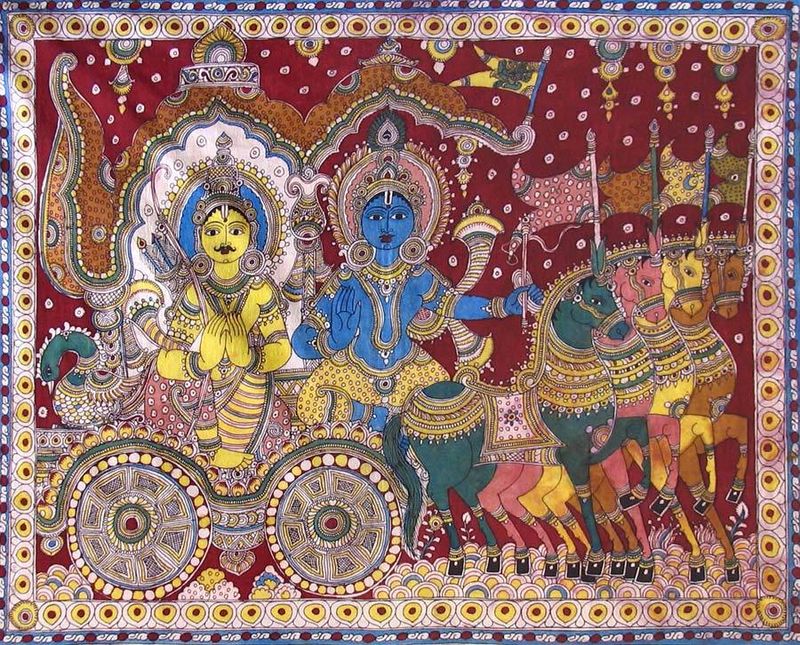

1 Trackback or Pingback